Chapter 1: The Bench That Had to Go
The chainsaw roared through the peaceful afternoon at Willow Creek Park, sending a flock of birds scattering from the branches of an enormous oak tree.
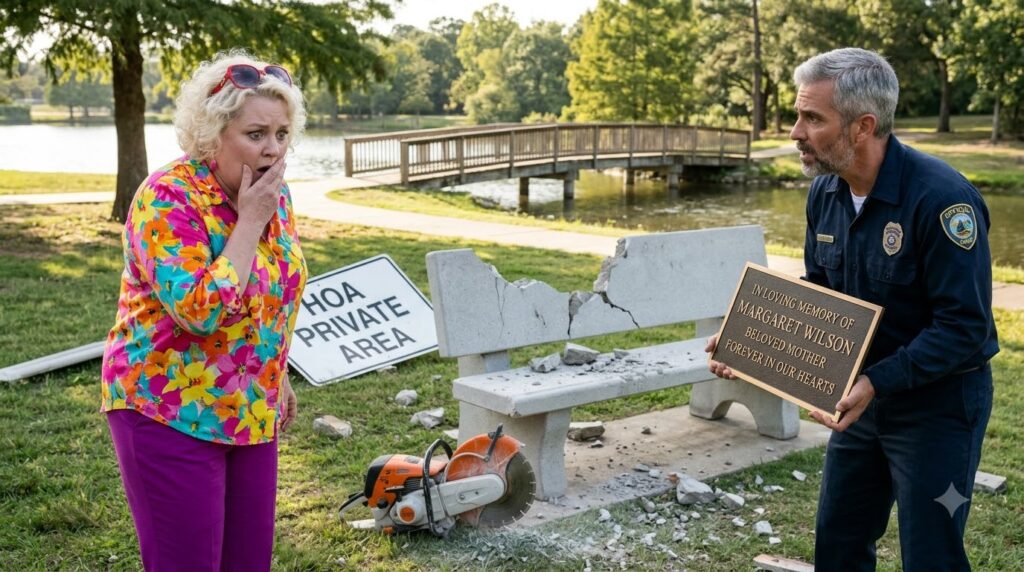
Karen Wilson leaned forward, pressing the spinning blade against the backrest of an old wooden bench.
At fifty-five, Karen was the president of the Willow Creek Homeowners Association, a position she treated less like a volunteer responsibility and more like a personal kingdom. Her platinum-blonde hair was styled into a perfect bob, and her bright yellow blouse stretched across her slightly overweight figure as she struggled to control the heavy machine.
Her white pants were already speckled with sawdust.
She didn’t care.
The bench was in her way.
And when something stood in Karen Wilson’s way, she believed it had only two choices: move or be destroyed.
The chainsaw bit deeper into the weathered wood.
A sharp crack echoed across the park.
The wooden backrest split, twisted, and collapsed onto the grass. A rectangular bronze plaque tore loose from its mounting screws, struck the pavement, and landed face-down beneath the broken boards.
Karen released the throttle.
For a moment, the only sounds were the ticking of the cooling chainsaw and the distant laughter of children playing near the park entrance.
Then Karen smiled.
“Finally.”
Behind her stood a brand-new white sign with enormous gold letters:
HOA PHOTO SPOT
Karen had ordered the sign herself.
The upcoming Willow Creek Community Appreciation Festival was only three days away, and she intended to have her photograph taken beneath the oak tree, surrounded by flowers and smiling residents.
The old memorial bench had ruined her vision.
Its dark wooden slats were faded. Its black metal armrests were scratched. One leg had settled slightly into the earth after decades of rain.
To Karen, it looked like an embarrassment.
She had complained about it for months.
When the town’s parks department refused her request to remove it, she decided to handle the matter personally.
She switched off the chainsaw and placed it on the grass.
Then she shoved the broken backrest with her foot.
“Nobody wants some rotten old bench in their pictures.”
“Mrs. Wilson!”
The voice came from the walking path.
Daniel Brooks, a forty-five-year-old park maintenance employee, was hurrying toward her. He wore a forest-green polo shirt, khaki work pants, and a silver maintenance badge clipped to his chest.
He stopped several feet away, staring at the destruction.
For nearly twenty years, Daniel had helped maintain Willow Creek Park. He had repaired its fences, planted its flower beds, and cleared fallen branches after storms.
He had never seen anyone deliberately destroy a memorial.
“What have you done?” he asked.
Karen brushed sawdust from her blouse.
“I’ve improved the park.”
Daniel looked at the chainsaw, then at the broken bench.
“That bench belongs to the town.”
Karen laughed.
“I’m the HOA president. This park serves our community.”
“It serves everyone,” Daniel replied. “And you had no authorization to touch that bench.”
Karen’s smile disappeared.
She stepped toward him, pointing one manicured finger at his chest.
“Listen carefully. I have worked too hard to let some maintenance man tell me what I can and cannot do.”
Daniel didn’t move.
Instead, his attention shifted to something lying beneath the splintered wood.
The bronze plaque.
He bent down and carefully lifted it from the grass.
Dirt covered the engraved lettering.
He wiped it with his sleeve.
Then he stopped.
His expression changed.
“Mrs. Wilson,” he said quietly. “You need to look at this.”
Karen rolled her eyes.
“If this is another lecture about park regulations—”
“Just look.”
Something in his voice made her hesitate.
She snatched the plaque from his hands.
At first, she saw only tarnished bronze and scratches.
Then she tilted it toward the sunlight.
The engraved words became visible.
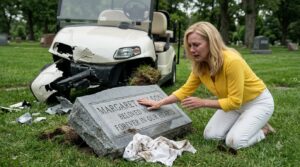
IN LOVING MEMORY OF MARGARET WILSON
BELOVED MOTHER
FOREVER IN OUR HEARTS
Karen stared.
Her fingers tightened around the metal.
She read the name again.
Margaret Wilson.
Her mother’s name.
The color drained from her face.
For several seconds, she couldn’t speak.
Then a faint whisper escaped her lips.
“Oh God… that’s my mother.”
The plaque suddenly felt impossibly heavy.
Karen looked toward the shattered bench.
The broken wood.
The scattered screws.
The sawdust covering the grass.
She had destroyed a memorial dedicated to the woman who had raised her.
But what Karen didn’t yet understand was that the bench held a history far more complicated than a daughter’s forgotten grief.
And the man standing before her knew part of it.
Daniel watched her carefully.
“Your mother,” he said, “was the reason this park exists.”
Karen slowly raised her eyes.
“What?”
Daniel looked toward the old oak tree.
“Mrs. Wilson, there are things about Margaret that I think you need to know.”
For the first time in years, Karen Wilson had nothing to say.