Chapter 10: The Legacy Beneath the Oak Tree
One year later, Willow Creek Park looked much the same as it always had.
Children still raced along the walking paths.
Older couples still paused beneath the oak tree.
Dogs chased fallen leaves across the grass.
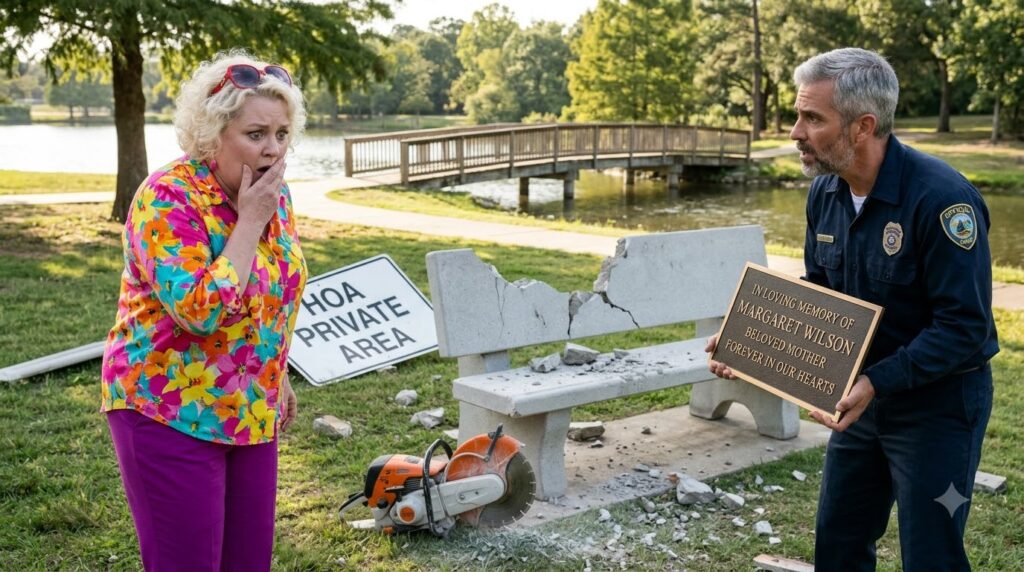
The memorial bench remained in its familiar place, its bronze plaque polished by the changing seasons.
But the community surrounding it had changed.
The Willow Creek HOA had adopted clearer rules governing its authority.
Public park access was no longer described as an association privilege.
Residents received written explanations before enforcement actions, and the board had established a process for requesting reasonable accommodations and reviewing disputed fines.
Susan Caldwell had been elected president.
She was respected not because she made the most demands, but because she listened carefully before making decisions.
Karen Wilson no longer attended every HOA meeting.
She no longer inspected her neighbors’ lawns or photographed minor violations.
Her days had become quieter.
She spent several mornings each week volunteering with a local senior assistance program.
Sometimes she delivered groceries.
Sometimes she drove older residents to appointments.
Sometimes she simply sat with people who wanted company.
The work wasn’t glamorous.
Nobody presented her with awards.
There were no gold-lettered signs announcing her accomplishments.
And Karen had discovered that she didn’t miss them.
One Tuesday morning, she helped Helen Parker carry several grocery bags into her kitchen.
Helen’s husband had returned home after a long recovery, and the couple still needed occasional assistance.
Karen placed the bags on the counter.
Helen poured two cups of coffee.
They sat together at the small kitchen table.
For a while, they discussed ordinary things.
The weather.
The rising cost of groceries.
The roses blooming near the park.
Then Helen looked at Karen.
“You’re different now.”
Karen smiled faintly.
“I hope so.”
Helen stirred her coffee.
“I was angry with you for a long time.”
“I know.”
“That warning you sent when my husband was sick… it hurt more than you probably realized.”
Karen lowered her eyes.
“I’m sorry, Helen.”
Helen nodded.
“I believe you.”
The words were simple.
But Karen carried them with her for the rest of the day.
That afternoon, she visited Walter Harris.
Their occasional coffee meetings had become a comfortable routine.
Walter told stories about Eleanor.
Karen shared memories of Margaret.
Sometimes they laughed.
Sometimes they sat quietly.
Their friendship did not erase the past.
But it gave both of them something good in the present.
On her way home, Karen stopped at Willow Creek Park.
The afternoon sunlight was warm.
A young mother sat on the memorial bench, holding a sleeping baby.
Beside her, an elderly man rested after walking along the path.
Neither appeared to know the other’s name.
They simply shared the shade.
Karen stopped a short distance away.
She watched the young mother adjust the baby’s blanket.
The elderly man smiled and said something that made her laugh.
Karen thought of Margaret.
She imagined her mother standing beneath the oak tree, wearing her old gardening gloves and sensible shoes.
She imagined the quiet satisfaction Margaret must have felt watching strangers enjoy the place she had worked so hard to preserve.
Karen finally understood.
Her mother had never wanted power.
She had wanted people to feel welcome.
And she had understood something Karen had spent most of her life overlooking.
A community was not a collection of houses.
It was a collection of lives.
Each home held private struggles that outsiders couldn’t see.
Each neighbor carried memories, losses, responsibilities, and hopes.
Respect meant remembering that those lives mattered even when they didn’t fit someone else’s idea of perfection.
Karen walked toward the bench after the young mother and elderly man had moved on.
She sat down.
The wood was warm beneath her hands.
She traced the small hammer mark on the armrest.
Then she looked at the plaque.
“Hi, Mom,” she whispered.
A breeze moved through the oak leaves.
Karen smiled.
“I think I’m finally starting to understand.”
She remained there for nearly an hour.
Not because she was waiting for someone.
Not because she had an event to organize.
But because she enjoyed the peace.
As the afternoon faded, Daniel Brooks approached along the walking path.
He carried a small toolbox.
He stopped when he saw Karen.
“Everything all right?”
Karen nodded.
“Everything’s fine.”
Daniel looked at the bench.
“Still holding up well.”
Karen ran her hand across the smooth wood.
“Samuel did beautiful work.”
“You helped.”
Karen smiled.
“He did the hard part.”
Daniel shook his head.
“Not all the hard parts were made of wood.”
Karen looked at him.
For a moment, neither spoke.
Then they both smiled.
Daniel continued down the path to inspect a loose railing near the playground.
Karen stood and brushed a few fallen leaves from the bench.
Before leaving, she noticed a small folded piece of paper tucked beneath one of the armrests.
She carefully opened it.
The note was written in a child’s uneven handwriting.
Thank you for making this nice place where my grandma can sit when she gets tired.
There was no name.
Only a small drawing of a yellow flower.
Karen read the note twice.
Then she sat down again.
She thought about the day she had brought a chainsaw to the park.
She remembered her anger, her arrogance, and the satisfaction she had felt watching the old wooden backrest collapse.
She remembered believing that a photograph of herself beneath the oak tree would somehow prove her importance.
Now she held a child’s handwritten thank-you note.
No one knew she would find it.
No one had written it to impress her.
It was simply gratitude for a place where someone could rest.
Karen folded the note and slipped it into her purse.
She would keep it beside her mother’s letter.
As she walked toward the parking lot, she passed the spot where her enormous HOA PHOTO SPOT sign had once stood.
Nothing remained of it.
The grass had grown back.
A few wildflowers had appeared along the edge of the path.
Karen stopped to admire them.
For years, she had believed that leaving a legacy meant putting her name on something important.
Her mother had shown her another way.
A legacy could be a bench beneath a tree.
A meal delivered to someone who was ill.
A neighbor treated with patience.
A public space protected for people who might never know the names of those who saved it.
Karen could never undo what she had done.
She could never recover the years she had spent misunderstanding her mother.
And she could never demand that everyone forgive her.
But she could choose how to live the years ahead.
She could listen more carefully.
Help without expecting recognition.
Respect boundaries.
Admit mistakes.
And remember that dignity belonged to everyone, not merely those who followed her rules.
Behind her, the oak tree stood tall against the evening sky.
Its branches stretched over the memorial bench, offering shade to whoever might need it next.
Karen looked back one final time.
The bench was empty now.
But it wouldn’t stay that way.
Tomorrow, someone would sit there.
Perhaps an elderly widower remembering his wife.
Perhaps a tired mother holding her child.
Perhaps two strangers who needed a moment of peace.
And they would all be welcome.
That was what Margaret Wilson had fought for.
That was what Karen had nearly destroyed.
And that was what she had finally learned to protect.
Because the greatest legacy we leave behind isn’t the authority we held, the rules we enforced, or the recognition we received.
It’s the kindness people can still feel long after we’re gone.