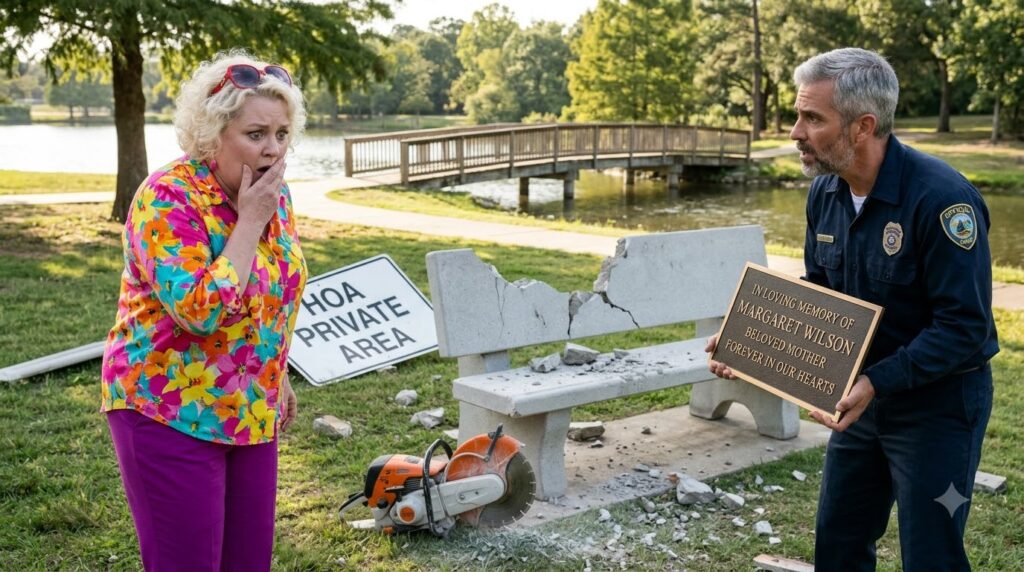
Chapter 3: A Photograph Nobody Could Ignore
By six o’clock that evening, photographs of the destroyed memorial bench were circulating through Willow Creek’s neighborhood Facebook groups.
The first image showed the broken wooden backrest lying beneath the oak tree.
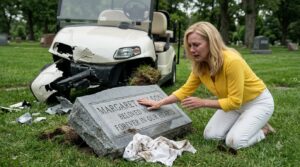
The second showed the bronze plaque.
The third showed Karen standing beside an orange chainsaw, wearing her bright yellow blouse and white pants.
The photographs had been taken by a woman walking her dog.
Within two hours, hundreds of residents had seen them.
Some were furious.
Others were stunned.
Several remembered Margaret Wilson personally.
One woman wrote that Margaret had delivered meals to her family after her husband lost his job.
Another remembered Margaret helping organize a fundraiser for a child who needed a wheelchair.
A retired firefighter shared a photograph of Margaret planting the first rosebush near the park entrance.
But the comment that affected Karen most came from someone she barely knew.
Margaret Wilson spent her life making room for other people. Her daughter destroyed the one place where we could sit and remember her.
Karen read the sentence three times.
Then she turned off her phone.
She was sitting alone in the formal living room of her large two-story house.
Everything around her was immaculate.
Cream-colored furniture.
Polished hardwood floors.
Expensive framed photographs.
A crystal chandelier hanging above a glass coffee table.
Karen had spent years creating a home that looked successful.
Yet she had never felt more uncomfortable inside it.
Her husband, Richard, entered carrying two cups of tea.
At fifty-nine, Richard was a retired accountant with a patient manner and a habit of avoiding unnecessary conflict.
He placed one cup beside her.
“I saw the pictures,” he said.
Karen stared at the carpet.
“I know.”
Richard sat across from her.
For several moments, neither spoke.
Then he asked the question she had been avoiding.
“Why did you take a chainsaw to a public bench?”
Karen looked up sharply.
“It was falling apart.”
“Then why didn’t you ask the town to repair it?”
“I did.”
“And?”
“They said it was historically significant.”
Richard waited.
Karen looked away.
She knew what he was thinking.
She had ignored the answer because it wasn’t the answer she wanted.
Richard sighed.
“Karen, this isn’t about the festival anymore.”
She folded her arms.
“I made a mistake.”
“Yes,” he said gently. “You did.”
His agreement irritated her.
She had expected him to defend her.
Instead, he reached into his pocket and placed an old photograph on the table.
It showed Margaret Wilson standing beneath the oak tree, surrounded by children holding small gardening tools.
Karen recognized her mother immediately.
Margaret was smiling.
Not the polite smile she wore for family portraits.
A wide, joyful smile.
“Where did you get that?” Karen asked.
“Your mother gave it to me.”
Karen picked up the photograph.
On the back, Margaret had written:
The best things we leave behind are the places where other people can feel at home.
Karen stared at the handwriting.
She had not seen it in years.
Richard leaned forward.
“Your mother once told me she worried about you.”
Karen stiffened.
“Worried about what?”
“That you were working so hard to earn people’s respect that you might forget how to give it.”
Karen set the photograph down.
“That’s unfair.”
Richard didn’t argue.
He simply sat quietly.
That silence was worse than another accusation.
After a while, Karen stood and walked upstairs.
She entered the guest bedroom, where several boxes of Margaret’s belongings had remained untouched since her death.
Karen had intended to sort through them years earlier.
But there had always been another HOA meeting, another community event, another renovation project.
She opened the first box.
Inside were old sweaters, handwritten recipes, and family photographs.
The second contained Christmas decorations.
The third held a stack of folders tied with faded blue ribbon.
Karen untied the ribbon.
The top folder was labeled:
WILLOW CREEK PARK — PUBLIC ACCESS AGREEMENT, 1995
Inside were newspaper clippings, meeting minutes, and letters bearing official town seals.
Karen read the first page.
Then the second.
Her breathing changed.
One sentence had been underlined in Margaret’s handwriting.
The property shall remain open for the use and enjoyment of the general public, without restriction based on neighborhood association membership.
Karen read it again.
The park was not HOA property.
It had never been HOA property.
And the document made something else painfully clear.
Margaret had fought specifically to prevent any private neighborhood organization from controlling access to the park.
Karen sat on the floor.
For years, she had told residents that the HOA maintained special authority over the surrounding green space.
She had approved signs.
Organized private events.
Threatened to report visitors who didn’t live in Willow Creek Estates.
She had even tried to establish parking restrictions.
Now she understood that her mother had spent years protecting the park from exactly that kind of control.
At the bottom of the folder lay a sealed envelope.
Her name was written across the front.
For Karen, when she is ready.
Karen stared at it.
She recognized her mother’s handwriting.
But she had no idea what was inside.