Chapter 5: The Meeting That Changed the Neighborhood
The emergency HOA meeting took place on Thursday evening in the community clubhouse.
Every chair was occupied.
Additional residents stood along the back wall.
Karen entered wearing a simple navy-blue dress.
For once, she had left her bright jewelry at home.
She carried a folder containing the park agreement, her mother’s letter, and a written statement.
The room grew quiet when she approached the front table.
Three board members were already seated.
The vice president, Susan Caldwell, opened the meeting.
Susan was sixty-two, a former elementary school principal known for her calm judgment.
She had served alongside Karen for four years.
During that time, she had often disagreed with Karen’s aggressive approach to enforcement.
But she had rarely challenged her publicly.
That evening was different.
Susan explained that the board had received numerous complaints following the destruction of the memorial bench.
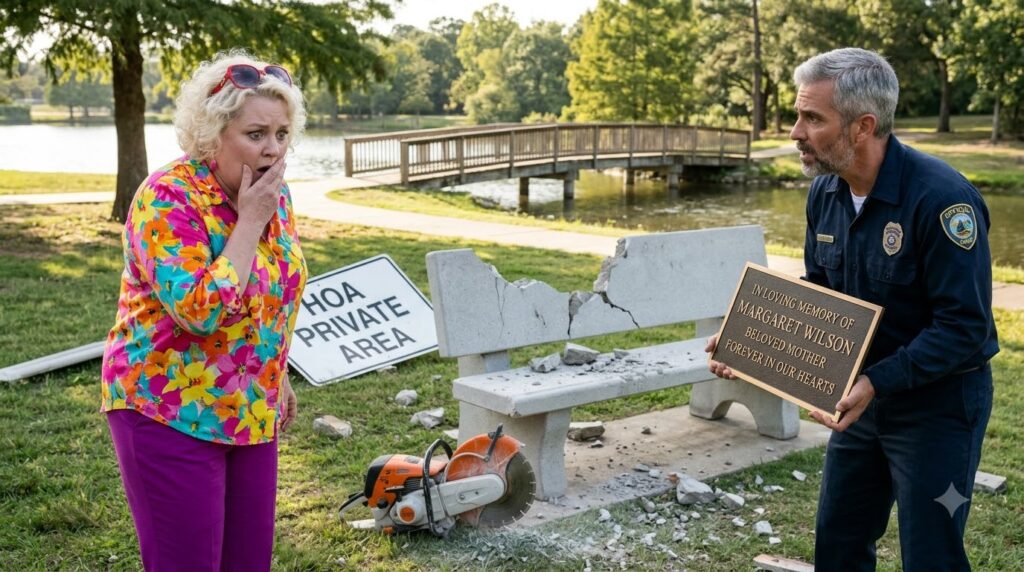
Residents had questioned Karen’s judgment, her use of HOA authority, and whether association funds had been used to purchase the large PHOTO SPOT sign.
Karen listened.
The sign had indeed been purchased with HOA money.
She had approved the expense herself.
The board had not voted on it.
When Susan asked her to respond, Karen stood.
She looked across the room.
Faces she had known for years stared back at her.
Some were angry.
Others were simply disappointed.
Karen opened her folder.
“I destroyed the bench,” she said.
No excuses followed.
She admitted that she had ignored the parks department’s refusal.
She acknowledged that she had acted without authorization.
She confirmed that the sign had been purchased with association funds and promised to reimburse the HOA.
Then she placed a copy of the 1995 public access agreement on the table.
She explained that the park was town property, open to everyone.
The HOA had no authority to restrict access or claim exclusive control.
A murmur spread through the room.
Several residents exchanged surprised looks.
Karen continued.
She admitted that she had repeatedly misrepresented the association’s authority over the park.
She had treated public space as though it belonged to her organization.
And she had used her position to pressure people who disagreed.
“I thought I was protecting our neighborhood,” she said. “But I was protecting my own pride.”
The room remained silent.
Karen looked toward the back.
Helen Parker stood beside her adult daughter.
Karen remembered the lawn violation.
She remembered Helen’s tired voice when she called to explain her husband’s illness.
Karen had told her that personal circumstances did not excuse noncompliance.
Now those words made her ashamed.
“I also owe apologies to people I treated unfairly,” Karen said.
She looked directly at Helen.
“Especially those who needed understanding and received a warning instead.”
Helen didn’t smile.
She simply nodded.
That small gesture meant more than Karen expected.
Susan asked whether Karen intended to remain president.
Karen took a breath.
“No.”
Several people shifted in their seats.
Karen continued.
“Effective tonight, I resign.”
The statement caused an immediate stir.
Some residents appeared relieved.
Others looked surprised.
Karen had held the position for seven years.
Many had assumed she would fight to keep it.
Instead, she placed her resignation letter on the table.
Susan accepted it.
The board then voted to appoint Susan as interim president until a special election could be held.
The motion passed unanimously.
But the meeting wasn’t finished.
A resident named Thomas Reed stood near the back.
He was a sixty-eight-year-old retired postal worker who had lived in Willow Creek for thirty years.
He asked whether the board intended to review the warnings and fines issued under Karen’s leadership.
Susan agreed that the concern deserved attention.
A formal review would begin the following week.
Karen listened as residents described experiences she had never fully considered.
An older couple had been warned about a wheelchair ramp before the HOA approved its design.
A widower had received repeated notices about peeling paint while recovering from surgery.
A young family had been threatened with fines because their children left bicycles on the driveway.
Some complaints involved legitimate rules.
Others suggested that enforcement had been unnecessarily harsh.
Karen couldn’t undo those experiences.
But she could stop pretending they hadn’t happened.
When the meeting ended, most residents left without speaking to her.
Karen gathered her papers.
As she turned toward the door, Susan approached.
“You did the right thing tonight,” Susan said.
Karen shook her head.
“I should have done it years ago.”
Susan studied her for a moment.
“Maybe. But what matters now is what you do next.”
Karen nodded.
Outside, the evening air was cool.
She walked slowly toward her car.
For the first time in seven years, she was no longer HOA president.
The title she had valued so deeply was gone.
And strangely, beneath the shame and uncertainty, she felt a small measure of relief.
But the town’s investigation was still underway.
The memorial bench remained broken.
And one person had yet to forgive her.
Walter Harris.
The following morning, Karen drove to his house.
She knew he might refuse to open the door.
She went anyway.