Chapter 9: What a Home Is Supposed to Feel Like
Six months after the incident, Walter Bennett walked into the medication storage room on a bright Florida morning.
The fluorescent lights hummed softly overhead.
The beige walls were unchanged.
The six metal cabinets stood in the same row.
But the room felt different.
Each cabinet had its own lock.
A clearly posted policy explained access procedures and emergency contacts.
No single chain connected the doors.
Walter opened Cabinet Four.
Inside sat his medication container, exactly where he had left it.
He checked the labels, placed the medication he needed into his small carrying case, and closed the door.
Such an ordinary task.
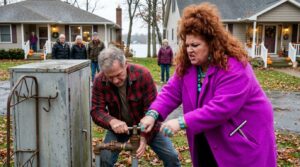
Yet he stood there for a moment, remembering the day Margaret had chained the cabinets shut.
He remembered her furious voice.
The metallic clang.
The frightened faces of his neighbors.
And the absurd sight of her bracelet caught in the chain she had used to intimidate them.
He still found the irony remarkable.
But it was not the part of the story that mattered most.
What mattered was what happened afterward.
The residents had refused to accept fear as normal.
They had asked questions.
They had gathered evidence.
They had supported one another.
And they had insisted that the association follow its responsibilities.
Outside the clubhouse, Rose was waiting beside a small garden.
She had helped organize a volunteer committee to improve accessibility throughout the community.
The handrail she had requested years earlier had finally been installed.
She showed it to Walter with quiet satisfaction.
“It’s nice not having to worry about that step anymore.”
Walter smiled.
Rose had also joined the residents’ advisory committee.
She had once avoided every meeting because she disliked confrontation.
Now she regularly reviewed proposals and encouraged neighbors to participate.
Harold had become a volunteer maintenance liaison.
He helped homeowners understand upcoming projects and ensured that contractors’ work was documented before final payment recommendations.
Evelyn served on the finance committee.
She had declined invitations to run for president, preferring to concentrate on budgets and internal controls.
Thomas remained interim president until the next scheduled election, when the homeowners selected a new board leadership team.
The new president was Linda Brooks.
She was sixty-eight, a retired librarian with a practical manner and a reputation for listening carefully.
At her first meeting, Linda made one promise.
The board would not always make decisions everyone liked.
But homeowners would be able to ask questions without being punished for asking them.
It was a modest promise.
That was why people believed it.
Walter’s daughter Rebecca noticed the change during her next visit.
Her father seemed lighter.
He attended community breakfasts again.
He had started walking regularly with Harold.
He even volunteered to help organize the annual holiday donation drive.
For months, Rebecca had worried that the dispute would force him to leave Seabreeze Palms.
Instead, he seemed more connected to his home than he had been in years.
One afternoon, they sat together on his screened porch.
Rebecca watched a pair of herons moving near the retention pond.
“Do you ever think about moving somewhere else?”
Walter considered the question.
He had considered leaving during the worst weeks of the dispute.
The thought had frightened him.
Not because he couldn’t imagine living elsewhere, but because this home held so much of his life with Susan.
They had chosen the condominium together.
Susan had loved the morning light in the kitchen.
She had planted the hibiscus beside the porch.
She had spent her final years surrounded by neighbors who brought soup when she was ill and sat with Walter when he needed company.
He didn’t want Margaret Whitcomb to become the reason he abandoned those memories.
“No,” he told Rebecca. “Not anymore.”
She smiled.
Then Walter added something he had been thinking about for months.
“I used to believe keeping the peace meant staying quiet.”
Rebecca turned toward him.
“What changed?”
Walter looked across the pond.
“I learned there’s a difference between peace and being afraid to speak.”
Later that evening, he opened a drawer and removed the original special assessment notice.
He had kept it with the other records.
Beside it was a copy of the board’s written apology and the corrected account statement.
He placed the papers in a folder labeled Seabreeze Palms—Resolved Matters.
Not everything had been simple.
The investigation had cost money.
Neighbors had disagreed.
Some relationships remained strained.
Margaret still owned her condominium, and Walter occasionally saw her walking through the community.
They did not speak.
He felt no obligation to seek revenge or pretend the past had never happened.
He simply wanted the rules to apply fairly to everyone.
That was enough.
The following spring, Seabreeze Palms held its annual community picnic.
Families gathered beneath the palms.
Grandchildren played lawn games.
Residents brought casseroles, fruit salads, and homemade desserts.
Walter sat beside Evelyn and Harold, watching the afternoon unfold.
Rose approached with a plate of cookies.
She set it on the table and laughed softly.
“Can you believe how much has changed?”
Walter looked around.
He saw neighbors talking openly with board members.
He saw volunteers discussing a drainage project with printed estimates available for anyone to inspect.
He saw a community where disagreement no longer automatically meant punishment.
Then he noticed the clubhouse door.
Beyond it was the hallway leading to the medication storage room.
For a brief moment, he remembered the sound of that chain being pulled tight.
The memory no longer frightened him.
It reminded him of the day everything began to change.
Margaret had believed that locking six cabinets would force six elderly residents to surrender.
Instead, her actions had united an entire community.
Walter picked up a cookie and smiled.
At seventy-seven, he had learned something he wished he had understood much earlier.
A home is more than the property you own. It is the place where your dignity should be safe.
And no president, board member, or person with a title should ever be allowed to put a lock on that.