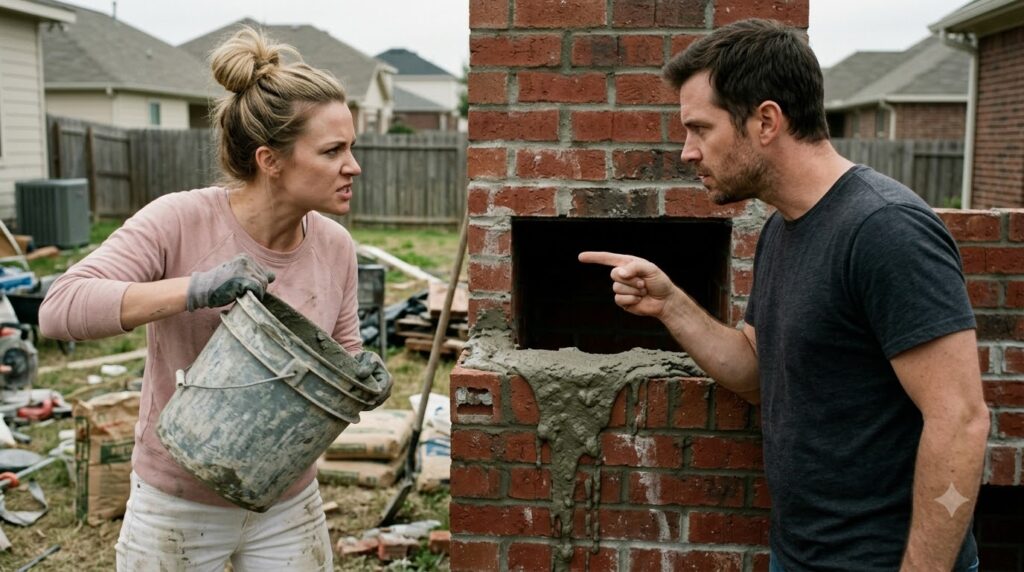
Chapter 4: Who Gets to Decide What Went Wrong
The next part of the job required patience.
Emily filled the remaining cavities carefully, checking the level of the cement as she worked. Mark kept the tools nearby and helped manage the area. The process was not especially complicated, but it demanded attention, and neither of them could afford to treat the material casually.
At one point, Emily paused before beginning another pour.
“Let me check the edge first,” she said.
Mark nodded and waited.
The small exchange reminded Emily how much easier the work became when she did not have to anticipate a criticism every time she stopped to think.
She had spent years learning to handle practical problems by examining them, making a decision, and correcting the result if necessary. She did not expect to perform every task perfectly. She expected to be allowed to learn from the ones that did not go as planned.
What she could not accept was the assumption that the person who made a visible mistake had automatically forfeited the right to explain it.
The distinction mattered beyond the brickwork.
A person could be responsible for an error without being solely responsible for every condition surrounding it. A worker could make a poor decision even when the work had been badly organized. A person offering advice could be correct about a technique and still be unhelpful in the way that advice was delivered.
Emily wanted to keep those possibilities separate.
Mark, however, seemed accustomed to treating responsibility as a simple question with a single answer. If Emily held the bucket, then Emily had caused the spill. If the spill was her fault, then his criticism was justified. If his criticism was justified, he had no reason to reconsider his behavior.
That chain of reasoning allowed him to avoid the more uncomfortable question of whether he had contributed anything useful before the problem occurred.
As they worked, Emily became increasingly convinced that the original argument had exposed a difference between them that the completed structure would not automatically resolve.
They could finish the wall. They could clean the bricks. They could even agree on a better method for the remaining work.
But none of those things would matter much if Mark continued to believe that being right about a mistake excused him from helping prevent one.
She did not want a permanent argument about the afternoon’s spill. She wanted a more reasonable way to work together.
When they reached the last cavity, Emily set down the bucket and examined the opening.
“Let’s take this one slowly,” she said.
Mark brought the necessary tools closer.
They completed the pour without another overflow. Emily checked the result, then stepped back to inspect the unfinished structure as a whole.
The wall still needed attention in places, and the earlier spill had left visible marks that would require cleanup. The work had not been flawless. It had, however, moved forward.
Mark surveyed the brickwork.
“We got it done,” he said.
“We got this part done.”
He glanced at her. “You always have to qualify everything?”
Emily almost smiled, but she was too tired to turn the remark into another exchange.
“I’m not trying to take anything away from what we finished. I’m saying we still have work to do.”
Mark looked toward the area where the cement had spilled.
“And you still think I was wrong to say something?”
Emily considered the question before answering.
“No. I think you were wrong to decide you knew everything that happened just because you saw the mess.”
He looked away.
She continued, keeping her voice level. “If I make a mistake, tell me. If you see a better way to do something, tell me before we start. I’m not asking you to agree with everything I do. I’m asking you to treat me like someone you’re working with, not someone you’re waiting to catch doing something wrong.”
Mark remained quiet.
Emily had no way of knowing exactly what he was thinking. Perhaps he still believed his original accusation had been reasonable. Perhaps he was beginning to understand that the way he had expressed it had made a practical problem more difficult.
She was not going to insist on an immediate confession.
An apology forced out of someone in the middle of an argument rarely carried much weight. What mattered more was what he would do the next time they disagreed.
Mark finally picked up the container they had used during cleanup.
“I’ll take care of this,” he said.
Emily watched him carry it toward the appropriate place for the tools and supplies.
It was another small action, but it was also a choice. He had noticed something that needed doing and had taken responsibility for it without waiting for Emily to ask.
She returned to the brickwork and began checking the areas that needed further attention.
The afternoon’s problem was no longer growing. The remaining work was clear, and they had a method for completing it.
But the question that had started the argument remained important to Emily.
Who was responsible when something went wrong?
She had no intention of claiming that the person doing the work was never at fault. That would be as unreasonable as claiming that the person watching could never contribute to a problem.
What she wanted was a fair answer, one based on what had actually happened rather than on who was easiest to blame.
Whether Mark could accept that distinction would determine far more about their next project than the quality of any single pour.