Chapter 3: The Difference Between Advice and Help
They began by examining the unfinished brickwork.
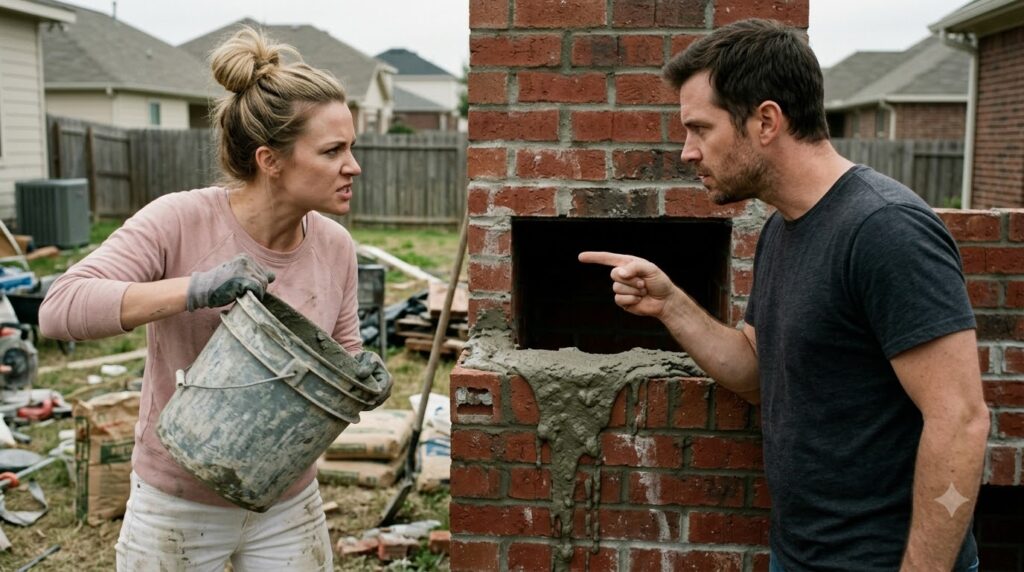
Emily showed Mark the cavity where the cement had overflowed and explained what she had been trying to do. She had been filling the opening while controlling the bucket with both hands. The angle had made the pour awkward, and the material had moved faster than she expected.
She did not claim that her method had been perfect.
“I should have slowed down,” she admitted. “I might have needed to reposition the bucket before I started. But I didn’t know how quickly that cement was going to move once I tipped it.”
Mark leaned toward the wall without touching it.
“You could have used a smaller amount at a time.”
“That might have helped.”
He seemed relieved to hear her acknowledge a practical suggestion. For a moment, the conversation appeared to be returning to familiar territory, where he could offer advice and she could decide whether to use it.
Then Emily asked, “Were you going to tell me that before I started?”
Mark straightened.
“I didn’t know it was going to spill.”
“Neither did I.”
“Then how could I have known?”
“You couldn’t know it would spill. But you could have asked if I needed help before I started pouring.”
He frowned. “I thought you had it under control.”
“I thought I did, too.”
That was the part Emily wanted him to understand. She had not deliberately made a mess. She had undertaken a task believing she could manage it, then encountered a problem. That was a normal possibility in physical work, especially when someone was handling heavy material.
The question was not whether she could have done something differently. She almost certainly could have.
The question was whether the possibility of a mistake gave Mark the right to stand aside, wait for the outcome, and then treat the result as proof that she had been incompetent.
Emily picked up a tool and indicated the next cavity.
“We can use smaller pours,” she said. “I can work more slowly, and we can check each opening before moving to the next. But if we’re doing this together, I need you to be part of the process instead of waiting to tell me what went wrong.”
Mark studied the wall.
“I don’t know much about pouring cement.”
“Then say that. There’s nothing wrong with not knowing. But acting as if you know exactly what I should have done doesn’t help either of us.”
He looked at her, and for a moment his expression suggested that he wanted to argue. Then he glanced toward the supplies and seemed to reconsider.
“I can handle the materials,” he said. “You can tell me what you need.”
It was not a grand apology. It did not settle every question between them. But it was a workable offer, and Emily decided to take it seriously.
They reviewed the remaining work and considered how to handle the next pour more carefully. Emily would manage the bucket and control the flow. Mark would help prepare the area, keep the necessary tools within reach, and assist with cleanup as they progressed. If either of them noticed a problem, they would address it before it became larger.
Most importantly, neither would assume that a mistake had only one possible explanation.
Emily knew that the new arrangement would work only if they both followed through. An agreement made during an argument could easily disappear once the immediate frustration faded.
Still, she was willing to give the plan a chance.
They returned to the work.
This time, Mark did not stand with his arms folded. He prepared the area and made sure the tools were close enough to reach. Emily checked the bucket, positioned herself more carefully, and began filling the next cavity in smaller amounts.
The work proceeded more slowly.
That was not a problem. The purpose was to complete the structure properly, not to finish as quickly as possible at the expense of control.
As Emily poured, Mark watched the level of the cement. He did not interrupt her with a running commentary. When she paused to inspect the opening, he waited until she asked for the next tool.
The difference was small but unmistakable.
Emily still had to concentrate on the physical task. Mark’s cooperation did not make the bucket lighter or remove the need for care. What it did was reduce the unnecessary strain of managing the work while also defending herself against criticism.
When the cavity was filled to the intended level, Emily stopped and checked the result.
No cement ran over the edge.
Mark looked at the bricks, then at her.
“That looks better.”
“It does.”
Neither of them celebrated. One successful pour did not prove that the earlier spill had been entirely her fault or entirely avoidable. It simply showed that their revised approach could work.
They moved to the next opening.
Emily maintained a steady pace, and Mark stayed involved in the process. When she needed a tool, she asked. When he saw something that might affect the work, he raised it before she began the next pour.
The tension between them did not disappear, but it became less important than the task in front of them.
For the first time that afternoon, they were working toward the same immediate goal instead of fighting over who deserved to be blamed for failing to reach it.
Yet Emily remained aware that the most meaningful test would come when something went wrong again.
It was easy to cooperate after a disagreement had made the cost of criticism obvious.
What mattered was whether Mark could remember the lesson when he once again had the opportunity to judge her from a distance.