Chapter 2: What Responsibility Actually Looked Like
Mark did not reach for a tool immediately.
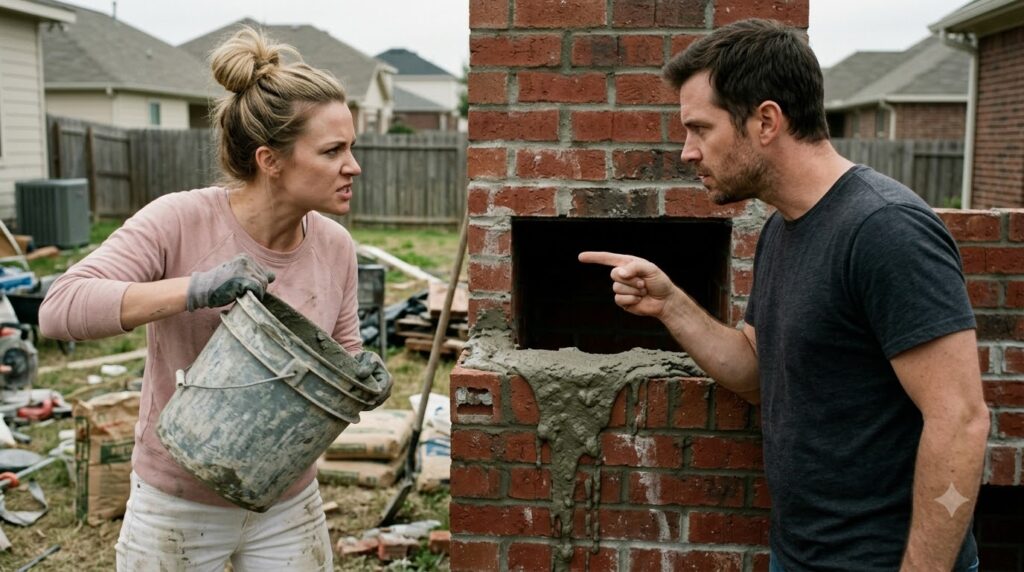
He stood with his arms folded, watching Emily examine the spill. She found a suitable tool for removing the excess cement and began carefully working at the material that had collected along the edge of the brick cavity.
She moved slowly. The cement was still wet enough to manage, but rushing would only spread it farther across the brickwork.
Mark shifted his weight.
“You don’t have to make this into a whole thing,” he said.
Emily kept her attention on the wall. “I’m cleaning it up.”
“You know what I mean.”
She did. He wanted the argument to end without either of them having to reconsider what had happened. He wanted her to accept the criticism as an ordinary part of the work, then move on.
But that was precisely what she had done too many times already.
She lifted some of the excess material away from the edge and set the tool aside long enough to inspect the cavity. The spill was not catastrophic, but it had wasted material and created additional work. Some of the cement could be recovered; the rest would need to be cleaned away before it hardened.
There was a cost, even if the cost was only time and effort.
“I know I spilled it,” she said. “I can see it. You don’t have to keep showing me.”
“Then why are we arguing?”
“Because you went straight to blame.”
Mark looked toward the house again, as though he might find a more comfortable conversation waiting there.
Emily returned to the task. She scraped away another section of the overflow, taking care not to disturb the work that remained intact.
The practical problem gave her something to concentrate on while she considered what to say next. She did not want the argument to become a contest over who could produce the longest list of grievances. That would not repair the wall, and it would not change their working arrangement.
What mattered was the pattern.
When a task went well, the result belonged to the project. When something went wrong, the person who had physically performed the task became the obvious target. Mark could criticize the technique, question the decision, and distance himself from the outcome without having to take on any of the work himself.
Emily had tolerated that pattern because she wanted the project completed. She had told herself that finishing the structure would be easier than repeatedly discussing how they divided the labor.
Now she wondered whether that convenience had come at a greater cost than she had admitted.
She put down the tool and examined the edge of the cavity again.
“Can you bring me something to collect the excess?” she asked.
Mark looked surprised.
“What?”
“A container for the material I’m removing. We need to keep the area clean enough to finish the job.”
He glanced toward the tools and supplies. For a moment, she thought he might turn the request into another explanation of what she should have done differently.
Instead, he walked over and retrieved a suitable container.
It was a small action, hardly enough to settle their disagreement. Still, it changed the situation. Mark was no longer merely commenting on the work. He had been given a specific responsibility, and he had accepted it.
Emily continued cleaning while he held the container nearby. Neither of them spoke for several minutes.
The silence was not comfortable, but it was more productive than their argument had been.
When she finished removing the worst of the spill, Emily stepped back to assess the damage. The bricks were stained, and the area would require further attention. The work had lost time, and they would need to be more careful with the remaining cement.
Mark looked at the wall.
“Could have been worse,” he said.
“Could have been better, too.”
He gave her a tight look, but she did not soften the answer.
She was not trying to punish him. She simply refused to pretend that a preventable mess was a success because it could have been larger.
Mark set the container down.
“So what do you want me to do?”
The question sounded impatient, but Emily heard something else beneath it. For once, he was asking about an action rather than announcing a judgment.
“I want us to finish the job properly,” she said. “And I want us to agree on how we’re going to do that before we start again.”
He glanced at the remaining cavities.
“We know what we’re doing.”
“Do we?”
The question was not sarcastic. Emily genuinely wanted to know whether they had a shared plan or merely two different assumptions about how the work should proceed.
Mark did not answer.
She pointed toward the unfinished brickwork. “We need to decide how much cement goes into each opening, how we’re going to control the pour, and who’s doing what. If you see something that needs changing, tell me before the material is moving. Don’t wait until something goes wrong and then act as if the whole problem is mine.”
Mark rubbed the back of his neck.
“You’re making it sound like I don’t do anything.”
“I’m talking about this job.”
“It’s a shared project.”
“Exactly.”
The word settled between them.
Emily had not asked Mark to accept blame for a spill he had not caused. She had asked him to recognize that a shared project required more than shared opinions.
She picked up the bucket and inspected what remained inside. The immediate cleanup was under control, but the next pour would require a decision about their approach.
Emily was prepared to continue.
She was no longer prepared to continue under the same unspoken arrangement.
Mark looked at the bucket, then at the wall.
“All right,” he said. “Let’s figure out the next step.”
Emily nodded, but she did not resume pouring.
Before another drop of cement touched the bricks, they would have to agree on what each of them was responsible for—and whether Mark was willing to accept a responsibility that involved more than watching.