Chapter 5: The Work That Remained
By the time they finished for the afternoon, the immediate spill had been contained and the remaining work had progressed. Emily inspected the brickwork once more, making note of the areas that still needed attention.
The structure was not perfect, but it was moving toward completion.
Mark gathered the tools while Emily made sure the remaining materials were left in a condition suitable for the next stage. Their work had become more orderly, and the absence of another argument made the afternoon feel less exhausting than it had earlier.
Still, Emily did not confuse a better afternoon with a permanent solution.
Mark had helped once she made the consequences of his behavior impossible to ignore. He had followed the revised plan, carried out the tasks they had agreed upon, and refrained from criticizing her every time she paused to check her work.
Those were meaningful improvements.
They were also the kind of improvements that could disappear the next time frustration took over.
Emily had learned that people could agree with a reasonable argument without changing the habits that had made the argument necessary. The real measure of cooperation was not whether someone could repeat the right words after a disagreement. It was whether that person behaved differently when there was no immediate pressure to do so.
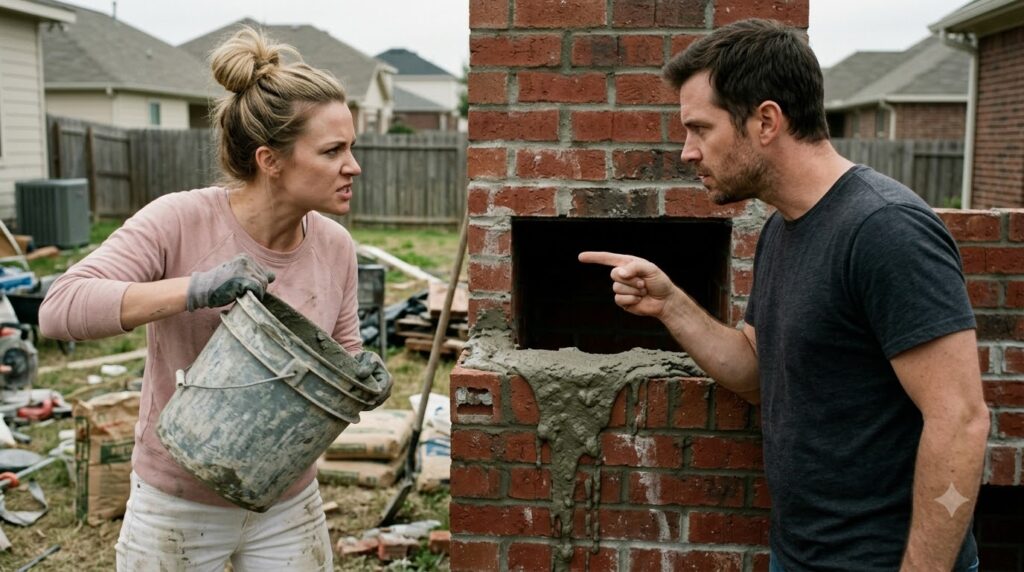
As she put away her gloves, Mark approached the wall and looked at the area where the cement had spilled.
“I still think you could have been more careful,” he said.
Emily stopped.
There it was again: the desire to return to the original judgment, even after they had made progress.
She did not become angry. Instead, she considered what he had actually said.
He might have been right that greater care would have prevented the overflow. Emily had already acknowledged that possibility. There was no need to argue over it again.
What mattered was what he intended to do with that observation.
“I could have been,” she said. “And next time I’ll take more care with the pour.”
Mark nodded, apparently expecting the conversation to end there.
Emily continued.
“But that doesn’t change what I said earlier. If you see a problem developing, help me address it. Don’t wait until it’s over and then act like the result tells you everything you need to know.”
He looked at her for several seconds.
“So I’m supposed to be responsible for your mistakes now?”
“No.”
Her answer came without hesitation.
“You’re responsible for your part of the project. I’m responsible for mine. If I make a mistake, I’ll own it. If you make one, I expect you to do the same. And if something goes wrong while we’re working together, we figure out what happened before we decide who’s at fault.”
Mark looked down at the ground.
Emily could see that he was still uncomfortable with the conversation. She did not expect him to become a different person in a single afternoon, and she was not interested in forcing a declaration that he had suddenly understood everything.
She wanted him to hear the boundary.
The next time they worked together, she would not accept criticism as a substitute for cooperation. She would consider useful advice, admit her own errors, and make reasonable changes when needed. But she would not continue a shared project under an arrangement in which one person performed the difficult tasks while the other claimed the authority to judge every result.
If they could not agree on that, they would need to reconsider how they approached future work.
That was not a threat. It was a practical consequence of what they had experienced.
Mark glanced at the bucket beside the structure.
“I wasn’t trying to make things harder,” he said.
Emily believed that he might not have intended to. But intention did not erase the effect of his behavior.
“I know you may not have meant to,” she replied. “But you made a difficult job harder when you decided to blame me instead of helping.”
He had no immediate response.
For a moment, Emily wondered whether she should say more. She could explain the frustration she had felt each time he offered an opinion without taking part in the work. She could remind him that the afternoon had been about more than a single spill.
But she had already explained what she needed.
Repeating it would not make him more willing to hear it.
She picked up the bucket and moved it to the designated work area. Mark collected the remaining tools, and together they finished putting the site in order.
There was no dramatic apology, no sudden revelation, and no guarantee that their next disagreement would be easier.
There was only a clearer understanding of what cooperation required.
Emily had made a mistake with the cement. She was willing to accept that.
Mark had made a mistake of his own when he treated the visible result as sufficient evidence to assign blame. Whether he was willing to accept that remained his decision.
As they prepared to leave the unfinished structure for the day, Emily took one last look at the brickwork.
The spill had not ruined the project. It had cost them time, created extra work, and exposed a problem in the way they handled responsibility. The physical damage could be addressed with patience and care.
The other problem would require something less tangible: a willingness to treat each other fairly when the outcome was disappointing.
Emily had done her part by acknowledging the error and changing her approach.
Now it was Mark’s turn to show whether he could do the same.
She did not need him to admit that she had been entirely right.
She needed him to understand that being the person holding the bucket did not automatically make her the only person responsible for what happened.
And until that understanding became part of how they worked together, the unfinished brick structure would remain a reminder of the question neither of them could answer by pointing at the mess.
When something goes wrong, is responsibility determined by the person holding the tool—or by everyone whose choices helped shape the outcome?