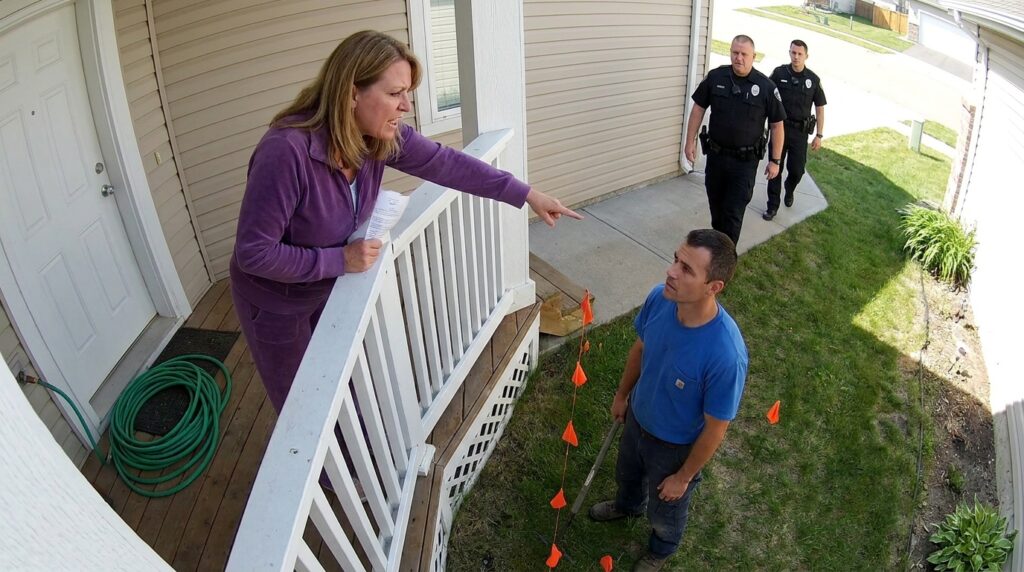
CHAPTER 3: THE GATHERING HEAT
The black phone screen reflected the harsh midday white of the sky, but Jesse didn’t wait for her thumb to hit the dialer. He dropped back down on his knees, his rough denim trousers grinding into the gravel-choked soil of the easement lane. The iridescent puddle the size of a silver dollar was widening, feeding off the heat of the baked earth. It didn’t pool like water; it had a heavy, synthetic surface tension that sluggishly separated the gray dust particles, leaving a greasy, multi-colored ring on the white base of the vinyl fence post.
“You have a structural encroachment, ma’am,” Jesse said. His voice was too quiet to carry past the hedge line, but it held the steady weight of a man who spent ten hours a day reading the hidden plumbing of corporate complexes. He reached into his belt pouch and drew out a short-handled trenching spade, its iron edge chipped and silvered from three years of striking flint. “The city code gives my crew authority to clear any unmapped barrier within forty-eight inches of the curb strip. If you don’t have a stamped engineering variance on file by the time that rig turns the corner, this iron blade goes right through whatever you’ve got buried under this sod.”
The tracksuit trousers shifted back half a foot. The white rubber soles of her sneakers made a wet, tearing sound as she stepped through a small patch of clover that had been poisoned yellow by broadleaf spray. Above him, her breathing was short, erratic, the rhythmic click of her fingernails on the vinyl rail remaining dead silent.
“You touch that fence, and it’s a civil felony,” she said. The legal precision from two minutes ago had curdled into something desperate, an artificial authority scraping against the bottom of its own cage. “That line—that’s private installation. It was permitted before this entire county went to digital recording. You don’t have the clearance to audit a historical plot.”
Jesse didn’t look up to answer. He drove the spade straight down, three inches out from the filled post hole. The hardened iron bit through the parched fescue roots with a dry crunch, then stopped dead against the same unyielding metallic shelf he had struck with the probing rod. The jar of the impact traveled up the ash handle, vibrating through the small bones of his wrist like a low-voltage shock. The odor hit him immediately—a pungent, chemical stink of old copper cleaner mixed with the sour rot of industrial grease. It was the smell of a machine shop basement, not a residential property line.
He pulled the spade back, scraping a three-inch wedge of topsoil away from the obstruction. Underneath the clean yellow clay lay a rough, blackened concrete cap, its surface poured without a trowel finish. Embedded in the aggregate was a thick, unpainted iron conduit, three inches in diameter, held down by heavy galvanized steel saddles that had rusted into flaky orange scabs. The conduit didn’t head toward the house. It ran perfectly parallel to the fence, tracking the exact vector of the municipal fiber path.
Jesse leaned closer, the sweat dripping from his chin onto the rusted iron saddle. Right where the concrete met the clay, two small copper leads—no thicker than household appliance cords—had been spliced directly into the iron casing. They were wrapped in black vulcanized tape that had grown brittle and cracked under the pressure of the earth, leaving the green, oxidized wire exposed. The leads ran through a hole drilled into the very bottom of the vinyl post, completely hidden from anyone standing on the sidewalk.
“That’s a bypass tap,” Jesse muttered, his fingers tracing the green corrosion on the copper wire. The digital map on his tablet was still flickering, its error message highlighting the four-hundred-amp phantom draw that shouldn’t have existed in a standard residential cul-de-sac. “You’re pulling juice directly off the main primary trunk before it hits the transformer box down the block. This isn’t gray-water, ma’am. This is a federal utility theft junction.”
The paper sheet in her hand finally gave a sharp, distinctive rattle as her grip tightened, crumpling the heavy bond paper against the purple fabric of her sleeve. Jesse looked up over his shoulder. The oversized amber lenses were pointed down at the trench lane, her lips compressed into a thin, colorless line that made her jaw look like old limestone. She wasn’t holding the phone to her ear anymore; her knuckles were white against the plastic casing, her arm stiff against her side.
“You don’t know what you’re looking at, boy,” she whispered, her voice dropping all its suburban cadence, leaving only the hard, dry rasp of someone who had spent decades keeping a fence line closed. “The association put those poles in thirty years ago. We paid for the line extension ourselves when the county refused to run the cables past the creek. It’s an equalization link. It’s completely legal under the old residential covenant.”
“The old covenant didn’t let you drill into a city conduit and run unmetered lines up through a vinyl post,” Jesse said. He reached down and clicked his ruggedized camera onto real-time diagnostic mode, the lens focusing on the brittle tape and the weeping iridescent fluid beneath the concrete lip. “The moment the sub-contractor drops the teeth of that ditch-witch into this trench line, they’re going to rip this copper out of the ground. The whole grid for Lot 42 goes dark, and the county sheriff comes out with the fraud unit before five o’clock.”
He heard the heavy, metallic rumble of the diesel machine change pitch at the end of the street. The excavation crew had thrown the transmission into low gear. The vibrations were moving through the pavement now, a low, rhythmic thumping that vibrated through the soles of Jesse’s boots and made the small puddle of chemical fluid in the clay ripple like oil.
She took another step down, her shadow completely covering the exposed concrete lip and the spade. “I have an injunction being filed at the district courthouse right now,” she said, her fingers jabbing toward the street where the yellow silhouette of the trenching rig was just beginning to clear the corner line. “If that machine crosses the flags before the marshal delivers the papers, your company loses its municipal license by morning. Pack up your tools, Jesse. This is your last warning.”
Jesse stood up slowly, the iron spade held low near his thigh. He looked past her bleached hair, toward the high-mounted porch security camera that stared down at the boundary strip like a dead glass eye. The red tally light wasn’t blinking; it was solid, recording every grain of dust, every drop of iridescent moisture, and every line on her face in real-time detail. He didn’t drop his stance. He took his tablet, swiped past her property files, and hit the priority override button for the main office.
“The crew doesn’t stop for an unfiled sheet of paper, ma’am,” he said, his voice dropping into the same flat rhythm as the distant engine. “They stop for a badge or a stop-work order signed by a county judge. If you don’t have either one of those in the next sixty seconds, we’re cutting the sod.”