
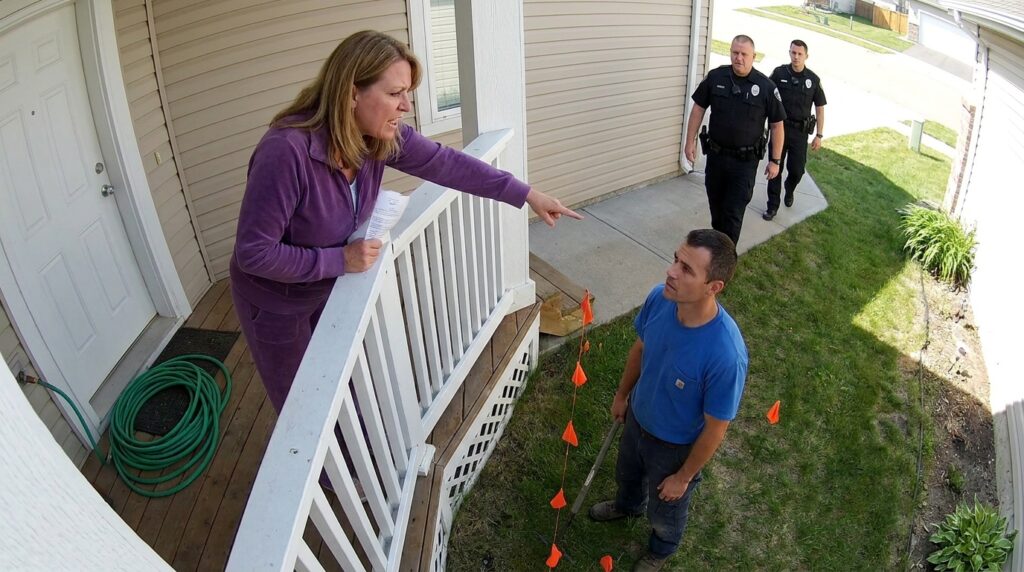
CHAPTER 1: THE FIRST STAKE
The fiberglass rod didn’t slide into the earth; it fought it. Jesse leaned his weight into the T-handle, feeling the vibration of dry gravel and impacted yellow clay grind through the palms of his split-leather gloves. The heat in the cul-de-sac didn’t rise; it sat, heavy with the smell of scorched fescue and two-cycle exhaust. He drove the stake down until exactly eight inches of fluorescent orange vinyl fluttered against the gray sod.
To the delivery trucks and the mail carriers, it was just a plastic ribbon. To Jesse, it was a coordinate locked against a county satellite three hundred miles above.
He wiped his brow with his forearm, leaving a smear of dark loam across his forehead. He didn’t look up at the house, but he knew the blinds had twitched. They always twitched by the third stake. The house was a pristine, multi-gabled split-level with vinyl siding so clean it looked like plastic wrap. On the side yard, a green garden hose lay coiled with mechanical precision, its brass nozzle gleaming like a shell casing.
Jesse unclipped the ruggedized tablet from his tool belt. The screen was spider-webbed across the corner, the glare of the July sun turning the vector lines into green streaks. He zoomed into Lot 42. A blinking blue dot marked his boots. According to the city grid, the four-foot easement ran parallel to the white vinyl fence line, but there was a dead spot in the telemetry—a jagged gray anomaly where the municipal fiber route met the old residential water main. It shouldn’t have been there. It looked like an old patch, or a line laid without a voucher.
A screen door clicked. It wasn’t the slam of an angry kid; it was the heavy, intentional pop of a spring-loaded hinge.
Jesse didn’t turn around. He reached into his canvas pouch, drew a second orange flag, and measured three paces north along the property line. He knew the boots were coming before he heard them—the soft, rhythmic thud of thick-soled sneakers moving across expensive turf.
“You’re two feet over the marker from five years ago,” a voice said.
Jesse kept his eyes on the ground. He looked at the white vinyl fence. The bottom rail was stained with a faint green crust from a lawn chemical spider. He drove the second stake down. The metal tip struck something hard—not stone, but the dull, flat thud of treated iron or thick concrete just four inches beneath the topsoil. The vibration stung his wrists.
“Did you hear me, young man?”
Jesse straightened his spine slowly. The vertebrae in his lower back gave three distinct pops. He turned to face the porch. She was standing three steps up, elevated behind a white vinyl railing that looked like a row of teeth. Her purple tracksuit was zipped tight despite the eighty-five-degree heat, and a pair of massive, tortoise-shell sunglasses sat atop a cap of stiff, bleached hair. In her left hand, she held a crisp, uncreased sheet of standard copy paper.
“The city map says the line is here, ma’am,” Jesse said. His voice was flat, dried out by road dust and cheap canteen water. He didn’t offer a smile. In this code, a smile was a sign of weakness or an admission of guilt.
She didn’t look at his tablet. She raised the paper, her thumb pinned against the edge like a splint. “I have the deed restriction right here. No municipal excavation within five feet of an existing residential structure. Your flags are on my grass.”
Jesse looked down at the orange vinyl fluttering by his boot. Between the plastic ribbon and her fence, the earth was dry, cracked, and waiting for the blade. He noticed a small, clean scar on the vinyl fence post directly behind her—a drill hole that had been filled with gray silicone, completely mismatched with the white plastic. It was exactly where the telemetry anomaly ended.








