CHAPTER 8: THE ENVIRONMENTAL PERIMETER
The yellow tape didn’t stretch; it snapped against the wet trunk of the juniper bush with the clean, plastic crack of a whip. Two state environmental wardens in matte-gray slickers pulled the line taut across the throat of the cul-de-sac, their thick rubber boots leaving deep, waffle-patterned tracks in the chemical-slicked muck of the easement lane. The rain had started ten minutes after the machine stopped—a cold, needle-sharp summer downpour that turned the yellow clay dust into a gritty, bubbling slurry that smelled of old vinegar and sulfur.
“Step back behind the wash-station, contractor,” the nearest warden said. He didn’t look at Jesse’s face. His eyes were shielded behind a wide, clear plastic visor that was already fogging from his breath, his hands clad in thick nitrile gloves that stayed locked around a pressurized decontamination nozzle.
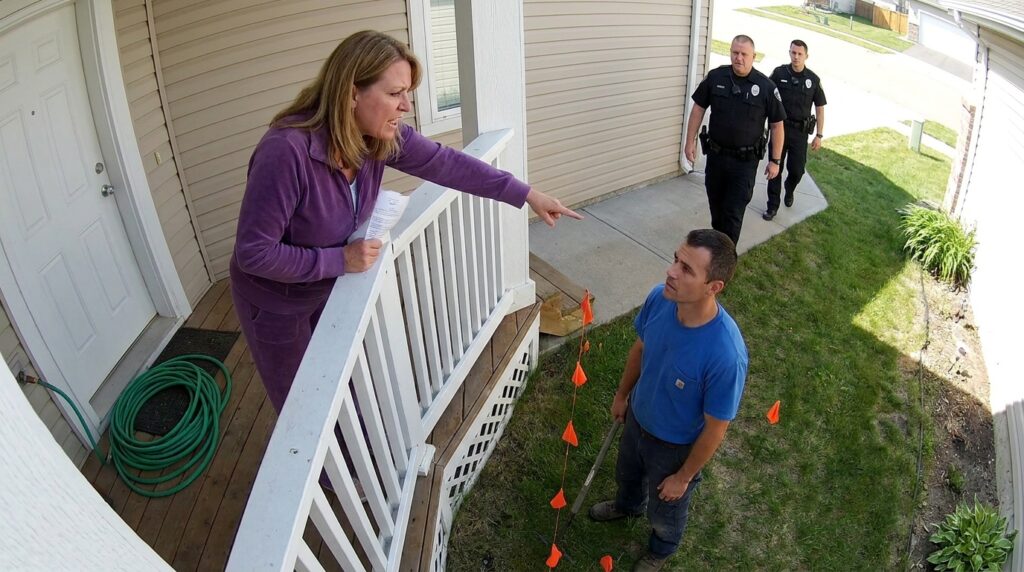
Jesse didn’t drop his shovel. He stood on the driveway of Lot 42, his leather work boots submerged up to the second eyelet in the oily run-off. His blue T-shirt was soaked through, the cotton clinging to his shoulder blades and smelling faintly of the trichloroethylene that was currently turning the white vinyl fence posts a dull, chalky green.
“My truck’s still inside the line,” Jesse said. His voice was raw from the fumes, his throat feeling like he had swallowed a handful of dry smithy scale. He pointed the iron tip of his spade toward the blue utility rig parked near the curb, its amber roof beacon still rotating silently through the gray sheets of rain.
“Your truck belongs to the state logistics pool until the core sample clears, Jesse,” Officer Miller said from behind him. The stocky cop was leaning against the fender of his cruiser, his black uniform uniform dark with water, his cap pulled low over his eyes. He wasn’t holding his clipboard anymore; he had a ruggedized county cell phone pinned between his shoulder and his ear, his voice dropping into a tense, rhythmic murmur that stayed below the rumble of the state generators. “The district supervisor just pulled the original eighty-eight charter from the vault. The site isn’t listed as residential acreage. It’s registered as a closed corporate testing terminal. The whole development shouldn’t have been permitted.”
Jesse wiped a mixture of rainwater and clay grit from his forehead with his forearm. Through the dark mesh of the house’s screen door, the interior lights had gone completely black. The resident hadn’t come down the steps, but the pale, circular shape of her face was still visible behind the double-paned glass of the upper bay window, her forehead pressed directly against the frame like a specimen behind glass. She was watching the wardens drive heavy brass ground stakes into the center of her lawn, right through the clover she had treated with broadleaf spray.
“The telemetry anomaly on my screen didn’t come from the city grid, Miller,” Jesse said, unclipping the spider-webbed tablet from his belt. The screen was dead—the battery casing had bloated from the chemical vapor coming off the trench lane—but his fingers still traced the cracked vector lines from memory. “The four-hundred-amp draw wasn’t an input line. It was an output. The circuit was driving a series of low-frequency induction pumps located under her cellar floor. They’ve been cycling the fluid back into the deep water main every time the neighborhood pressure drops.”
The younger deputy walked back from the white fence line, holding a small brass cylinder he’d pried from the base of the vinyl corner post. The metal was heavy, octagonal, stamped with a serial number that had been coated in thick, red paraffin wax to prevent corrosion. He dropped it into Jesse’s leather-gloved palm with a heavy, metallic clink.
“Look at the thread design,” the deputy whispered, his eyes scanning the road where a third gray warden van was currently turning into the lane. “That’s military surplus from the old ordnance depot across the ridge. It’s an explosive-override cap. If someone tries to shut down that conduit by force without the bypass code, the pressure differential drops a cold-soldered seal that blows the casing line.”
Jesse turned the brass cylinder over in his hand, his thumb catching on a rough edge where the paraffin had peeled away. Beneath the red wax, a second stamp was visible—not the “MAN” logo from the lead patch, but a clean, three-letter engraving that made the skin on the back of his neck tighten: C-O-U.
“The county didn’t lose the records from eighty-eight, Miller,” Jesse said quietly, his eyes tracking the yellow caution tape as it was looped around the neighborhood’s mailboxes. “They hid them. The association didn’t pay for the line extension because they wanted cable. They paid to keep the monitors off this side of the creek.”
Officer Miller didn’t look up from his phone, but his jaw muscle twitched once, a hard, white knot tightening beneath his weathered skin. He hung up the call without saying goodbye, his fingers clenching the ruggedized case until the plastic groaned. “Pack your hand tools into the wash-crate, Jesse,” he said, his voice dropping into the same dead rhythm as the rain hitting the asphalt. “The state warden just called for an underground structural core. They’re bringing the big drill rigs down the highway. We’re going inside that basement.”