CHAPTER 7: THE RESUMED CUT
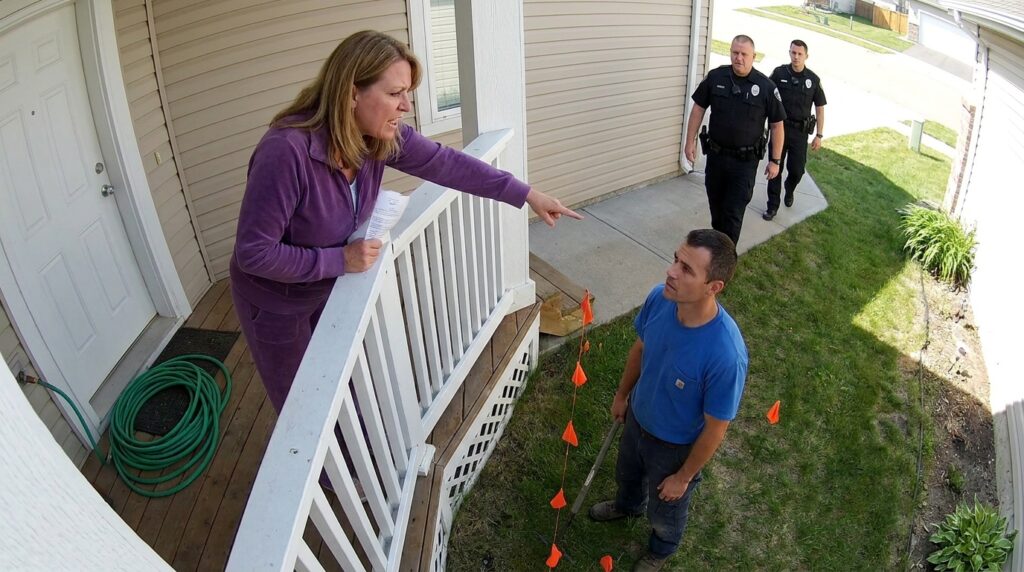
“Drop the wheel,” Jesse said into the radio handset, his voice small and static-clipped beneath the rising drone of the yellow trenching rig. He didn’t look back toward the oak screen door where the deadbolt remained turned. His eyes stayed on the dry, parched turf of the easement strip, where the orange vinyl flags were vibrating so fast they looked like static lines against the manicured fescue.
The operator fifty feet down the lane didn’t hesitate. The heavy hydraulic cylinders on the back of the Ditch-Witch gave a high-pitched, metallic shriek as they extended, forcing the sixty-inch steel wheel down through the crisp surface soil. The solid iron teeth struck the hard clay with a sound like a low-caliber rifle shot, throwing up a blinding cloud of yellow grit that smelled instantly of sulfur, zinc primer, and hot grease.
Jesse didn’t move away from the white vinyl fence line. He stood with his heavy work boots planted exactly behind the municipal boundary markers, his leather gloves clamped tight around the fiberglass handle of his spade. The vibration through the sod was massive now, an organic, rhythmic thudding that traveled straight up his shinbones and settled into his teeth. Every time the steel teeth completed a revolution, a thick, dark spray of the iridescent chemical fluid misted out from the narrow trench lane, coating the pristine white plastic of her porch railing in a pattern of greasy, blue-green freckles.
Officer Miller had already drawn his cruiser three houses back, his roof lights finally cycling through their silent, blue-and-red sequence to block the entrance of the cul-de-sac. The younger deputy stood near the juniper bushes down the block, his phone pressed flat to his ear as he stayed focused on the green transformer hatch with its wire-twisted latch. The neighborhood had gone completely dead; the distant lawnmowers had cut out, and behind the glare of three separate bay windows across the street, the pale shapes of faces were pressed against the glass, watching the yellow machine tear back into the earth.
The spade wheel sank forty inches deep, the steel chassis of the rig groaning under the resistance of the buried aggregate. Jesse leaned over the edge of the fresh cut, his eyes tracing the line where the iron conduit met the blackened concrete cap. The concrete was splitting now, hair-line fractures webbing out from the impact zone like dry ice cracking under water.
With a wet, tearing crunch, the bottom edge of the spinning wheel didn’t hit shale—it sheared straight through the side of the unauthorized casing.
The pressure release didn’t hiss; it gave a heavy, hollow thump that rattled the vinyl fence posts all the way to the corner of the garage. The sulfurous odor became an active wave, so thick it burned the back of Jesse’s throat and turned the edges of the green weeds instantly gray. A sluggish, dark stream of viscous, blue-black sediment began to spill out into the fresh clay ditch, pooling around the ground-down lead patch with the “MAN” stamp. It wasn’t utility coolant. It was the heavy, aromatic sludge of untreated trichloroethylene and spent zinc slag—the industrial runoff of the defunct manufacturing plant that had supposedly been remediated forty years ago.
Jesse wiped a drop of the grease from his cheek with the back of his split-leather glove, looking up as the oak door behind the wire screen finally gave a long, slow creak.
She didn’t step onto the porch steps. She stayed inside the threshold, her purple tracksuit a dark blur behind the mesh, her oversized amber sunglasses gone. Without the lenses, her eyes were small, pale, and completely fixed on the black fluid filling the trench strip. Her hands weren’t holding the uncreased paper notice anymore; they were pressed flat against the wood frame of the door, her fingers twitching against the grain as the smell of her late husband’s legacy filled the afternoon air.
“It’s thirty feet down,” she said through the screen. Her voice didn’t have any of the administrative ice left; it was just a dry, rattling whisper that barely carried over the mechanical idle of the diesel engine. “He didn’t want the county to forfeit the land value when the factory closed. He said the soil would filter the core before the association ever took over the greenways. We just needed twenty years.”
Jesse didn’t answer her. He reached down and dipped the tip of his brass calipers into the black sludge, watching the digital display flicker once before dying completely as the acidic compound began to eat through the cheap chrome plating of the sensor. The parallel copper leads she had run through the vinyl post weren’t there to steal power for her house; they had been feeding an active, continuous electrical current to an underground sacrificial anode system, using the city’s own power trunk to delay the corrosion of the rotting iron pipe just long enough for the estate to remain cleared of liability.
“The twenty years ended a long time ago, ma’am,” Jesse said flatly.
He turned his back on the screen door, clipping his ruined tablet to his tool belt. The operator down the lane threw the machine’s transmission into reverse, the hydraulic lines whistling as the steel wheel rose from the trench, leaving the black truth of Lot 42 bubbling up into the light under the silent, watchful glare of the suburban windows. The line had been marked, the easement was open, and the weight of the labor was finally off his hands.