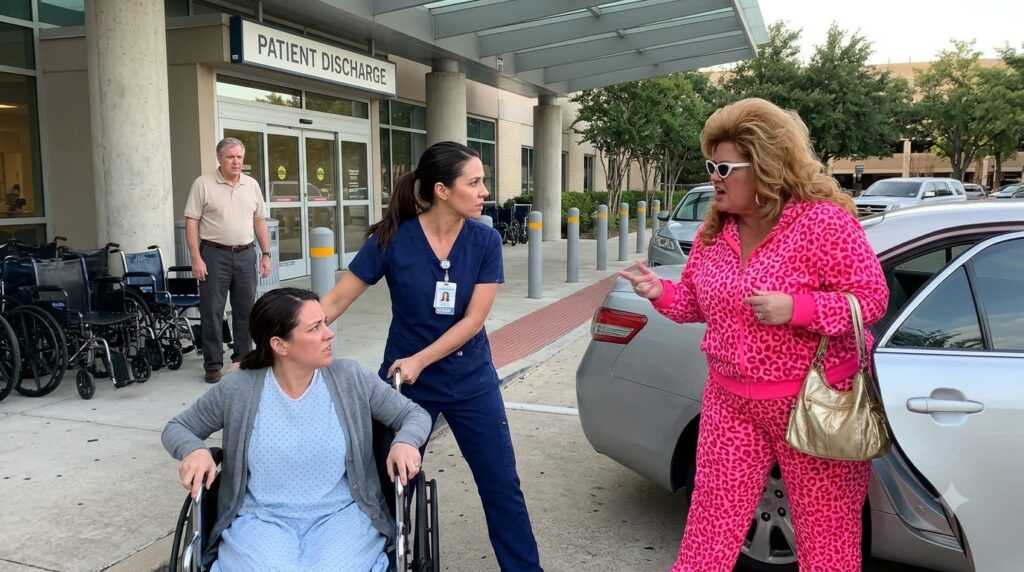
Chapter 9: The Door Opens Again
Three months after the confrontation, Margaret returned to the hospital for a scheduled follow-up appointment.
Her surgeon was pleased with her recovery.
Her incision had healed.
Her strength was returning.
She could walk comfortably for longer periods, and she had begun attending her weekly book club again.
Rachel drove her to the appointment.
When they arrived, Margaret noticed changes near the patient discharge entrance.
The row of transport wheelchairs was now positioned beneath a large sign explaining that assistance was available on request.
Bright floor markings identified the patient transfer area.
A transport attendant stood nearby, helping families move safely between wheelchairs and vehicles.
The changes were modest.
They were also thoughtful.
After the appointment, Margaret asked Rachel to drive past the discharge entrance rather than leaving through the parking garage.
Rachel glanced at her.
“Are you sure?”
Margaret nodded.
They approached the covered driveway.
The automatic doors opened and closed.
A nurse guided an older man toward a waiting SUV.
His daughter stood beside the open passenger door, holding a folded blanket.
The nurse checked the wheelchair brakes.
The man rose carefully.
His daughter supported his arm.
He settled into the seat.
The nurse waited until he was comfortable before moving the wheelchair away.
Margaret watched the entire transfer.
Nothing dramatic happened.
No one shouted.
No one grabbed the chair.
No one decided that the man’s need for assistance was an inconvenience.
The process unfolded with quiet patience.
Margaret felt her shoulders relax.
Rachel parked briefly in an authorized waiting space.
“Do you want to go inside?”
Margaret considered it.
Then she smiled.
“No. I just wanted to see it.”
She looked toward the glass doors.
For months, that entrance had represented the moment she lost control of her own movement.
Now she saw it differently.
It was a place where people were helped.
Where nurses did difficult work.
Where families waited with blankets, medications, and car keys.
Where most people treated one another with ordinary decency.
Linda Whitcomb had occupied ten terrible seconds of Margaret’s life.
Margaret no longer wanted those seconds to define the entire place.
As Rachel pulled away, Margaret reached for her daughter’s hand.
“Thank you for taking care of me.”
Rachel squeezed it.
“You’ve been taking care of me my whole life.”
Margaret laughed softly.
“Well, somebody had to.”
Across Houston, Thomas and Linda were attending a family dinner at their daughter’s house.
Their daughter, Melissa, had heard about the hospital incident through her parents.
She was forty-one, a high school counselor, and a mother of two teenagers.
She had been deeply upset by what happened.
Not only because Linda had frightened a recovering patient, but because Thomas had spent years quietly absorbing the consequences of her behavior.
Melissa had told both parents that she loved them.
She had also told Linda that her behavior needed to change.
At dinner, the family discussed ordinary things.
School schedules.
Home repairs.
Thanksgiving plans.
Then Melissa’s youngest son accidentally spilled iced tea across the table.
The glass tipped.
Liquid spread toward Linda’s purse.
For an instant, everyone froze.
The old Linda might have shouted.
She might have accused the boy of carelessness and demanded that someone replace anything damaged.
Thomas saw her shoulders tighten.
Linda looked at the spreading tea.
Then at her grandson’s frightened face.
She reached for a napkin.
“Let’s get this cleaned up.”
The boy exhaled.
Melissa handed her another towel.
No one commented on the moment.
They simply cleaned the table and continued dinner.
Thomas noticed, though.
Later, while they were driving home, he said, “You handled that well.”
Linda looked out the window.
“He didn’t mean to spill it.”
Thomas nodded.
“No, he didn’t.”
There was no grand reconciliation.
No sudden transformation.
Linda still became impatient in traffic.
She still disliked waiting.
She still occasionally began a complaint before stopping herself.
But she had started recognizing the moment when irritation became a choice.
And Thomas had started speaking up before that choice harmed someone else.
Their marriage remained complicated.
Yet for the first time in years, both were participating in the work of making it healthier.
A few weeks later, Linda completed her required community service at a local nonprofit that organized donated household supplies for older adults.
She spent several mornings sorting boxes, labeling shelves, and helping volunteers prepare deliveries.
One day, an elderly woman arrived to collect a donated walker.
The woman moved slowly.
Linda waited while a volunteer adjusted the walker’s height.
She watched the woman test it carefully before taking a few steps.
The woman smiled with relief.
“Now I can get around my kitchen without holding onto the counters.”
Linda looked at the walker.
It was a simple piece of equipment.
Metal tubing.
Rubber grips.
Four stable legs.
To someone who did not need it, it might seem ordinary.
To the woman standing before her, it represented independence.
Linda remembered Margaret’s wheelchair.
She remembered how casually she had treated it as something she could take.
For the first time, she fully understood that the chair had never been the real issue.
The issue was whether she believed another person’s need mattered as much as her own.