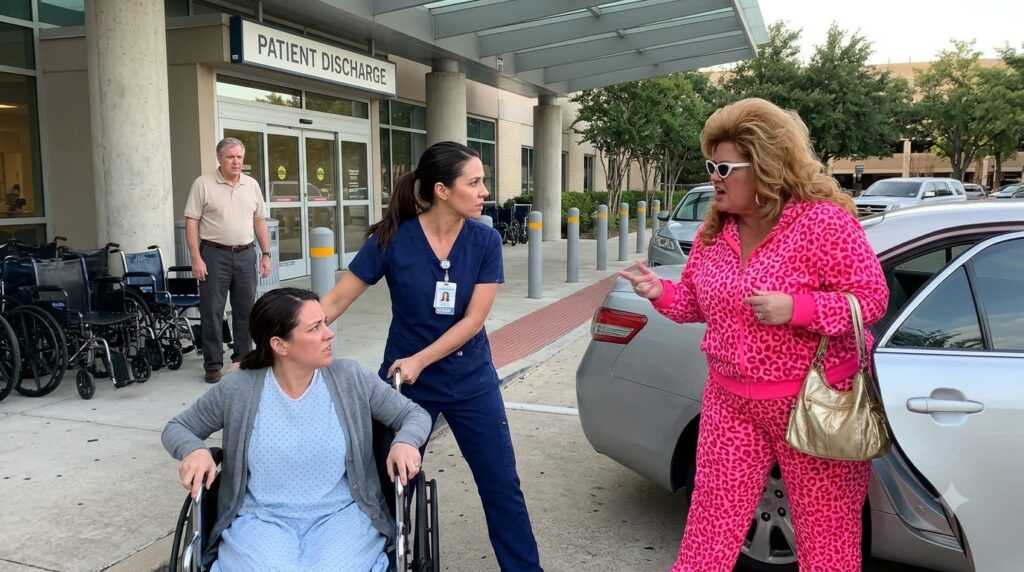
Chapter 8: A Different Kind of Accountability
The legal review took several weeks.
During that time, Linda’s attorney advised her to stop discussing the incident publicly and avoid contacting witnesses.
Linda followed that advice reluctantly.
The hospital continued its internal safety improvements.
Margaret continued recovering.
Thomas continued refusing to change his account.
Eventually, the prosecutor’s office authorized a misdemeanor assault charge based on the reported unwanted physical interference and the available evidence.
The charge did not mean Linda had already been found guilty.
It meant the case would proceed through the legal process.
Linda was notified and appeared in court with her attorney.
She wore a conservative navy outfit rather than the bright tracksuit she had worn at the hospital.
Her hair was neatly styled.
Her expression was controlled.
Thomas accompanied her but sat quietly.
Margaret was not required to attend the initial hearing.
She remained at home, where Rachel helped her prepare lunch and tried not to check her phone every few minutes.
Margaret had made one decision early in the process.
She would cooperate truthfully.
She would not make the case the center of her life.
At a later stage, Linda’s attorney discussed a negotiated resolution with the prosecutor.
Linda initially resisted.
She wanted the entire matter dismissed.
She insisted that her intentions had been misunderstood.
But the video was clear, and multiple witnesses had given consistent accounts.
Her attorney explained that continuing to deny the basic sequence of events would not make the recording disappear.
Thomas also refused to support a false version.
Eventually, Linda agreed to resolve the case through a court-approved arrangement that required her to accept responsibility for the physical interference, complete an anger-management program, perform community service, pay applicable court costs, and avoid contact with Margaret.
The precise legal consequences were determined through the court process, not by the hospital or Margaret.
Margaret received notice of the resolution.
She read it at her kitchen table.
Rachel waited for her reaction.
“Is that enough?” Rachel asked.
Margaret thought for a moment.
She had never wanted Linda imprisoned.
She had wanted the behavior acknowledged.
She had wanted assurance that the woman could not simply frighten another patient and walk away claiming she was the victim.
Most of all, she had wanted to stop feeling as though she needed to justify her right to basic care.
“I think it’s a beginning,” she said.
Rachel sat beside her.
“You’re not angry?”
“Oh, I’m still angry.”
Margaret smiled faintly.
“But I don’t want to spend the rest of my recovery carrying her around in my head.”
That afternoon, Margaret went outside to water the chrysanthemums.
The weather had cooled slightly.
A breeze moved through the oak branches.
She worked slowly, careful not to strain her healing abdomen.
Across town, Linda attended her first anger-management session.
She entered the room expecting to find people who were much worse than she was.
Instead, she found ordinary adults.
A retired salesman who had frightened a neighbor during a property dispute.
A middle-aged woman whose workplace outbursts had cost her a job.
A man who had damaged his brother’s car during an argument.
The facilitator did not ask participants to describe themselves as bad people.
She asked them to identify the choices they made before losing control.
Linda disliked the exercise.
She preferred discussing what other people had done to provoke her.
When her turn came, she described the hospital incident as a misunderstanding.
The facilitator listened.
Then she asked, “What did you do with your hands?”
Linda frowned.
“I moved a wheelchair.”
“Was someone sitting in it?”
“Yes.”
“Had that person agreed to be moved?”
“No.”
The facilitator waited.
Linda stared at the floor.
The room was quiet.
For the first time, she could not escape into a story about rude employees or unfair treatment.
The question was too simple.
What had she done?
Linda remembered the wheelchair handles in her hands.
She remembered pulling.
She remembered the patient’s startled face.
Then she remembered the car door.
She had slammed it because she was angry that the nurse would not let her take control.
That was not concern for Thomas.
It was punishment directed at someone who had refused her demand.
Linda looked up.
“I shouldn’t have touched the chair.”
The facilitator nodded.
It was a small admission.
But it was the first one Linda had made without immediately adding an excuse.
Later that evening, she returned home.
Thomas was reading in the living room.
She sat across from him.
For several minutes, neither spoke.
Then Linda said, “I was wrong to pull that woman.”
Thomas lowered his book.
He did not rush to praise her.
He did not tell her everything was forgiven.
He simply said, “Yes, you were.”
Linda looked down.
“I know.”
Thomas watched her carefully.
He had heard apologies before.
Some had been sincere in the moment and forgotten by the next inconvenience.
He wanted to believe this one mattered.
But he understood that change would have to be measured in behavior, not words.
Linda remained seated.
Then she said something he had not expected.
“I made you look foolish, too.”
Thomas shook his head.
“You made your own choices.”
Linda considered that.
For once, she did not argue.