Chapter 2: The Ride Home That Never Happened
Rachel Ellis returned to the discharge entrance carrying a white pharmacy bag and a paper cup of water.
She stopped when she saw her mother surrounded by hospital staff.
Margaret was still in the wheelchair.
Her face had lost much of its color.
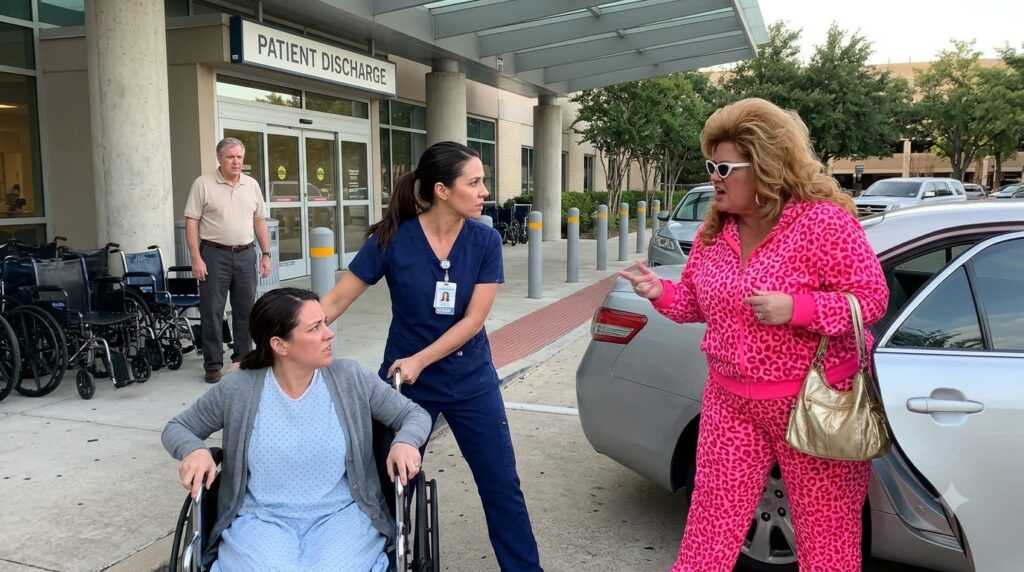
Angela stood beside her, speaking quietly with another nurse. A security officer was positioned near the sedan, and the woman in the pink tracksuit was arguing with a hospital supervisor.
Rachel hurried forward.
“Mom? What happened?”
Margaret tried to smile.
It was the same smile she had used throughout Rachel’s childhood whenever she wanted to make a frightening situation seem manageable.
“I’m all right, sweetheart.”
Rachel knew better.
Her mother was seventy-one years old, a retired elementary school librarian who had survived breast cancer, cared for her late husband through Parkinson’s disease, and spent the last three years learning how to live alone.
She did not frighten easily.
Yet her fingers were trembling against the wheelchair armrest.
Angela explained the incident without exaggeration.
A stranger had pulled Margaret’s occupied wheelchair away from the car. Margaret had reported abdominal pain afterward. The stranger had also slammed the vehicle door and blocked access to it.
Rachel turned toward Linda.
“Why would you do that?”
Linda looked her up and down.
“Your mother was sitting in a wheelchair my husband needed.”
Rachel glanced toward the empty chairs.
For several seconds, she could not find words.
Finally, she asked, “Are you serious?”
Linda opened her mouth to respond, but Daniel intervened.
“Ms. Ellis, your mother needs to be examined before discharge can continue.”
Rachel immediately turned back.
“Of course.”
Margaret’s shoulders sank.
She had been ready to go home.
She had dressed in the gray cardigan Rachel brought from her closet. Her discharge paperwork was complete. Her medications were collected. A neighbor had promised to leave homemade chicken soup on the porch.
Now she was going back inside.
Angela gently released the wheelchair brakes.
Margaret winced as the chair began moving.
Rachel noticed.
“Mom?”
“It’s just sore.”
Angela did not dismiss the complaint.
She guided Margaret through the automatic doors and toward a quiet assessment room near the surgical unit.
Rachel followed, still clutching the pharmacy bag.
Outside, Linda watched them disappear.
“Unbelievable,” she muttered. “All that drama over a wheelchair.”
Daniel turned toward her.
“Ma’am, I need your name.”
Linda stiffened.
“Why?”
“Because you’ve been involved in a reported safety incident.”
“I haven’t done anything wrong.”
Daniel kept his voice level.
“Then you can explain what happened.”
Linda identified herself as Linda Whitcomb.
Her husband was Thomas Whitcomb.
Thomas gave his name quietly, without looking at his wife.
Daniel asked whether he needed medical assistance.
Thomas shook his head.
“I had a knee replacement six months ago. It gets stiff when I walk too far.”
“Would you like a transport chair?”
Thomas looked at the row of empty wheelchairs.
“Yes, please.”
Daniel signaled to a hospital attendant, who brought one over.
It took less than twenty seconds.
Thomas sat down carefully.
Linda stared.
For the first time since the confrontation began, she seemed uncertain what to say.
The hospital supervisor, Patricia Vaughn, arrived moments later.
Patricia was sixty-two, with silver-streaked hair, reading glasses hanging from a cord, and the composed manner of someone who had spent decades resolving problems without allowing anger to dictate her decisions.
Daniel summarized the incident.
Patricia listened, then asked Linda a simple question.
“Did you move the wheelchair while the patient was seated in it?”
Linda hesitated.
“I moved it out of the way.”
“Without the patient’s permission?”
“She was taking forever.”
Patricia made a note.
“Did you close the car door to prevent her from entering?”
Linda crossed her arms.
“I was making a point.”
Patricia looked at her steadily.
“A patient recovering from surgery was preparing to leave this hospital. Your actions interrupted her discharge and may have caused an injury.”
Linda scoffed.
“She looked fine to me.”
Patricia’s expression did not change.
“Her medical condition is not yours to judge.”
Inside the hospital, Margaret lay on an examination bed while a physician checked her incision and asked about the pain.
Rachel stood nearby.
The examination revealed tenderness but no obvious external bleeding. The physician ordered additional observation and laboratory tests because the pain had begun after the abrupt movement.
Margaret stared at the ceiling.
She had been independent for most of her life.
She still drove to church, managed her own bills, and tended the rosebushes her husband planted thirty years earlier.
Being dependent on strangers had been the hardest part of surgery.
Now another stranger had treated her as though she were an inconvenience occupying something she had no right to use.
Rachel pulled a chair beside the bed.
“You’re safe now, Mom.”
Margaret nodded.
But she wasn’t thinking only about the pain.
She was thinking about Linda’s face when she demanded that Margaret get out of the wheelchair.
The woman’s anger had been absolute.
There had been no hesitation, no embarrassment, no recognition that Margaret was a person.
Just a demand.
A few minutes later, Angela entered the room.
“The discharge has been postponed until your physician clears you again.”
Margaret closed her eyes.
Rachel squeezed her hand.
Angela hesitated before adding something else.
“Security is reviewing the entrance cameras.”
Margaret opened her eyes.
“Did they see what happened?”
Angela nodded.
“The camera covers the entire pickup lane.”
For the first time that afternoon, Margaret felt something other than fear.
Relief.
There would be a record.
Not just of what Linda said happened.
But of what she actually did.