Chapter 10: What Dignity Looks Like
The following spring, Margaret Ellis stood in her front garden beneath the oak tree Robert had planted decades earlier.
The chrysanthemums had been replaced by fresh flowers.
Her roses were beginning to bloom.
A small wooden bench sat beside the walkway, and a wind chime moved gently in the breeze.
Margaret had regained most of her usual routine.
She drove short distances.
She attended church.
She volunteered twice a month at a neighborhood literacy program.
And every Thursday afternoon, Carol Jenkins came over for tea.
Life had not returned to exactly what it was before surgery.
Margaret tired more easily.
She accepted help more often.
But she no longer interpreted those changes as failures.
Age had taught her that independence was not the same as refusing assistance.
Sometimes independence meant having the freedom to accept help without surrendering dignity.
One afternoon, Rachel arrived carrying groceries and a folder of family photographs.
They spent an hour sorting pictures at the kitchen table.
There was Robert standing beside his first car.
Rachel on her high school graduation day.
Margaret holding her newborn grandson.
A photograph of the family at Galveston, laughing as wind blew their hair across their faces.
Then Rachel found a picture of Margaret and Robert outside the public library where Margaret had worked.
Robert’s arm was around her shoulders.
Margaret was smiling broadly.
Rachel held up the photograph.
“You look happy.”
“I was.”
Margaret studied it.
“Your father used to say that the easiest way to judge someone’s character was to watch how they treated a person who couldn’t do anything for them.”
Rachel smiled.
“That sounds like Dad.”
Margaret nodded.
“He wasn’t always patient. But he understood respect.”
She placed the photograph on the table.
The hospital incident had taught her something about that word.
Respect was not simply being polite when life was convenient.
It was recognizing another person’s humanity when their needs interfered with your plans.
It was waiting while someone moved slowly.
It was offering assistance without taking control.
It was telling the truth even when the truth made someone you loved uncomfortable.
Margaret thought of Angela, who had stepped between her and Linda without hesitation.
Daniel, who had treated the confrontation seriously.
Patricia, who had refused to dismiss the incident as an argument.
Evelyn, who had volunteered as a witness.
And Thomas, who had finally spoken honestly.
None of them had needed to make a dramatic speech.
They had simply done what the situation required.
A few days later, Denise Walker contacted Margaret one final time.
The hospital’s internal review was closed.
Its discharge safety improvements were in place.
Margaret’s medical records remained private.
The incident documentation had been retained according to applicable procedures.
There was nothing further Margaret needed to do.
Denise asked whether she had any remaining concerns.
Margaret thought about it.
“No,” she said. “I think you’ve handled it.”
Then she added, “Please thank Nurse Brooks for me.”
Denise promised to pass along the message.
That evening, Angela received a note through the hospital’s employee recognition program.
It was brief.
Margaret thanked her for protecting a patient who could not protect herself quickly enough.
Angela read the message after a long shift.
She had spent the day helping people through difficult transitions.
Some were relieved to go home.
Others were frightened.
Some had families waiting.
Others had no one.
The work could be exhausting.
The note reminded her why she continued doing it.
Meanwhile, Linda had finished the requirements of her court-approved resolution.
She had also written another letter to Margaret.
This one was different.
It did not mention discrimination.
It did not blame the nurse.
It did not suggest that the confrontation had been a misunderstanding.
Linda acknowledged that she had grabbed an occupied wheelchair without permission, frightened a recovering patient, and blocked access to the patient’s car.
She wrote that her husband’s knee discomfort had not justified any of those actions.
She apologized without asking Margaret to excuse her.
The letter was forwarded through the appropriate channel.
Margaret read it one quiet morning.
She sat for a long time afterward.
Then she placed it in the drawer beside Thomas’s earlier letter.
Rachel asked whether she planned to respond.
Margaret shook her head.
“I don’t think I need to.”
“Do you forgive her?”
Margaret looked toward the garden.
“I hope she becomes a better person.”
She paused.
“But forgiveness doesn’t require me to invite her into my life.”
Rachel nodded.
Margaret had no desire to punish Linda forever.
She also had no obligation to offer personal reconciliation.
The matter was resolved.
Her boundaries remained.
That afternoon, Margaret went outside to tend her flowers.
A delivery truck stopped across the street.
Her neighbor Carol was helping her older sister out of the passenger seat.
The woman used a walker and moved carefully down the driveway.
Margaret watched as Carol waited, giving her sister time to find her balance.
No one rushed.
No one complained.
No one treated the walker as an inconvenience.
Margaret smiled.
She walked to the gate and opened it wider so they could pass easily.
“Beautiful afternoon,” she called.
Carol waved.
Her sister smiled and continued toward the house.
Margaret stood at the gate for a moment, feeling the warm Houston sunlight on her face.
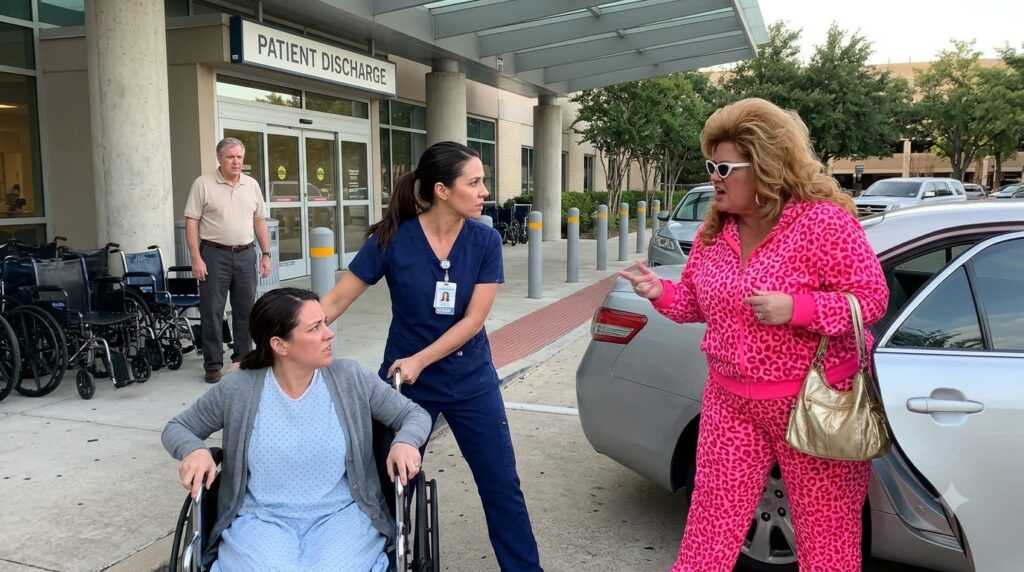
She remembered the hospital driveway.
The sudden pull.
The pain.
The slammed door.
And the helplessness of sitting in a wheelchair while a stranger decided she had more right to it.
But the memory no longer carried the same power.
Linda had been held accountable.
Thomas had chosen honesty.
The hospital had improved its procedures.
Margaret had recovered and reclaimed her ordinary life.
And the central lesson had become wonderfully simple.
A wheelchair was not a privilege to be seized by whoever shouted the loudest.
A hospital discharge was not a competition.
And needing help did not make a person less deserving of respect.
Margaret closed the garden gate and returned to her roses.
Inside, the kettle was warming for afternoon tea.
Her favorite chair waited beside the window.
Her daughter would visit on Sunday.
There were books to read, flowers to plant, and family dinners still to enjoy.
For a woman who had once been stopped just three feet from her ride home, those ordinary freedoms meant more than ever.
She had not needed to win an argument to reclaim them.
She had needed the truth to be heard, her boundaries to be respected, and the freedom to move forward.
And at last, she had all three.