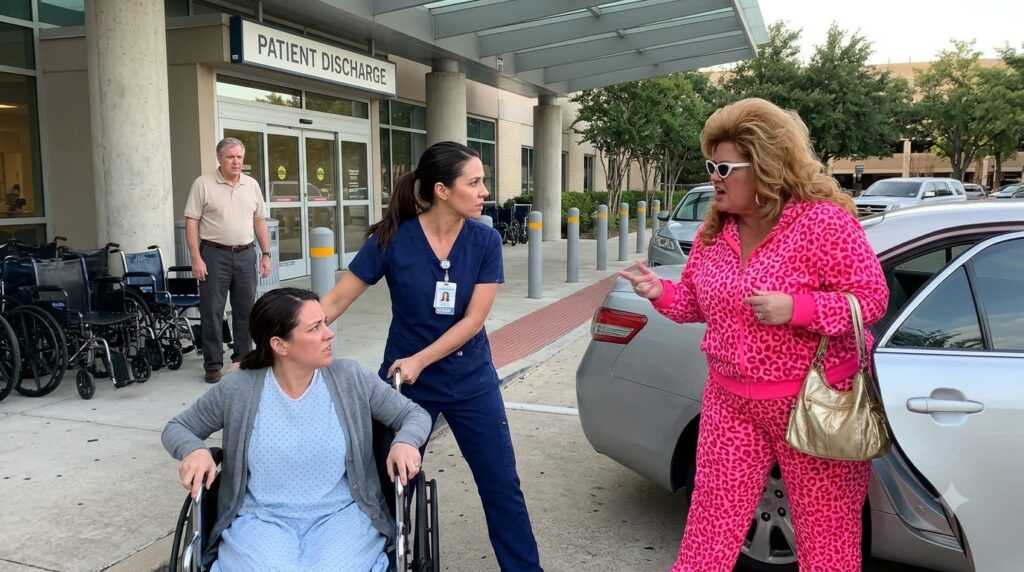
Chapter 6: The Price of Being Right
Linda called the hospital the moment she finished reading the letter.
She demanded Patricia Vaughn.
When told Patricia was unavailable, she demanded the chief executive officer.
When informed that her complaint would be handled through the established process, she threatened to contact a television station.
The patient relations representative remained professional.
Linda grew louder.
Eventually, the representative ended the call after explaining how Linda could submit additional information in writing.
Linda sat at the kitchen table, furious.
Thomas entered from the garage.
She held up the letter.
“Can you believe this?”
He read it.
His expression barely changed.
“They reviewed what happened.”
“They’re protecting their employees.”
Thomas placed the letter on the table.
“Linda, there’s video.”
She stared at him.
“How do you know?”
He hesitated.
Then he answered.
“I went back and told them what I saw.”
For several seconds, the kitchen was silent.
Linda’s face reddened.
“You went behind my back?”
“I told the truth.”
“You betrayed me.”
Thomas felt the familiar pressure to apologize.
It rose automatically, like a reflex developed over decades.
He almost said he was sorry.
Instead, he sat down.
“I watched you frighten a woman who had just had surgery.”
Linda looked away.
“You don’t understand what it’s like to be ignored.”
Thomas studied her.
He knew that complaint was real to her.
As they had grown older, Linda had become increasingly sensitive to situations where she felt overlooked.
She disliked waiting rooms, crowded restaurants, and customer-service counters where younger employees seemed impatient.
She often interpreted inconvenience as disrespect.
Thomas understood the feeling of becoming less visible with age.
He had experienced it himself after retirement.
But understanding a feeling did not excuse every action taken because of it.
“Being ignored doesn’t give us the right to hurt somebody,” he said.
Linda stood abruptly.
“I didn’t hurt her.”
“You don’t know that.”
Thomas’s voice remained quiet.
“Neither do I.”
Linda left the room.
For the first time in years, Thomas did not follow her to make peace.
Two days later, an officer with the Houston Police Department contacted Linda regarding the reported incident.
He explained that he was reviewing the available information and wanted her account.
Linda insisted she had done nothing criminal.
The officer did not argue over the phone.
He arranged a time to speak with her.
During the interview, Linda repeated her claim that she had merely repositioned an unused wheelchair.
When asked whether the chair had been occupied, she said the patient had been preparing to stand.
The officer clarified the question.
Was the patient seated when Linda moved the chair?
Linda hesitated.
“Technically.”
He recorded her answer.
The officer also reviewed the preserved video, witness statements, and the hospital’s incident documentation.
He spoke with Angela, Daniel, and Evelyn Parker.
He contacted Margaret through the appropriate process and asked whether she wished to provide a statement.
Margaret agreed.
She did not want to travel to a police station while recovering, so arrangements were made for a telephone interview.
Rachel sat nearby while Margaret described the event.
She explained that she had been frightened by the sudden movement and had experienced pain afterward.
She also explained why the car-door obstruction mattered.
“I couldn’t get into my daughter’s car,” she said. “She was standing there deciding whether I was allowed to leave.”
The officer asked whether Margaret had threatened Linda.
“No.”
Had she refused a request to share the wheelchair?
“No one asked me anything before she grabbed it.”
Margaret paused.
“I would have helped her husband find a chair if she’d asked. There were several nearby.”
After the interview, Margaret felt tired but relieved.
She had told her story.
She had not exaggerated.
She had not hidden anything.
And she had not needed to become cruel in order to defend herself.
The investigation continued.
Several days later, the officer informed Linda that the matter had been referred for prosecutorial review.
No final charging decision had been made.
Linda was furious.
She called Thomas into the living room and demanded that he contact the officer to change his statement.
Thomas refused.
Then she suggested that he tell investigators his knee pain had been unbearable and that he had urgently needed Margaret’s wheelchair.
Thomas looked at her.
“My knee was stiff. I wasn’t in danger.”
“You could say you were.”
“No.”
The word was quiet.
It was also final.
Linda stared at him as though he were a stranger.
Thomas stood.
“I won’t lie about a woman getting hurt so you can avoid admitting what you did.”
He walked into the bedroom and closed the door.
Linda remained in the living room.
For years, she had believed Thomas would eventually agree with her if she became angry enough.
Now he had stopped.
She could no longer rely on him to repair the consequences of her behavior.
And the hospital had made another decision.
Following its safety review, it issued Linda a written notice restricting her access to nonessential hospital areas, subject to necessary medical care and applicable patient-access requirements.
She could still obtain appropriate treatment.
She could not return to the discharge entrance to confront staff or patients.
The letter also instructed her not to contact Margaret or her family.
Linda placed it beside the first letter.
Two envelopes.
Two official responses.
Neither contained the apology she had expected.
She had begun the confrontation demanding a wheelchair that her husband did not need.
Now she was facing consequences she could not simply shout away.