Chapter 1: Three Feet from Safety
The wheelchair lurched backward so suddenly that Margaret Ellis thought she was falling.
Her hands flew to the armrests. Her feet, which had been moving toward the pavement, snapped back onto the footrests as the chair rolled nearly three feet away from the waiting car.
A sharp pain shot through her abdomen.
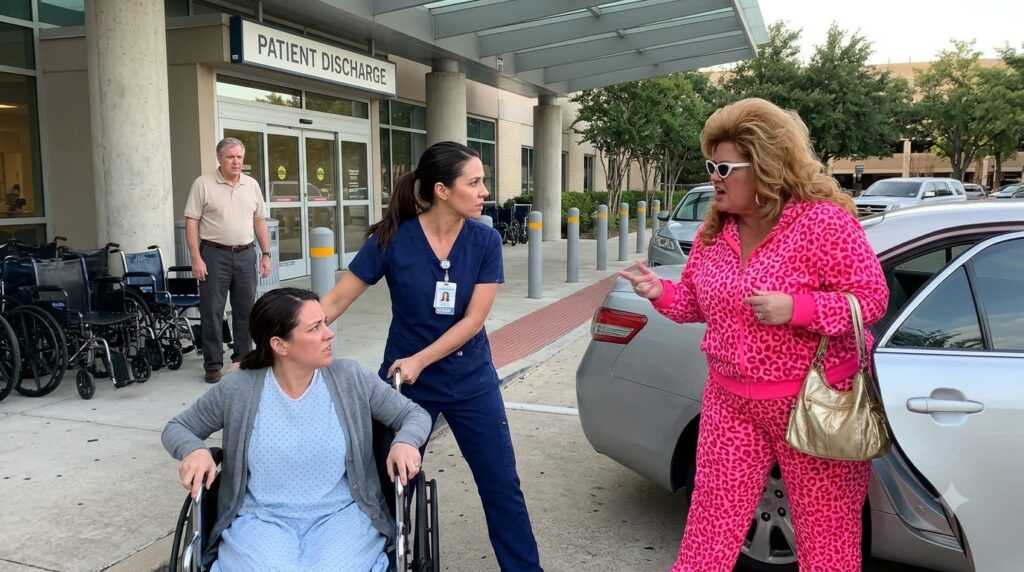
She had undergone surgery less than forty-eight hours earlier, and every movement still required care. Her discharge nurse had just positioned the wheelchair beside the open rear passenger door of her daughter’s sedan when someone grabbed the handles from behind.
That someone was a large woman dressed in a neon-pink leopard-print tracksuit.
Margaret heard the woman’s metallic gold handbag strike the wheelchair frame as she pulled.
Then came an angry voice.
“My husband needs that chair! Get out!”
Margaret stared up at her.
The stranger appeared to be in her mid-fifties, with enormous honey-blonde hair, oversized white sunglasses, and an expression suggesting that the entire hospital had personally offended her.
Margaret’s first instinct was to protect her incision.
Her second was to lock the wheelchair brakes.
“I just had surgery! Stop!”
The words came out louder than she expected.
Nurse Angela Brooks, who had been checking the passenger seat for a safe transfer, immediately stepped behind the wheelchair.
She took hold of the push handles and placed herself between Margaret and the stranger.
“Ma’am, step away from my patient.”
The woman refused.
Instead, she pointed toward a gray-haired man standing near the hospital entrance.
“My husband has a bad knee. He shouldn’t have to walk all the way to the parking garage.”
The man looked mortified.
He wore a beige polo shirt and dark trousers. Although he stood with one hand resting against his hip, he appeared perfectly capable of walking.
More importantly, he was standing beside a row of empty hospital wheelchairs.
Margaret noticed them immediately.
So did Angela.
The woman in pink apparently did not care.
When Angela refused to release the occupied wheelchair, the stranger stormed around its side toward Margaret’s waiting car.
Before anyone understood what she intended, she seized the open rear passenger door.
SLAM.
The sound echoed beneath the covered hospital entrance.
Margaret flinched.
The door had been her way home.
Now the stranger stood against it, arms spread wide, using her body to prevent anyone from opening it.
“You people think you can take everything!” she shouted.
Angela approached cautiously.
“Move away from the vehicle.”
The woman lifted her chin.
“Make me.”
Behind her, the gray-haired man pointed toward the empty wheelchairs.
“Linda, there are chairs right there.”
His wife glanced over her shoulder.
For one brief moment, Margaret thought the absurdity of the situation might finally reach her.
Instead, Linda turned back and pressed herself harder against the car.
Margaret had spent two days looking forward to leaving the hospital. She had imagined sitting in the passenger seat, watching Houston traffic through the window, and eventually seeing the familiar oak tree outside her own house.
She had not imagined being trapped at the discharge entrance by a stranger demanding her wheelchair.
Her daughter, Rachel, was returning from the hospital pharmacy with Margaret’s prescriptions. She had left the car unlocked so Angela could help her mother inside.
Margaret wished desperately that Rachel were there.
Then she was grateful she wasn’t.
Her daughter had already endured enough worry.
Angela reached for the radio clipped to her scrubs.
“Security to patient discharge. Immediate assistance requested.”
Linda laughed.
“Oh, wonderful. Call everybody. Maybe the hospital president can explain why my husband has to suffer.”
The automatic glass doors slid open behind them.
A security officer stepped outside.
He had heard the car door slam from the lobby.
His name was Daniel Mercer, and after fourteen years working hospital security, he recognized the difference between an ordinary complaint and a situation that could become dangerous.
He saw an elderly-looking woman sitting rigidly in a wheelchair, a nurse guarding her, and another woman physically blocking access to a vehicle.
His attention went first to Margaret.
“Are you hurt, ma’am?”
Margaret swallowed.
“My stomach hurts. She pulled me backward.”
Angela’s expression changed.
Until that moment, she had been focused on preventing another confrontation.
Now she was worried about what the sudden movement might have done to her patient.
“Margaret, don’t try to stand.”
Daniel spoke calmly to Linda.
“Step away from the car, please.”
Linda folded her arms.
“I’m not moving until somebody gets my husband a wheelchair.”
Daniel looked toward the empty chairs.
Then toward Linda’s husband.
The man lowered his eyes.
Daniel did not argue.
He simply spoke into his radio.
“Have the discharge supervisor come outside. We may need a medical reassessment.”
Linda seemed pleased.
At last, she believed, someone important was coming.
Margaret understood something Linda did not.
The hospital was no longer treating this as an argument over a wheelchair.
It was treating it as an incident involving a recovering surgical patient.
And that changed everything.