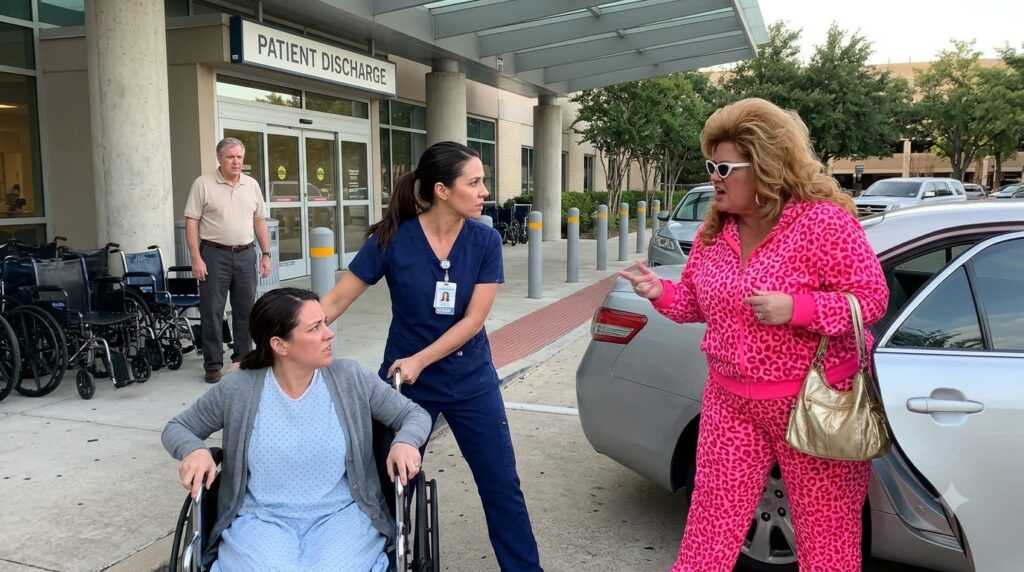
Chapter 5: The Husband Who Finally Spoke
Thomas Whitcomb arrived at the hospital alone three days after the confrontation.
He had told Linda he was going to a follow-up appointment.
That was true.
But he had also arranged to speak with Patricia Vaughn.
He waited in a small conference room near the administrative offices, holding a paper cup of coffee that had gone cold.
Thomas had never considered himself a courageous man.
He had worked as an insurance claims supervisor for thirty-eight years, paid his bills, raised two children, and tried to keep peace at home.
He believed in doing the right thing.
He also believed in avoiding unnecessary conflict.
For most of his marriage, he had convinced himself those principles could always coexist.
Now he was beginning to understand that they could not.
Patricia entered with a hospital risk-management representative.
She thanked Thomas for coming.
He looked down at his hands.
“I want to correct something.”
Patricia waited.
“My wife says the hospital wouldn’t help me.”
He shook his head.
“That’s not true.”
He explained that he had seen the empty wheelchairs before Linda approached Margaret.
He had even pointed them out.
Linda had refused to use one.
Thomas believed she was angry because Margaret’s chair was positioned conveniently beside the curb, while the empty chairs were several yards away.
He could not know every thought in his wife’s mind, but he knew what she had done.
“She wanted that particular chair,” he said. “And she didn’t want to wait.”
Patricia asked whether Thomas had requested that Margaret surrender it.
“No.”
“Did you tell your wife to take it?”
“No.”
Thomas paused.
“I should have stopped her sooner.”
Patricia did not offer easy reassurance.
She simply asked him to describe what happened next.
Thomas told them about the yank, the patient’s startled reaction, the nurse’s intervention, and the slammed car door.
He confirmed that Linda had blocked access to the vehicle.
Then he described the moment that had stayed with him.
“The woman looked scared,” he said. “Not angry at first. Scared.”
He rubbed his eyes.
“My wife saw that. She kept going anyway.”
Patricia thanked him for being truthful.
Thomas asked whether Margaret had been seriously hurt.
Patricia explained that she could not disclose private medical details without authorization.
He nodded.
“I understand.”
Then he asked whether there was a way to send an apology without contacting Margaret directly.
Patricia said the patient relations office could receive a letter and ask Margaret whether she wished to accept it.
Thomas took an envelope from his jacket.
He had already written one.
It contained no excuses.
He apologized for failing to intervene sooner and for the distress caused by the confrontation.
He did not ask Margaret to forgive him.
He only wanted her to know that someone who had witnessed the incident recognized how wrong it was.
Patricia accepted the envelope.
That afternoon, Margaret was finally discharged.
This time, the process was quiet.
Angela helped her into Rachel’s car at the same entrance.
A transport attendant remained nearby.
The wheelchair brakes were checked.
The car door stayed open until Margaret was safely seated.
No one hurried her.
No one demanded that she move faster.
As Rachel fastened the seat belt, Margaret looked toward the row of empty wheelchairs.
She had expected to feel embarrassed returning to the place where she had been frightened.
Instead, she felt a small but meaningful sense of control.
She had chosen to leave through that entrance.
She had refused to let one stranger determine how she would remember her hospital stay.
On the drive home, Rachel avoided the freeway construction near downtown Houston.
She took the familiar route through quieter neighborhoods, passing grocery stores, churches, and streets lined with live oaks.
Margaret watched the city slide past.
She had lived in Houston for forty-six years.
She had raised her children there, buried her husband there, and built a life that belonged to her.
The ordinary sight of homebound traffic felt unexpectedly precious.
When they reached her house, Rachel helped her inside.
A container of chicken soup waited on the porch, just as promised.
Margaret smiled.
Her neighbor, Carol Jenkins, had also left a note.
Rest. Eat. Call me if you need anything.
Margaret placed the note on the kitchen counter.
Then she settled into her favorite chair beside the living room window.
For the first time in several days, she felt truly safe.
That evening, Rachel received a call from Denise Walker.
The hospital had received a letter from Thomas Whitcomb.
Would Margaret like to read it?
Rachel explained the offer.
Margaret considered it.
She had no desire to speak with Linda.
But Thomas had been standing there.
He had seen what happened.
And she remembered his embarrassed expression when he pointed toward the empty wheelchairs.
“Yes,” Margaret said. “I’d like to read it.”
The letter arrived through the patient relations office the following day.
Margaret read it slowly.
When she finished, she folded it and placed it inside the drawer beside her chair.
Rachel asked what she thought.
Margaret looked toward the window.
“He should have spoken sooner.”
Rachel nodded.
“But he spoke now,” Margaret added.
That distinction mattered.
Thomas had not undone what happened.
He had done something smaller and more difficult.
He had told the truth when lying would have made his own life easier.
Meanwhile, Linda was waiting for the hospital to respond to her complaint.
She expected an apology.
Perhaps even a promise that employees would receive additional training.
Instead, a certified letter arrived at her house.
The hospital had completed its initial review.
Her allegations were not supported by the available evidence.
The letter also informed her that her conduct at the discharge entrance was being addressed separately.
Linda read it twice.
Then she noticed the final paragraph.
The hospital had preserved video evidence and provided relevant information to law enforcement in connection with the reported incident.
For the first time, Linda understood that the consequences might extend beyond an uncomfortable conversation with hospital management.