Chapter 3: What the Camera Saw
By five o’clock, the hospital’s patient discharge entrance had returned to its ordinary rhythm.
Cars arrived.
Families loaded bags into trunks.
Nurses guided recovering patients toward waiting vehicles.
The row of transport wheelchairs stood beside the glass doors, available to anyone who needed assistance.
But in the security office, the afternoon’s confrontation remained frozen on a monitor.
Daniel Mercer sat beside Patricia Vaughn while a second security officer reviewed the footage.
The recording was clear.
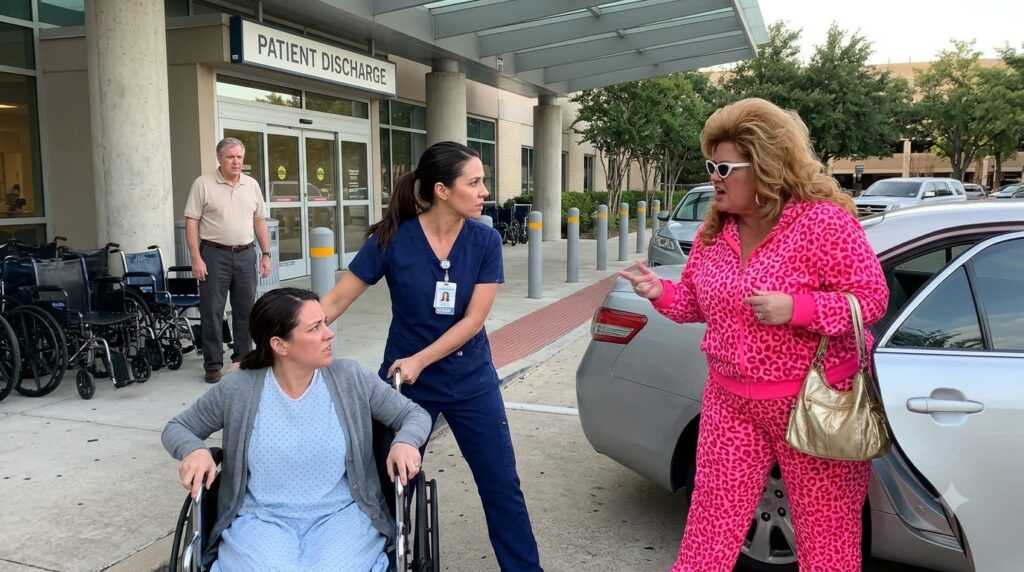
At 2:17 p.m., Margaret’s wheelchair was positioned beside Rachel’s sedan.
Angela was standing near the open rear passenger door.
Margaret was preparing to transfer.
Linda entered the frame from behind.
She approached quickly, grabbed both wheelchair handles, and pulled.
The chair rolled backward.
Margaret’s shoulders jerked.
Her hands flew toward the armrests.
Angela reacted immediately.
Then came Linda’s confrontation, followed by the car-door slam and the attempt to block access.
Patricia watched without speaking.
The video had no usable audio from the covered driveway, but the physical sequence was unmistakable.
Daniel paused the footage.
“There’s something else.”
He moved the recording backward.
Linda and Thomas had arrived nearly four minutes before the incident.
They had come through the automatic doors after an appointment in the outpatient orthopedic clinic.
Thomas had stopped beside the row of empty wheelchairs.
Linda had continued toward the curb.
Then she had turned, pointed at Margaret’s occupied chair, and walked toward it.
Patricia leaned forward.
“She passed the available chairs?”
“Yes.”
Daniel replayed the sequence.
Thomas could be seen gesturing toward an empty wheelchair.
Linda waved him off.
Then she approached Margaret.
Patricia sat back.
That detail mattered.
Linda had not mistaken the occupied chair for the only available option.
She had chosen to interfere with a patient already using it.
The second security officer enlarged the frame showing the wheelchair’s rear wheels.
“Look here.”
When Linda pulled, the wheelchair crossed a seam in the concrete.
The movement was abrupt enough to make Margaret’s upper body pitch forward before she caught herself.
Daniel recorded the timestamp.
Patricia instructed him to preserve the footage under the hospital’s incident-retention procedure and restrict access to authorized personnel.
She also asked for the names of witnesses.
Angela was one.
Thomas Whitcomb was another.
A patient transport attendant had seen the confrontation from inside the lobby.
And a woman waiting in a nearby vehicle had approached security afterward to say she had witnessed the entire incident.
Her name was Evelyn Parker.
She was sixty-eight, a retired accountant from Sugar Land, and she had been waiting to pick up her older sister.
Evelyn had seen Linda yank the wheelchair.
She had also seen Margaret recoil when the car door slammed.
Evelyn offered her contact information.
“I know what I saw,” she told Daniel. “And I don’t want that poor woman thinking nobody noticed.”
Daniel thanked her.
Meanwhile, Linda was becoming increasingly impatient.
She had been asked to remain in a designated waiting area while hospital security documented the incident.
Thomas sat nearby in the wheelchair the attendant had provided.
He had barely spoken.
Linda paced in front of him.
“This is ridiculous. They’re acting like I attacked somebody.”
Thomas looked up.
“You pulled her chair.”
“I moved it.”
“She was sitting in it.”
Linda stopped pacing.
“Whose side are you on?”
Thomas rubbed his forehead.
He had heard that question many times during their thirty-four years of marriage.
It usually appeared whenever Linda wanted agreement more than she wanted the truth.
He had learned that silence was often the quickest way to end an argument.
But today, silence had begun to feel different.
He remembered Margaret’s frightened expression.
He remembered the nurse rushing forward.
He remembered Linda slamming the car door while the patient sat helplessly nearby.
And he remembered the empty wheelchairs.
Thomas looked at his wife.
“You didn’t have to do any of that.”
Linda stared at him.
“You’re embarrassing me.”
He lowered his eyes.
For years, he had accepted that accusation whenever he disagreed with her in public.
This time, however, he did not apologize.
Across the hospital, Rachel was sitting beside her mother’s bed when the physician returned.
The laboratory results were reassuring, but Margaret’s pain remained significant enough that he wanted to keep her overnight for observation.
Rachel felt relief and frustration at once.
There was no evidence of an immediate surgical emergency.
But her mother had lost the chance to recover in the comfort of her own home.
Margaret looked toward the window.
The Houston afternoon was fading into evening.
“Your father would have hated this,” she said softly.
Rachel smiled sadly.
“He would have had plenty to say.”
Margaret’s husband, Robert, had been a quiet man until someone mistreated a person who could not easily defend themselves.
Then he became remarkably difficult to silence.
Margaret had always admired that about him.
She wondered when she had begun believing that standing up for herself was somehow impolite.
Rachel seemed to read her thoughts.
“Mom, we’re going to make sure this is documented.”
Margaret nodded.
But she had one concern.
“I don’t want my name all over the internet.”
Rachel understood immediately.
Her mother had never liked attention.
She did not want strangers discussing her medical condition, watching her frightened reaction, or turning a painful afternoon into entertainment.
“We won’t post anything,” Rachel promised.
That evening, Patricia called Rachel with an update.
The footage had been preserved. Witness statements were being collected. The hospital’s patient safety office would review the incident.
Then Patricia mentioned another detail.
Linda Whitcomb had filed a complaint.
Not about her own conduct.
About the hospital’s refusal to provide her husband with the wheelchair Margaret had been using.
Rachel stared at the phone.
“She filed a complaint against the hospital?”
“Yes,” Patricia said. “And we’re handling it through the appropriate process.”
Rachel looked toward her sleeping mother.
The woman who had caused the incident was now trying to present herself as the injured party.
Rachel had no idea how far Linda intended to take that claim.