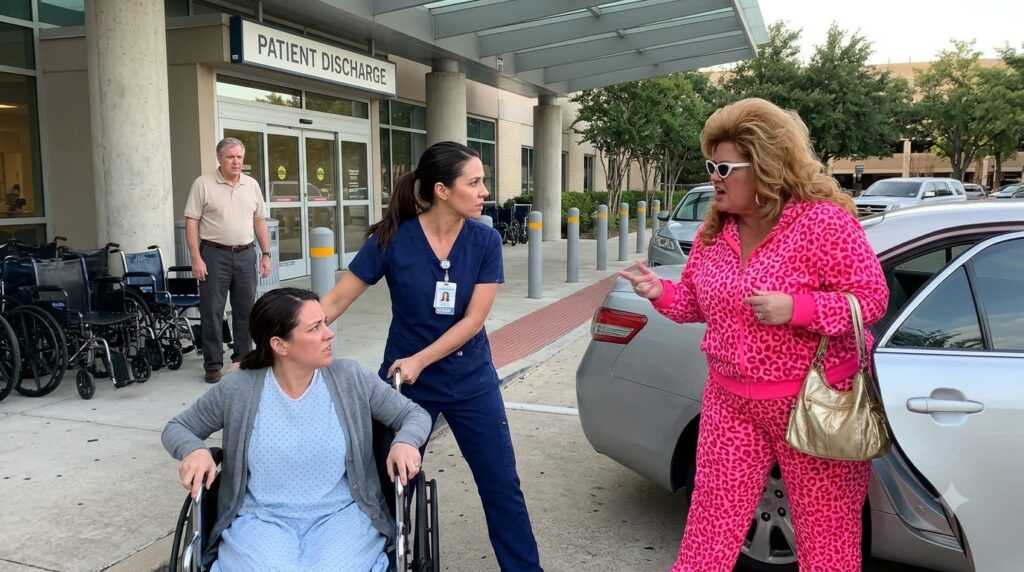
Chapter 7: The Woman Behind the Wheelchair
Margaret’s recovery was slower than she had hoped.
Her incision healed normally, and her surgeon was satisfied with her progress.
But she remained cautious.
The first time Rachel suggested taking her for a short drive, Margaret hesitated.
She was not afraid of cars.
She was afraid of being vulnerable in public.
The distinction frustrated her.
She had spent decades teaching children that fear became smaller when they understood it.
Now she was discovering how difficult it could be to follow her own advice.
One morning, Carol Jenkins arrived with fresh biscuits and found Margaret standing beside the front window.
“You look like you’re planning an escape,” Carol said.
Margaret smiled.
“Maybe I am.”
Carol had been her neighbor for twenty-two years.
They had shared holiday dinners, borrowed garden tools, and helped one another through the ordinary hardships of aging.
Carol knew when to offer advice.
She also knew when to sit quietly.
They settled at the kitchen table.
Margaret told her about the hesitation she felt whenever she imagined returning to a crowded public place.
Carol listened.
Then she said, “You spent forty years helping other people feel welcome. Don’t let one rude woman convince you the world belongs to her.”
Margaret looked down at her coffee.
She remembered the library where she had worked.
Children arrived there with every kind of need.
Some were shy.
Some were angry.
Some struggled to read.
Some came from homes where nobody had time to listen.
Margaret had always believed that dignity was not something people earned by being easy to accommodate.
It belonged to them already.
She had defended that belief for other people.
Now she needed to apply it to herself.
A week later, she asked Rachel to take her to the neighborhood garden center.
It was a small outing.
Just twenty minutes among plants and gardening supplies.
But Margaret wanted to choose new flowers for the front porch.
Rachel agreed immediately.
They parked close to the entrance.
Margaret moved slowly, holding the shopping cart for support.
She paused near a display of yellow chrysanthemums.
The scent of damp soil and fresh leaves reminded her of Robert.
He had loved gardening.
When his Parkinson’s disease made walking difficult, Margaret had brought chairs into the yard so he could sit beside her while she worked.
She remembered helping him into those chairs.
She remembered how carefully he had tried to preserve his independence.
And she remembered the anger he sometimes felt when strangers spoke to her instead of addressing him directly.
He had never wanted special treatment.
He had wanted ordinary respect.
Margaret stood among the flowers, thinking about the wheelchair at the hospital.
It had not been a prize.
It had not been a symbol of privilege.
It had been a tool allowing her to move safely when her body could not manage alone.
Linda had treated that need as an obstacle.
Margaret chose three pots of chrysanthemums.
Then she asked Rachel if they could stop for lunch.
Rachel looked surprised.
“Are you sure?”
Margaret nodded.
“I think I’m ready.”
They went to a quiet diner where Robert had once ordered pancakes every Sunday.
Margaret sat near the window.
She ordered tomato soup and half a turkey sandwich.
The meal was ordinary.
That was exactly why it mattered.
Meanwhile, Thomas was making changes of his own.
He had begun attending physical therapy more consistently.
His knee was improving.
He also started visiting his older brother, James, who lived across town.
James had always been more outspoken than Thomas.
When Thomas explained what happened at the hospital, James listened without interruption.
Then he asked a difficult question.
“How long have you been cleaning up after Linda?”
Thomas considered it.
He thought about restaurant managers, store clerks, neighbors, and family gatherings.
He thought about the apologies he had offered on Linda’s behalf.
He thought about the times he had told himself that keeping peace was an act of loyalty.
“Too long,” he admitted.
James did not suggest abandoning his marriage.
He suggested something more practical.
“Start telling the truth at home, too.”
Thomas took that advice seriously.
He told Linda that he would not participate in false complaints or pressure witnesses.
He also told her he would no longer accompany her into businesses if she intended to intimidate employees.
Linda accused him of choosing strangers over his wife.
Thomas replied that he was choosing behavior he could live with.
Their marriage did not improve overnight.
There were tense dinners and long silences.
But Thomas no longer accepted responsibility for every uncomfortable moment Linda created.
Several weeks after the hospital incident, Denise Walker called Margaret.
The patient relations office had received a request from Linda’s attorney.
Linda wanted to send a written apology.
Denise made clear that Margaret was under no obligation to receive it.
Margaret sat quietly with the phone in her hand.
She had accepted Thomas’s letter.
Linda’s was different.
An apology could be meaningful.
It could also be another attempt to control the story.
Margaret asked whether she could read it without agreeing to respond.
Denise said yes.
When the letter arrived, Margaret opened it at the kitchen table.
The first paragraph expressed regret that the incident had become upsetting.
The second explained Linda’s concern for her husband’s mobility.
The third suggested that the situation had been misunderstood by everyone involved.
Margaret read the letter twice.
Then she placed it beside her cup of tea.
Rachel asked what she thought.
Margaret considered her answer carefully.
“She regrets the trouble,” she said. “But she still hasn’t said what she did.”
Rachel nodded.
Margaret folded the letter.
She would not respond.
Not yet.