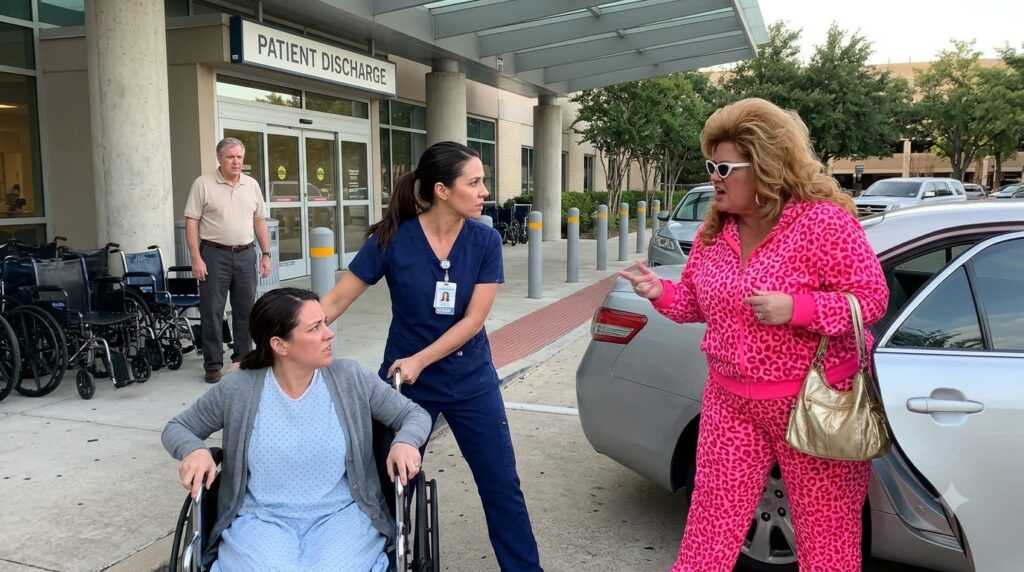
Chapter 4: The Complaint That Changed Everything
Linda Whitcomb had never liked being told no.
In her mind, rules existed to keep other people from taking advantage of her.
If a restaurant refused to seat her before a reservation, she complained.
If a store would not accept an expired coupon, she demanded a manager.
If a neighbor parked too close to her driveway, she photographed the car and sent messages to the neighborhood association.
She considered herself assertive.
Thomas had another word for it, though he rarely said it aloud.
Exhausting.
The morning after the hospital confrontation, Linda sat at her kitchen table in their suburban Houston home, typing a formal complaint on her laptop.
She had already told several friends that hospital employees had humiliated her disabled husband.
Thomas had asked her not to describe him that way.
He had undergone knee replacement surgery months earlier, and although he occasionally needed help walking long distances, he had not been denied assistance at the hospital.
An attendant had provided him with a wheelchair almost immediately.
Linda ignored that distinction.
Her complaint alleged discrimination, disrespect, and improper treatment by hospital staff.
She claimed that a nurse had refused to help Thomas and that security had threatened her for requesting reasonable accommodation.
She omitted the wheelchair yank.
She omitted the car-door slam.
And she omitted the empty wheelchairs.
Thomas watched her type.
“Linda, that’s not what happened.”
She did not look up.
“I know what happened.”
“You grabbed that woman’s chair.”
Linda’s fingers stopped.
“She was being selfish.”
Thomas stared at her.
The word seemed to hang in the kitchen.
Selfish.
A woman recovering from surgery had been sitting in a wheelchair provided for her discharge.
Linda had physically pulled her away from her ride home.
Yet somehow, in Linda’s version, the patient was the selfish one.
Thomas pushed back his chair.
“Don’t put my name on that complaint.”
Linda turned sharply.
“What?”
“I don’t agree with it.”
For a moment, she seemed more surprised than angry.
Thomas rarely challenged her directly.
Especially not when she was already upset.
“You’re my husband.”
“I know.”
“Then you should support me.”
Thomas looked toward the framed photograph on the kitchen counter.
It showed them on their wedding day, standing beneath an arch of white flowers.
They had been younger, thinner, and full of plans.
He remembered how Linda had once volunteered at church fundraisers and brought meals to sick neighbors.
He remembered her sitting beside his mother during chemotherapy, reading magazines aloud because the older woman was too tired to hold them.
He had loved her kindness.
Over the years, however, something had changed.
Linda had become increasingly convinced that any inconvenience was a personal insult.
Thomas had spent so much time smoothing things over that he barely noticed when ordinary embarrassment became a constant part of his life.
He looked back at her.
“Supporting you doesn’t mean saying something happened when it didn’t.”
Linda slammed the laptop shut.
“Fine. I’ll handle it myself.”
Later that afternoon, Patricia Vaughn received the formal complaint.
She read it carefully.
Then she reviewed the incident report and the preserved video.
The contrast was substantial.
Patricia forwarded the complaint to the hospital’s patient relations department and legal counsel for appropriate review.
She also requested a separate examination of whether the discharge entrance needed additional safety measures.
Not because the hospital had caused Linda’s behavior.
But because the hospital had a responsibility to protect patients from foreseeable interference.
The review identified several practical improvements.
The row of transport wheelchairs could be marked more clearly.
A staff member could remain near the entrance during peak discharge hours.
And the transfer area could be separated more visibly from general pedestrian traffic.
Patricia approved those changes.
But she refused to let the operational review distract from Linda’s individual responsibility.
The footage showed an occupied wheelchair being moved without consent.
That fact would not disappear because Linda filed a complaint.
Meanwhile, Margaret remained in the hospital.
Her pain had improved overnight, and her physician found no evidence of a new internal injury. The sudden movement had likely aggravated already tender tissues around her surgical site.
She was medically stable.
Emotionally, she was less certain.
Whenever she closed her eyes, she remembered the sensation of the wheelchair moving without warning.
She had spent the night worrying that someone might approach her from behind again.
Rachel noticed that her mother kept looking toward the doorway.
“Mom, do you want me to ask someone to close the door?”
Margaret shook her head.
“No. I want to be able to see who’s coming.”
Rachel sat quietly beside her.
She wanted to tell her mother that the incident was over.
But she knew that would be too simple.
An event could end in seconds and still follow someone for days.
A patient advocate named Denise Walker visited Margaret that afternoon.
Denise was in her late fifties, with a calm voice and a habit of listening without interrupting.
She explained the hospital’s reporting process, available support services, and Margaret’s options for making a statement.
Margaret asked one question first.
“Will that woman get to see my medical records?”
“No,” Denise assured her. “Your medical information remains protected.”
Margaret exhaled.
Then she asked whether the security footage would be posted publicly.
Denise explained that the hospital would handle the recording through its security and legal procedures, not release it for public entertainment.
That mattered enormously to Margaret.
She wanted accountability.
She did not want publicity.
After Denise left, Margaret asked Rachel for a pen.
She began writing her account of the incident in careful, deliberate handwriting.
She described the wheelchair moving backward.
The pain.
The stranger’s demand.
The slammed door.
And the fear of being unable to reach her own car.
At the bottom, she added one sentence.
I was a patient trying to go home, and I deserved to be treated like a person.
Rachel read it twice.
Then she looked away before her mother could see the tears gathering in her eyes.
That evening, Daniel Mercer received a call from the hospital’s legal department.
They wanted the preserved footage and witness information prepared for a meeting with the responding police officer.
Linda’s complaint had not stopped the review.
It had ensured that every detail would be examined more closely.