
CHAPTER 9: THE TOTAL INVENTORY
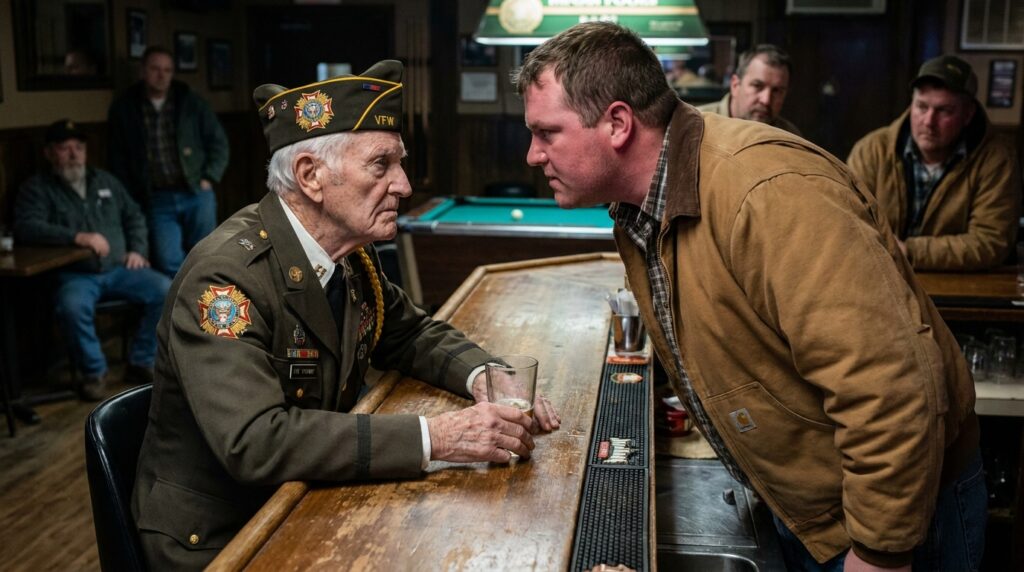
“The gate padlock doesn’t change the alignment of the tumblers, Miller,” Calvin said.
The iron door of the unassigned repository didn’t give way with a clean swing. It ground against the damp concrete floor of the cellar, its heavy steel plates pitted by sixty years of river damp and coal dust from the old railroad line. The smell inside was immediate—not the sour beer and pine sap of the tavern, but the ancient, desaturated scent of frozen iron, dry ledger paper, and the bitter grease used to seal military packing crates before the records went black.
The elder Miller brother stood exactly three feet from the iron cabinet, his gray state uniform jacket unbuttoned at the throat to let the chilled cellar air hit his skin. His flashlight—the heavy three-cell club—lay flat on top of the green-painted metal, its yellowed beam slicing through the floating coal dust to illuminate a single, three-digit stamp stamped directly into the steel: 382. He wasn’t reaching for his belt loop anymore. His hands were braced against his hips, his posture displaying the heavy, flat exhaustion of an administrator who had run out of tracking numbers.
“The marshal’s vehicle just cleared the county line bridge, Calvin,” Miller said. His voice didn’t have the administrative oil left in it; it was flat, thin, and dry as a winter leaf scraping across asphalt. “He’s got the district audit team with him. If those ledger books are still in the cabinet when the log is signed, the whole valley pool goes into receivership. My family’s yard won’t have enough credit to buy fuel for the haulers by Tuesday morning.”
Calvin didn’t look at the stairs behind him. He could hear the low, rhythmic ticking of his truck’s cooling manifold through the open foundation grate—a steady mechanical countdown echoing off the wet limestone walls. He stepped into the light of the flashlight, his boots dragging through a thin crust of gray saltpetre that had grown along the floorboards over fifty winters. The coarse wool of his service uniform jacket was stiff with the river fog he’d driven through, the tarnished brass buttons catching the yellow beam like old coins dug out of a garden.
“Your yard has been running on unassigned timber quotas since seventy-six, counselor,” Calvin murmured. He reached into his pocket, his calloused thumb sliding along the cold edge of the notched brass wedge. He didn’t use an economy of movement; he laid the key flat on top of the green steel, directly beside the flashlight casing. The film of oxidized tallow on the metal was dark green, smelling of old ordnance. “Your father didn’t build that business out of credit. He built it out of the six books sitting behind this latch.”
The younger Miller—the stocky one—remained near the bottom of the masonry steps. His chest was still bound tight beneath his duck jacket, his breathing coming in short, shallow hitches that rattled his ribs every time he shifted his weight against the damp stone wall. He didn’t look at Calvin with the raw local dominance he’d used at the zinc counter. His eyes were fixed on the five file-cut teeth of the brass key, tracing the manual adjustments Calvin had ground into the metal with a hand tool when the delta run was closed.
“The names aren’t in there, are they?” the stocky one asked, his voice cracking under the pressure of the subterranean quiet. “My brother says it’s just numbers. Just coordinates and shipment logs with no government headers.”
“The names don’t need a voucher,” Calvin said. He didn’t wait for the elder Miller to move. He gathered the key into his fingers, slid the heavy brass tang into the narrow vertical keyway below the stamp, and turned his wrist.
The mechanical shift inside the door was massive—a slow, scraping clunk of ungreased iron bars sliding out of their floor sockets. The friction was so heavy it vibrated through the soles of Calvin’s boots, a dull, physical reminder of the weight his brother Caleb had dropped when he signed his separation papers at the junction depot.
The door swung six inches, its top hinge giving a high, metallic shriek that cut through the low rumble of the river outside. Inside the shelf, six uniform volumes sat side-by-side in the dust. Their covers weren’t leather; they were made of heavy, gray pressed fiberboard, water-stained along the margins and bound with iron rivets that had turned the paper around them the color of dried blood. There were no institutional labels. No department insignias.
The elder Miller reached out a clean, clipped finger and touched the spine of the first book. “If the marshal takes these, Calvin… Caleb’s name goes into the public ledger. The separation stays dishonorable. The whole state will see the fraud.”
“The state only sees what fits in the column, son,” Calvin said, his rasp dropping into that final, level iron register that left no room for administrative argument. He reached past the officer’s hand, his old fingers locking around the gray fiberboard bindings, and pulled all six volumes into the crook of his arm. The weight was substantial—the literal mass of forty-five years of unrecorded labor, paid for with the silence of a dead brother and a coat that had never been taken off. “Caleb didn’t die for the ledger. He died so the yard could keep its tractors rolling while the rest of us were cleaning the grease out of the delta. The audit’s over.”
From the top of the stairs, the first blue flash of the marshal’s light bar cut through the cellar grate, throwing a rhythmic, rotating shadow across the limestone foundation like a blue sickle cutting through the dark. The sound of balanced tires crunching onto the depot gravel was uniform, cold, and final.
Calvin didn’t tuck the books into his coat lining. He held them openly against his chest, his boots turning toward the masonry steps with the same unhurried, perfectly balanced stance he’d used when Miller first crowded his space at the bar counter. The false bottom of the valley had been cleared away, and the absolute reality of the ninety-second command was about to walk up into the cold night air to face the ledger.








