
CHAPTER 6: THE IRON AUDIT
The thread didn’t snap with a clean pop; it unraveled with a slow, fibrous drag that Calvin felt all the way through the calloused skin of his index finger. The notched brass key lay in his palm, cold, flat, and coated in a thin, greenish film of oxidized tallow and old grease. It was an unyielding wedge of metal, five inches long, its teeth ground down manually with a hand file to match an iron lockbox that had never existed on any public inventory.
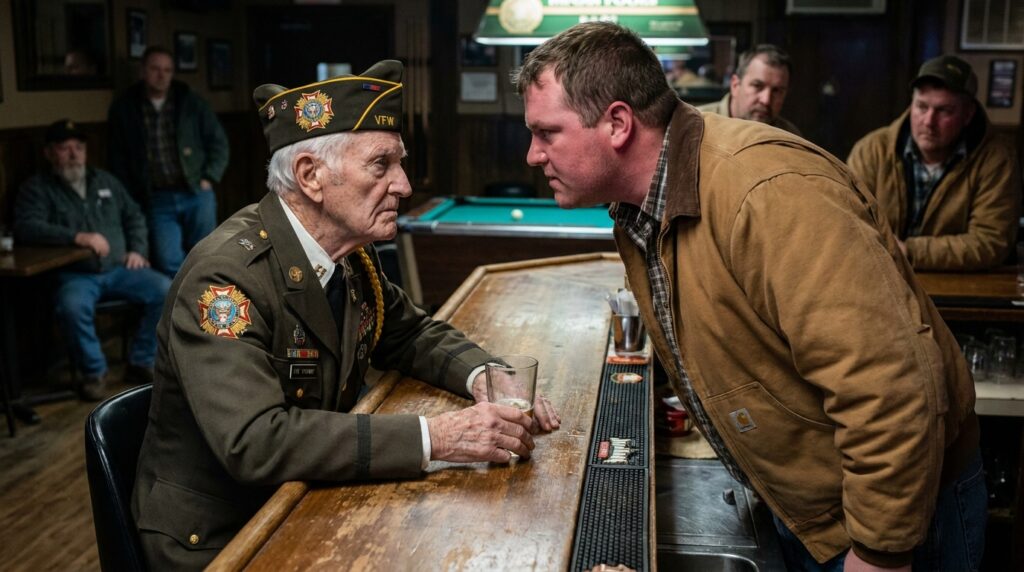
The state officer—the older Miller brother—didn’t draw the three-cell flashlight from his belt, but his shoulder dropped three inches, his center of gravity tilting over his boots to match Calvin’s leverage. He knew the family name wouldn’t hold a perimeter if the old man decided to clear his front for a second time. The desaturated glow of the blue neon beer tube caught the side of his plastic name-tag, casting a thin, sharp shadow across the gray fabric of his shirt like a pencil line drawn on slate.
“The lining’s empty, counselor,” Calvin said. His voice was a dry, hollow rattle now, the rasp of a dry well-pump scraping against gravel at the bottom of the casing. He didn’t drop the key. He held it flat against the zinc, the iron scent of his skin mixing with the stale malt that rose from the pine floorboards. “Everything I ever carried is sitting right on top of the wood.”
The younger Miller—the one who had taken the pool table frame with his ribs—wasn’t outside in his truck anymore. His silhouette appeared behind the mesh of the screen door, his broad, stocky frame leaning against the cedar jamb to relieve the pressure on his left flank. He didn’t push the door open. He stood in the humid night air, smelling of diesel smoke and wet limestone, watching his brother try to collect an account that had been running for fifty-four winters.
The officer looked down at the brass key, then at the yellowed separation paper bearing the name Caleb Vance. His hand remained level over the cash register, his fingers twitching in a slow, administrative calculation. “The state has a record of the lockbox, Mr. Vance. It’s been sitting in the basement of the depot at the junction since the seventy-two flood. They call it an unassigned repository. No name, no allocation. Just a three-digit stamp on the iron.”
“The stamp’s three-eight-two,” Calvin murmured. He didn’t lift his whiskey glass. The gray condensation ring had dried completely, leaving a salt-crust on the unvarnished oak counter. “And there’s nothing in that iron but six ledger books written in purple ribbon ink. No names. Just numbers and lat-long coordinates for six coordinates in the delta.”
The bartender took a breath, a short, wet rattle through his nose that broke the stagnant air behind the beer taps. He looked at the paper, then at the key, his face turning the color of skimmed milk under the low-wattage bulbs. “Caleb was your brother, wasn’t he, Calvin? The one who went down in the valley pool before the timber lines were cut.”
Calvin didn’t look at the boy. He kept his eyes locked on the gray uniform jacket before him, tracking the slight, rhythmic movement of the officer’s breathing. Time seemed to slow down, dilating until the intervals between the mechanical rings of the telephone in the back hallway felt like minutes. He could feel every individual thread of his wool coat—the weight of it, the heat it held against his ribs, the old cedar smell that had survived three decades of dark closets.
“Caleb didn’t go down in the pool,” Calvin said. The words came out slow, heavy, like iron plates dropping into wet clay. “Caleb was nineteen when he panicked at the crossing. He signed the separation papers because they told him it was the only way to avoid the stockade at the junction. I took his name because the command structure didn’t issue receipts for the things we did on the other side of the line. The ninety-second didn’t exist on the state pool, counselor. If you audit that ledger in the cellar, you aren’t going to find an account for the Miller family. You’re just going to find the names of the men who didn’t come back to sign the vouchers.”
The officer’s hand dropped an inch away from his belt. The administrative arrogance in his jaw didn’t collapse; it simply stiffened, turning into the hard, silent recognition of a man who had finally found the boundary of his own authority. He looked at the key on the zinc, then at his brother’s broken silhouette against the screen door. The state pool was an engine that ran on paper, but the iron Calvin was holding had been forged before the ledger was even printed.
“The file says dishonorable,” the officer whispered, his voice losing its oiled, transactional tone, dropping into the raw, flat register of the valley. “My father said a man who carries that kind of stamp doesn’t have a right to a seat at the table.”
“Your father spent the war maintaining the air compressors at the depot, Miller,” Calvin said. He didn’t look up as he slid the brass key back across the oak, leaving a thin, greenish trail through the wood-dust. “He knew how to hold a pressure line, but he never had to live inside the tank. The paper’s a lie. The brother’s dead. The coat’s exactly as heavy as it was when I put it on in sixty-nine.”
The room stayed frozen. The two regulars by the jukebox didn’t move their quarters; their boots remained aligned with the floorboards, their eyes fixed on the yellowed paper that had ceased to be an interrogation and had become a monument. The bartender slowly reached out, his hand steady now, and picked up the fresh whiskey glass he had set down fifteen minutes ago. He didn’t offer it on the house; he simply set it directly on top of the typewritten name, pinning the old lie under four ounces of amber fluid.
Outside, the phone in the back hallway gave one final, truncated clink before the line went dead, the silence returning to the tavern floor like a layer of dry, unbrushed soot. Calvin closed his fist over the empty seam in his trousers, feeling the loose threads where the nylon had torn away, a small, ragged gap that would remain open long after the light bar on the sedan had cleared the gravel lot.








