
CHAPTER 3: THE WEIGHT OF THE THRESHOLD
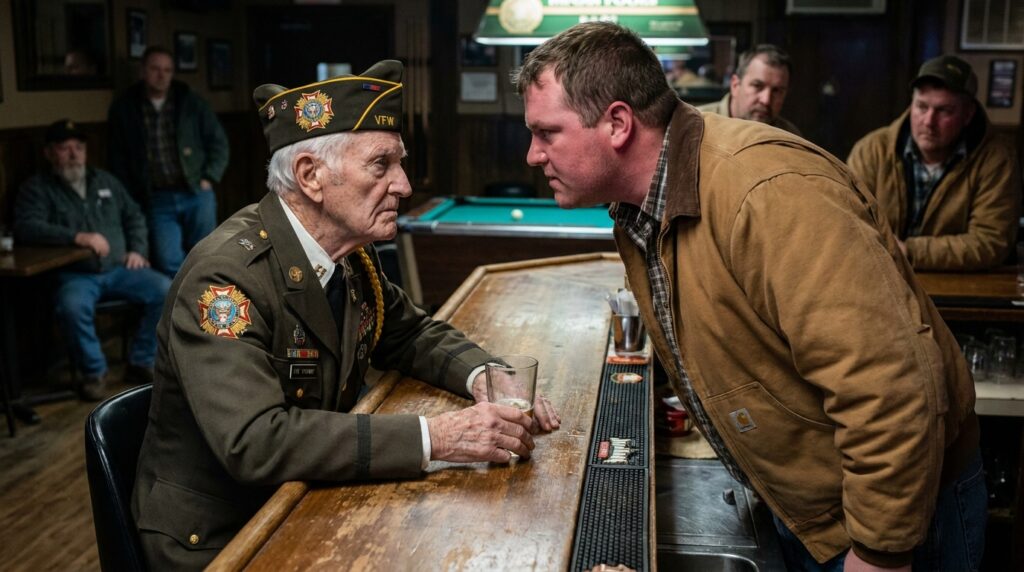
“The inventory doesn’t open for men who bleed as easy as you do, Miller,” Calvin said.
The silence that followed was not empty; it was the heavy, pressurized quiet that settles inside an engine block right before the piston snaps. The low hum of the beer cooler seemed to vibrate through the soles of Calvin’s boots, a dull reminder of old generators humming in buried concrete bunkers. Miller didn’t back off. The younger man’s chest rose, the thick duck fabric of his work jacket straining against a broad, solid frame built from generations of unchallenged rural authority. He didn’t understand leverage; he only understood bulk.
“You’ve been talking down from that stool for ten years, old man,” Miller spat, his voice dropping into a throat-clearing rasp that signaled the end of his patience. “But the ground down here is exactly the same for everybody. Let’s find out how much of that coat is just empty wool.”
Miller’s left hand left the zinc counter, a quick, heavy arc intended to hook Calvin by the collar of his service uniform jacket and drag him down onto the oil-stained pine floorboards. It was a projection of raw mass, unguided by technical discipline—the classic opening movement of a man who spent his life wrestling tractor tires and fence posts.
Calvin didn’t lean away. To retreat was to give up the structural rigidity of the barstool. Instead, he allowed his left shoulder to drop slightly, inviting the contact, absorbing the friction of Miller’s calloused palm against the coarse fabric of his sleeve. The moment Miller’s weight committed forward, Calvin’s right hand moved. It was a brief, economical economy of movement, a single arc that had nothing to do with anger and everything to do with physics. His thumb remained hooked near the small ridge where the brass key lay hidden, using that localized tension to anchor his wrist.
With his left arm pinned, Calvin used the counter’s iron edge as a fulcrum. He didn’t strike; he simply reset his hips, planting his heel into a knot in the floorboards where the wood had dried out and splintered over fifty winters. The grease on the floor provided a dangerous slide, but Calvin’s boots had deep, cross-hatched rubber soles that caught the grain of the fir. He reached up, his right fingers finding the structural gap beneath Miller’s armpit—the soft junction where the brown work coat met the flannel shirt.
“The road is closed,” Calvin murmured, his breath steady, his eyes locked on the tiny white scar beneath Miller’s ear.
Miller’s momentum was already too massive to check. He had anticipated a soft collapse, the brittle yielding of an octogenarian’s frame. Instead, he encountered a structure that felt like an iron hitching post driven deep into the bedrock. Calvin’s forearm became a rigid bar, transferring the kinetic energy of Miller’s own rush back into his collarbone. The friction was immense—the sound of heavy cotton ripping along a seam, the sharp clink of the three-and-a-half-inch framing nails shifting inside Miller’s pocket.
The younger man’s balance vanished. His boots skidded across the dark circle of grease near the taps, his center of gravity tilting toward the open floor behind him. Calvin didn’t pursue. He simply sustained the pressure for three inches, a disciplined defensive shove that utilized Miller’s own overextended mass to clear his immediate front. The physical reordering of the space was instantaneous. Miller’s bulk drifted back into the gray shadows where the light from the neon beer sign couldn’t reach, his hands clawing at the empty air as his heels caught the edge of the frayed green felt.
The pool table sat exactly where Calvin had mapped it—forty-two inches from his stool. The corner bracket was made of cast iron, rusted to a dark cocoa color and pitted by decades of spilled beer and sweat. It was an unyielding boundary, a hard edge that didn’t care about family names or regional land holdings. When Miller’s hip struck the timber frame, the sound was like an axe hitting an old stump—a hollow, splintering thud that rattled the heavy slate slab underneath and sent three pool balls rolling into the pockets with a sequence of dull, iron clicks.
The bartender didn’t shout. The regulars by the jukebox froze, their hands suspended over their pockets, their faces pale under the desaturated yellow light of the dangling lamps. Nobody moved to help. In this valley, when an established weight was suddenly shifted, men waited to see where the dust settled before they chose a side.
Calvin remained on his stool, his left hand returning to the zinc counter, his fingers resting within an inch of the gray condensation ring. His heart rate hadn’t spiked; his breathing remained a slow, rhythmic draw through his nose, smelling the iron filings and the sour malt that had risen from the floorboards during the disruption. His service uniform jacket was still straight, the brass buttons aligned, though a faint smell of old cedar had been knocked loose from the wool by the exertion.
On the floor beside the pool table, Miller lay among the sawdust and the dry husks of peanuts, his breath coming in short, ragged gasps as his brain tried to calculate how forty-two inches of space had disappeared so quickly. His brown work coat was pulled up around his chin, the pockets inverted, the framing nails scattered across the oak boards like old teeth.
“You’re done here, Miller,” Calvin said, his voice flat, level, and entirely devoid of heat. “Go home and fix your fence.”








