
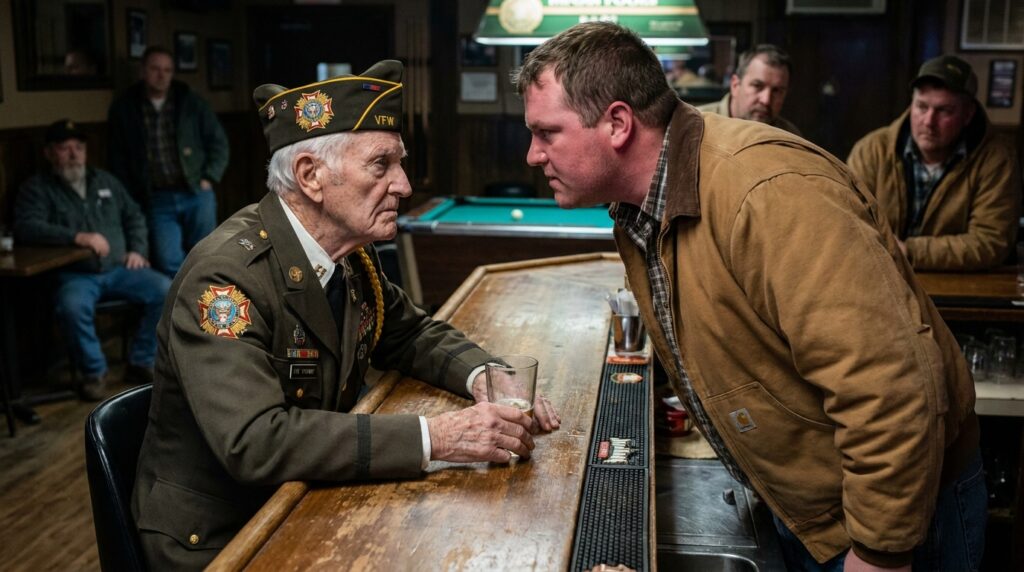
CHAPTER 5: THE PRICE OF AUDIT
“Let it ring,” Calvin said.
The bartender’s hand remained frozen three inches above the iron lever of the register, his eyes darting from the yellowed document on the zinc counter to the dark hallway where the mechanical bell continued its rhythmic, metallic strike. Every vibration of the telephone seemed to draw more dust from the uninsulated drywall. The regulars by the pool table didn’t go back to their quarters; they stood like old fence posts in a shifting fog, their shadows long and hard against the grease-stained floor.
“It’s the seven-four exchange,” the boy whispered, his voice dry, stripping away the defensive casualness he usually maintained behind the bar. “Nobody calls out of that exchange unless they’re looking for the timber records or the marshal. You know what’s on that paper, Calvin. If Miller’s old man got to a phone before he reached the county road—”
“I know exactly what’s on the paper,” Calvin interrupted. He didn’t lift his fingers from the oak edge. The slow, rhythmic ache in his left hip had sharpened into an iron spike, but his spine remained flat against the vertical support of the barstool. He reached out with his left hand, the coarse wool of his sleeve rasping against the zinc, and turned the paper ninety degrees so the typed name—Caleb Vance—faced the kid directly. “Read the date at the bottom. Not the stamp. The ink.”
The bartender leaned closer, his breath hitching as he checked the tiny, purple ribbon-tinted digits in the corner of the document. “Nineteen sixty-nine. That’s before the valley pool was logged out.”
“That’s before your father had a mortgage on this roof,” Calvin said. He slid his thumb down to his trouser seam, his skin catching the hidden ridge where the notched brass key remained sealed in its dark oilcloth wrapper. “A man doesn’t carry a dead brother’s bad paper for fifty years just to show it to a clerk. He carries it because it’s the only receipt that doesn’t have a government tracking number on the back.”
The phone stopped ringing on the eighth stroke, its sudden absence leaving a hollow, pressurized quiet that made the hum of the beer coolers sound twice as loud. The smell of sour malt seemed to rise through the cracks in the floorboards, thick and greasy, clinging to the back of Calvin’s throat. He didn’t look back toward the screen door, but his ears tracked the distinct crunch of dry limestone gravel outside—not a truck’s heavy dual-axle rumble, but the light, uniform tread of a sedan with balanced tires.
One of the regulars near the jukebox cleared his throat, a sharp, wet sound that cut through the silence. “Calvin, there’s a light bar on the roof of that car. It ain’t the sheriff.”
Calvin didn’t turn his head. He watched his reflection in the amber bottle across the zinc. He could see the small white scar beneath his own chin, the silver tissue left by a fragment of an intake valve that had shattered during an unlogged run through the delta forty-five years ago. The world outside this valley thought it could audit a man’s inventory by looking at a ledger, but a real inventory was written in the friction of iron against bone.
The screen door opened. The rusted spring didn’t click this time; someone held the cedar frame against their palm, allowing the humid evening air to flood the tavern floor with the scent of wet asphalt and ditch-weed. The silhouette that stepped into the desaturated light wore a gray, unstructured uniform jacket—no brass buttons, no ribbons, just a black plastic name-tag that sat perfectly level over the left pocket.
“Calvin Vance?” the man asked. His voice wasn’t loud. It had the smooth, oiled delivery of an inspector who spent his life checking serial numbers on state property. He didn’t look at Miller’s scattered framing nails or the dent in the pool table’s timber frame. His eyes went straight to the yellowed paper lying on the zinc counter.
“The name’s on the wood,” Calvin said, his rasp level and unhurried. He didn’t move his hand away from the glass. “You’re about six miles past your regional boundary, counselor.”
The officer stepped forward, the heavy leather of his duty belt creaking with a dry, mechanical squeak that matched the rhythm of his stride. He stopped two feet from the stool, his bulk blocking the light from the neon sign, throwing Calvin’s face into deep, desaturated shadow. He didn’t reach for his holster, but his fingers remained hooked near the iron ring of his flashlight—a heavy, three-cell club that had seen service on harder roads than this one.
“The state doesn’t have boundaries when the paper’s fraudulent, Mr. Vance,” the man said. He reached down with two fingers, his nails clean and clipped, and touched the yellowed edge of the discharge. “This file was flagged out of the regional repository three hours ago. A man down at the depot said someone was trying to verify a service record with a dead name.”
The bartender took a step back, his boots dragging on the duckboards, his hand dropping completely away from the cash register. “He didn’t show it to nobody here,” the boy lied, his voice cracking slightly under the pressure of the gray uniform. “It just fell out of his coat when he—”
“Shut up, son,” Calvin said, not looking back. He kept his eyes locked on the officer’s plastic name-tag. It read Miller. Not the stocky bully who had gone over the pool table, but the older brother—the one who had gone to the capital ten years ago to work the administrative logistics for the district court. The inventory wasn’t just a local dispute anymore; the family was using the state’s teeth to collect the debt Miller had dropped in the sawdust.
“Your brother needs to learn how to fall,” Calvin murmured, his right hand finally leaving his knee. He didn’t reach for the paper. Instead, his fingers slid into the hidden fold of his trousers, his nails catching the heavy thread that sealed the notched brass key. With a single, sharp pull born of old, calloused strength, he snapped the nylon line. The key slid into his palm, cold, heavy, and smelling of the lubricating grease he’d used to keep it from rusting inside his clothes since the year the river froze over. “He thinks because a man’s old, his leverage goes soft.”
The officer’s eyes shifted to Calvin’s closed fist, his posture stiffening as his weight shifted back onto his heels. He recognized the mechanical precision of the movement—it was the same lack of deceleration that had sent his brother across the green felt thirty minutes ago. “You’re carrying more than a bad record, aren’t you, old man? Let’s see what else is in the lining of that coat.”
The regulars didn’t step forward. The room remained perfectly static, a desaturated tableau of old iron and dry timber, while the phone in the back began its dry, mechanical ring for the second time, louder now, like an alarm indicating that the main valve had just failed.








