
CHAPTER 2: TESTING THE METAL
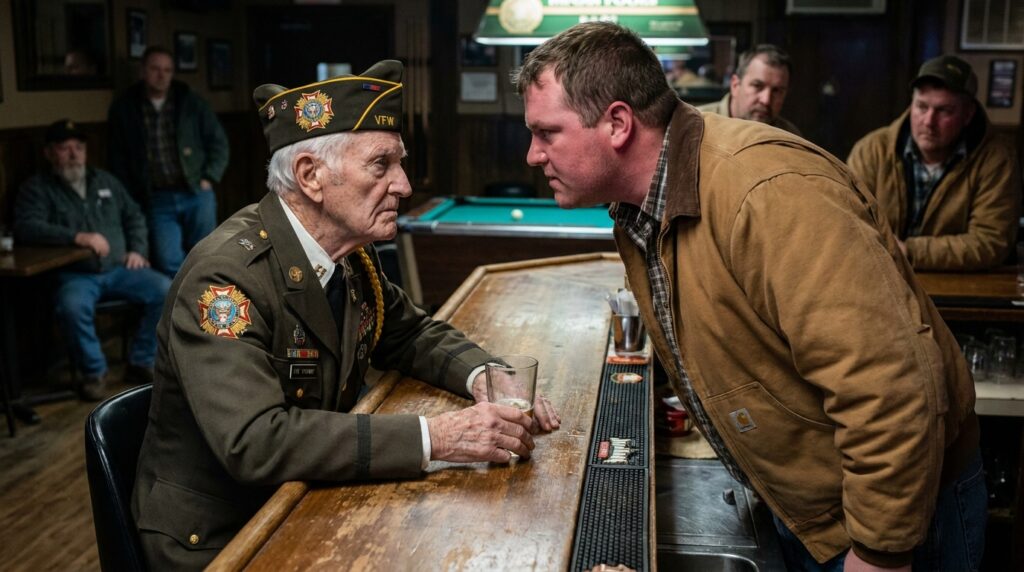
“A man who spends too much time looking at the floor usually finds what he’s looking for,” Miller said. He didn’t drop his arm. Instead, he rotated his wrist, bringing a thick, blunt thumb down onto the zinc counter. The friction of his calloused skin against the metal made a sharp, dry scraping sound that cut straight through the low hum of the beer coolers. “And right now, you’re looking at a lot of old dirt.”
Calvin didn’t blink. The desaturated light from the neon sign overhead—a sputtering blue tube that hummed in a broken three-beat rhythm—cast long, gray shadows across Miller’s face, emphasizing the deep, grease-stained lines around his mouth. This was the testing phase. In the field, a perimeter wasn’t breached with an immediate rush; it was probed with small, repetitive movements designed to map the defense’s reaction times. Miller was mapping.
“I’ve seen enough dirt to know what stays buried,” Calvin replied. He shifted his weight by a fraction of an inch, his boot leather creaking against the grit on the floorboards. The movement was internal, a tightening of the oblique muscles that anchored his spine against the backrest of the stool. “And what rots when it gets rained on.”
Miller laughed, a short, dry bark that lacked any real humor. He shifted his bulk, his hip crowding closer to Calvin’s left side, the rough brown duck fabric of his work jacket scraping against the faded wool of Calvin’s service coat. “You talk real authorized for a man who doesn’t have a badge or a tractor. This whole town’s tired of the phantom routine, Calvin. We got people trying to run a business here, and then you walk in looking like a walking monument that forgot to get buried.”
Calvin didn’t answer with words. He let the silence stretch, heavy and thick with the smell of iron and sour malt. In the reflection of the amber bottles, he watched the bartender’s hands. The young man had stopped wiping the tap. His fingers were locked around the edge of the zinc sink, his knuckles turning the color of skimmed milk under the low-wattage bulbs. He knew the weight of Miller’s family name in this valley; he knew who owned the paper on the roof over his head.
Miller leaned in further, his breath hot and smelling of cheap tobacco and charred meat. “Let’s see the brass, old man. You got all these ribbons pinned to your chest like they mean something down at the bank. Let’s see what happens when we start counting ’em.” He reached out, his thick fingers hooking toward the lower edge of Calvin’s lapel, his intention clear—to pull the fabric forward, to break the older man’s posture, to turn the uniform into an interrogation.
Calvin’s hand didn’t move from the bar counter, but his thumb slid an eighth of an inch to the left, touching the small, stiff ridge in the seam of his trousers where a notched brass key was stitched into the lining. It was a mechanical anchor, a physical reminder of things that remained locked. The metal was cold against his skin through the pocket cloth, a stark contrast to the stifling, grease-heavy air of the tavern.
“The medals aren’t for counting,” Calvin said, his voice dropping an octave, losing its dry rasp and hardening into something flat and level, like a iron plate dropping onto stone. “And your fingers are too dirty to touch that wool.”
Miller’s hand froze an inch from the tarnished brass buttons. His eyes narrowed, the small white scar beneath his ear turning a dull, angry purple as the blood rushed to his jaw. He didn’t pull back. The lack of deceleration in Calvin’s posture was a variable he hadn’t accounted for in his initial probe. In his experience, age always brought a softening, a slight roll of the shoulders, an instinctive tuck of the chin to protect the throat. Calvin sat as straight as a steel surveyor’s stake driven into frozen clay.
“You think you’re the only one who knows how to hold a line?” Miller whispered, his voice tightening as he dropped his center of mass, preparing to use his stocky build to force Calvin off the stool by sheer leverage. “This valley doesn’t owe you a clearing, old man. We’ve been paying your rent in silence for ten years. It’s about time we checked the inventory.”
Beyond Miller’s shoulder, the two regulars by the pool table had stopped their game entirely. One of them held his cue vertically, the blue chalk on the tip catching a stray beam of light from the dangling shaded lamp. The green felt of the table looked old, frayed at the pockets where the iron brackets had worn through the wool—a rusted boundary waiting for a body to break it. Calvin tracked the distance between the edge of that table and his own left heel. Forty-two inches. A single clean pivot on the ball of the right foot would clear the stool and establish the necessary friction against the floorboards to counter a forward rush.
“The inventory’s closed,” Calvin murmured, his eyes locking onto the exact point where Miller’s work jacket bunched at the armpit—the structural weakness in the younger man’s stance. “Think about your knuckles before you open it.”








