
CHAPTER 7: THE JUNCTION RUN
The second-gear synchro didn’t catch until the lever was forced four inches past the gate, its iron teeth barking against the flywheel with a dry, metallic shudder that rattled the dashboard pins. Calvin didn’t lift his boot from the clutch. He held the steering wheel—a thick, cracked circle of black vinyl wrapped in electrical tape—with his left hand, while his right thumb remained anchored against the notched brass key now tucked into his service jacket’s interior pen slot.
The headlights of the old high-bed pickup were dim, their yellowed glass lenses pitted by decades of river-gravel and road salt, throwing two uneven cones of light across the limestone dust of the county road. Ahead, three hundred yards through the low hanging river fog, the red taillights of the gray sedan danced along the ridges of the washboard dirt. The elder Miller wasn’t using his light bar. He was running flat, his rear tires kicking up a thick, choking cloud of gray powder that smelled of dried silt and old sulfur.
Calvin didn’t close the distance. To crowd a state vehicle on a single-lane timber road was to invite a PIT maneuver from a car that carried three times his braking capacity. Instead, he timed his speed by the low, rhythmic thumping of his own left rear tire—a recap that had been separating from the carcass since the spring rains. Every four rotations, the rubber gave a dull, hollow thwack against the wheel well, a mechanical clock tracking the miles left before the tread turned to rags.
On the floorboards beside the gearshift, a small, notched iron oil-can rolled with every turn of the road, its brass spout clicking against the rusty seat frame. The can was empty, but the residue inside had turned to a sticky, black varnish over twenty years, smelling of tallow and heavy gear oil. It was the same fluid Calvin had used to grease the lock box hinges back when the depot at the junction still had a station master.
The road began to tilt downward, dropping into the gap where the valley pool had been logged out in the early seventies. The trees here were different—second-growth scrub pine that grew thin and crowded, their branches scraping against the truck’s side mirrors with the sound of dry fingers dragging across canvas. The fog was thicker near the bottom, tasting of river moss and the wet, iron-heavy mud that never truly dried out between the pilings.
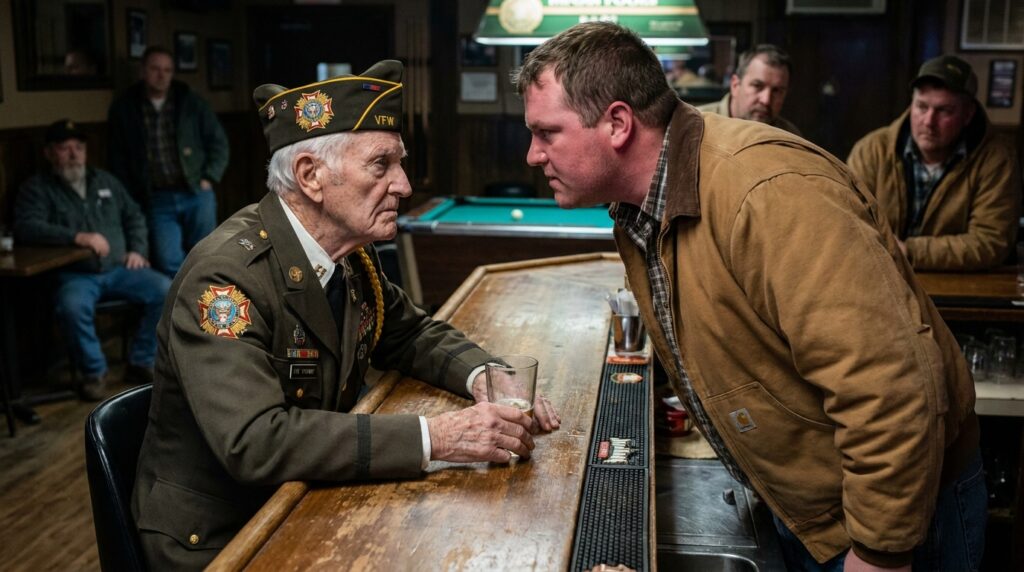
In the small rectangle of the rearview mirror, Calvin watched the tavern light fade to a dull orange smudge against the ridge line. The regular patrons would still be standing by the zinc counter, their eyes fixed on the fresh glass of whiskey that was currently holding down the edges of his brother’s bad paper. They wouldn’t talk about the throw; they wouldn’t talk about the name Caleb Vance. In a valley that lived on the margin of the timber quotas, men didn’t discuss an old debt until the collection truck had already cleared the county line.
The sedan ahead slowed its pace, its brake lights flaring into two bright, blood-colored discs through the gray mist. The road was narrowing here, preparing for the crossing at the old iron bridge—a three-span Pratt truss built before the first war, its deck made of unanchored oak timbers that rattled like loose teeth whenever a load crossed the channel.
Calvin let his foot slide off the accelerator. He didn’t use the brakes; the shoes were thin, and the heat would fade them to nothing before he reached the junction depot. He allowed the engine’s compression to drag the truck down, the heavy four-speed transmission whining in a high, mechanical register that echoed off the clay bluffs to his right. Through the windshield, he could see the gray sedan’s nose dip as it hit the approach timbers, the sound of the loose wood hitting the iron stringers rolling back through the fog like a series of distant, muffled shots.
“Six miles to the repository,” Calvin murmured to the dark cab. His rasp was dry, his tongue catching on the salt of his own skin.
He reached down, his fingers finding the iron spout of the rolling oil-can, steadying it against the transmission hump as the truck’s front tires took the first oak plank. The vibration was massive, a loose, shuddering judder that started in the steering box and traveled straight up his arms into the stiff wool of his shoulders. The bridge didn’t have a guardrail—just two rusted iron channels, four inches high, that had been bolted to the timber deck when the logging trucks still used the run. One wrong calculation on the wheel, one slide on the slick, river-wet wood, and the high-bed would go over the lip into thirty feet of black water that had been silted up by fifty years of gravel washing.
Beyond the bridge, the road split. The left fork went up toward the high ridge where the Miller family kept their equipment yards; the right fork dropped into the old ditch where the railroad tracks had been pulled up in seventy-six. The sedan’s right turn signal didn’t flash, but the car’s mass leaned heavily into the ditch run, its rear bumper scraping the limestone outcrop as it cleared the bridge frame.
Calvin followed. He didn’t adjust his mirror. He didn’t need to see what was behind him; the only inventory that mattered was currently rolling through the weeds three hundred yards ahead, and the lock was already waiting for the key in his pocket.








