
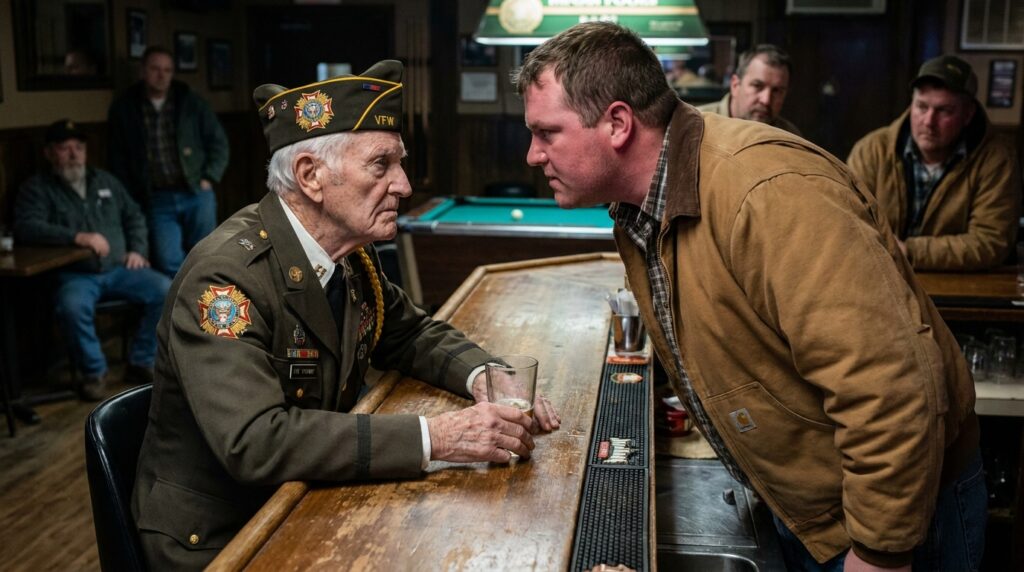
CHAPTER 4: THE REVERSAL OF FRICTION
“Alright,” Miller said. The word was wet, broken by the taste of copper and the dust that had accumulated on the floorboards since the last sweep. He didn’t try to lift his shoulders off the pine. His hands stayed flat against the grit, his fingers twitching slightly as the scattered framing nails settled into the grooves around him. “Alright, I get it.”
Calvin didn’t lower his chin. His gaze remained anchored to the small white mark behind Miller’s ear, treating the man’s sudden compliance as another variable to be measured rather than a victory to be celebrated. In his experience, a perimeter that collapsed too quickly was usually an invitation to an ambush. He let his right hand drop back to his knee, his fingers skimming the stiff seam where the notched brass key remained sealed. The iron in the air was thicker now, stirred up by Miller’s heavy landing against the pool table’s rusted corner casting.
“You’re done here, Miller,” Calvin repeated. The rasp in his throat didn’t fluctuate. It carried the dry, mechanical rhythm of an old windlass locking into a greasy sprocket. “Take your iron off the floor.”
The regular by the jukebox—the one holding the cue vertically—slowly lowered the timber shaft until the rubber bumper clicked against his boot. His partner didn’t make a sound. The silence in the room had changed its texture; it was no longer the passive waiting of a crowd watching a bully work. It had become the hard, desaturated quiet of men who had just seen a machine they didn’t understand operate with perfect economy.
Miller rolled onto his flank, his work coat bunching around his ribs like a torn tarp. He gathered his boots under his weight, the friction of his heavy rubber soles against the grease-spotted wood making a low, rhythmic grunt. He didn’t look at Calvin as he reached out to gather the framing nails. His fingers scraped against the floorboards, collecting the silver spikes two at a time, his knuckles gray with wood dust and old soot. When he finally stood, his center of gravity was broken, his shoulders sloping inward to protect the cracked rib where the timber frame had caught him.
He didn’t speak again. He walked toward the screen door, his boots dragging through the sawdust near the threshold, leaving two dark, uneven tracks that ended at the gravel lot outside. The door didn’t slam; the spring was old, rusted to a dull orange coil that pulled the cedar frame back into the jamb with a soft, hollow click.
Calvin watched the reflection in the amber bottles until the gray shape of Miller’s truck cleared the gravel turn at the county road. Only then did he allow his shoulders to drop a quarter of an inch. The ache in his left hip was a slow, grinding heat—the price his eighty-year-old bone paid for holding ninety pounds of rushing mass against a zinc counter. It wasn’t an injury; it was simply the friction of survival.
The bartender didn’t approach immediately. He spent thirty seconds picking up an empty pint glass, his fingers unsteady against the rim, before he moved down the duckboards to where Calvin sat. He didn’t use the wet rag this time. He set a fresh glass on the oak counter, the base clicking against the wood exactly two inches from Calvin’s left thumb.
“On the house, Calvin,” the boy said, his voice thin, lacking the grease of his usual tavern hospitality. “He won’t be back before the weekend.”
Calvin looked at the glass. The amber fluid inside was clear, but it didn’t interest him. His eyes were tracking a small, square edge of white paper that had worked its way out of his own breast pocket during the brief physical exertion. The wool had stretched where the brass buttons were sewn, and through the gap in the fabric, the corner of the document looked dry, brittle, and yellowed by thirty years of stale air.
He reached up with two fingers, his movements deliberate, and pulled the paper free. It wasn’t his name on the header. The faded typewritten letters spelled out Caleb Vance—a name that didn’t exist in the county records, followed by a stark, red ink stamp that marked the file as a dishonorable separation from the service.
The bartender’s eyes dropped to the paper, his expression hardening as he read the classification through the low-wattage light of the dangling lamp. The reverence that had settled into the room after the throw seemed to evaporate, replaced by a colder, sharper curiosity. In a blue-collar valley, a uniform was an armor, but a fraudulent paper was a lie that no amount of leverage could fix.
“That’s not your name, Calvin,” the boy murmured, his hand retreating from the fresh glass until it rested on the iron edge of the cash drawer. “My father said you came out of the ninety-second with a citation. This says something else.”
Calvin didn’t tuck the document back into the seam. He let it lie on the zinc, the yellowed edge curling upward under the heat of the neon tube above them. He could hear the regulars by the pool table shifting their feet, their boots clicking against the floor as they moved closer to the bar channel, their silent compliance turning into something heavy and transactional. The false bottom of his life had just cleared the surface, and the price of his victory over Miller was about to be collected in full.
“The paper belongs to the coat,” Calvin said, his rasp dropping into the quiet space between them. “The coat belongs to the room. If you want to check the inventory, son, you better make sure you can carry the weight.”
From the back of the room, near the darkened hallway that led to the office, a phone began to ring—a dry, mechanical bell that had no business waking up a tavern at this hour. The bartender didn’t move to answer it. He kept his eyes on the yellowed paper, his knuckles locking onto the iron handle of the register as the first real danger of the night began to knock against the wall.








