
CHAPTER 1: THE ACCRUAL OF FRICTION
The cold iron edge of a buckled belt shouldn’t rattle against a barstool unless a man’s center of gravity has already shifted toward violence.
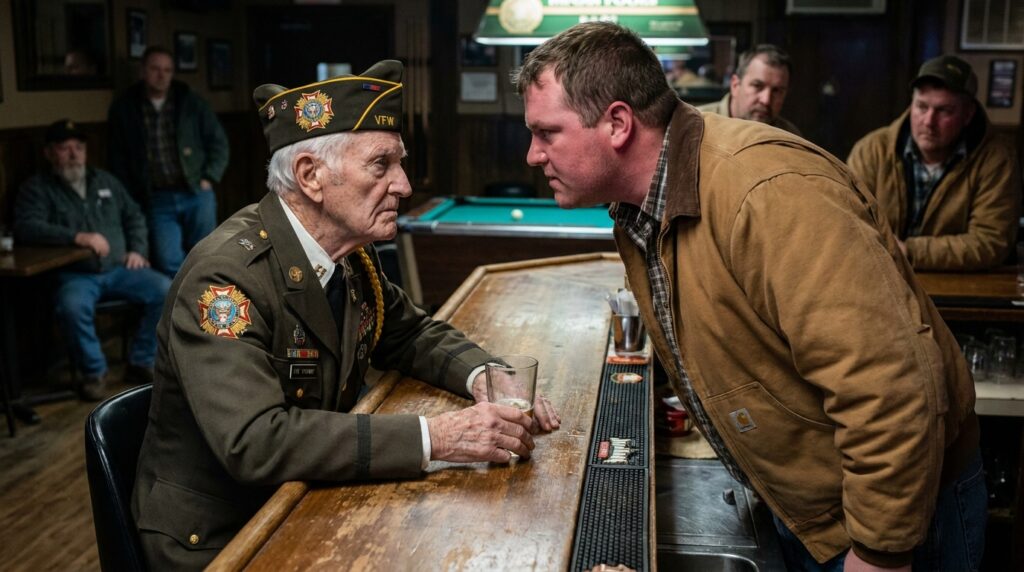
Calvin didn’t look down at the buckle, nor did he look at the stocky forearm currently occupying the six inches of air directly above his own left sleeve. The wool of his service jacket was old, heavy with the scent of cedar chests and the dry, alkaline dust of a parade ground he hadn’t seen since the winter of ninety-two. The brass buttons were tarnished to the color of wet sand, but they were still secure, held by thick nylon thread he’d sewn himself with a curved sail-maker’s needle.
“You’re in the wrong booth for a circus, old man,” the voice beside him was thick with the grey fat of cheap lard and twenty years of unchallenged local weight. It belonged to Miller, a man whose family name was still stenciled onto the rusted grain hoppers outside the town line. Miller smelled of diesel exhaust and stale tobacco—the kind of labor that didn’t know the difference between building something and simply wearing it down.
Calvin let his fingers remain flat on the zinc counter. The glass of ditch-water and cheap whiskey sat three inches from his thumb, its condensation leaving a grey ring on the unvarnished oak underneath. The wood was deeply grooved by forty years of sliding mugs and metal coins, split along the grain lines where the moisture had gotten in during the wet seasons. He didn’t lift the glass. To lift the glass was to change the angle of his elbow, and an altered elbow meant giving up the clear three-inch channel between his ribs and the counter’s lip.
“The jacket’s clean,” Calvin said. His voice didn’t have the gravel of a theatrical threat; it had the dry, rhythmic rasp of an old pump handle left out in the weeds behind a well-house. “The road’s clean too, if you walk it straight.”
A couple of three-and-a-half-inch framing nails were rolling around in Miller’s open jacket pocket, clicking together like dry teeth every time the younger man leaned another half-inch forward. In the reflection of the mirror behind the rows of dark amber bottles, Calvin could see the rest of the room. The two men by the jukebox hadn’t moved their quarters from the glass top, but their boots had turned ten degrees toward the bar. The bartender, a boy with the graying temples of someone who had inherited a debt rather than a business, was wiping the same spot on the beer tap with a rag that had long since ceased to be dry.
“My uncle had a coat like that,” Miller said, his shoulder dropping slightly, the brown duck fabric of his work coat bunching where the grease from an auger line had stained it black. “Died in a ditch in Biloxi before he ever saw a boat. Took three weeks to get the smell out of the upholstery. I don’t much care for the smell of old wool.”
Calvin watched the condensation on his glass. A single drop, heavy with the salt of the room’s humidity, broke from the rim and ran down the side, cutting a clean path through the film of grease on the exterior. He timed it by the steady hum of the compressor in the coolers below—three seconds for the drop to reach the zinc.
“You’ve got three inches of clear wood between your hip and mine, son,” Calvin murmured. He didn’t turn his head. He could see the small white scar just below Miller’s left ear, the jagged kind left by a broken fan belt or a sloppy hook. “That’s about two inches less than a man needs to keep his teeth where they were born.”








