
CHAPTER 9: The Registry Sale
The epoxy binding the handle of the colonel’s mug was dark, uneven, and smelled faintly of vinegar and cured polymer. It was an unglamorous fix, the kind executed with a cold flashlight blade between shifts, meant only to keep the fluid from leaking onto the logistics desk.
I didn’t reach for the cup. My left hand moved to the edge of the iron desk, my fingertips tracing the coarse, rough canvas covering the three ledger books. The fibers were stiff, treated with paraffin wax to resist the damp limestone seepage that ran down the gray concrete wall five feet behind the colonel’s shoulder. When I drew the top volume toward me, the iron hinges of the cabinet behind us gave a low, dry whine—the sound of ungreased metal under pressure.
“Open it to the green separator,” Vance said. He didn’t drop his right hand from his side, but his weight shifted slightly off his heels, his wire-rimmed glasses catching the greasy amber light of the utility heater. “You’ll find your own allocation code next to the logistics stamp for Fort Meade. Two hundred thousand dollars, cleared through a holding firm registered in Delaware.”
The paper inside was heavy, double-weight ledger stock with vertical ink lines that had faded from purple to a dull, rusted gray. The columns were written entirely by hand—not in Vance’s standard left-leaning scrawl, but in the small, round, characterless script of an administrative clerk from the regional payroll depot.
My thumb caught the edge of the green cardboard divider. The sequence was there. My full name, my old deployment serial number, and a five-character alphanumeric routing block that ended in three parallel grease-pencil strikes. The exact same mark ground into the lintel above the tunnel mouth outside.
“That’s the disposal log,” I said. The words didn’t bounce off the concrete; they were absorbed instantly by the heavy, moisture-laden air of the cell. “This isn’t a transit registry, Marcus. It’s an invoice.”
Vance didn’t flinch at the use of his name. His white hair remained perfectly level beneath the low clearance of the structural ceiling beams. “A transit lane doesn’t run on air and well-wishes, son. Every mile of asphalt between here and the Ohio border costs four hundred dollars in fuel, blind eyes, and local enforcers who don’t ask why a black hoodie has blood on the cuff. The collection firm didn’t steal the list. They bought it from the man who gave you your retirement citation.”
The room seemed to rotate an inch on its axis, the chemical smell of the burning kerosene wick turning rancid against the back of my throat. The entire structure of my two-year exile—the quiet warehouse lot, the cold coffee in lonely diners, the belief that I was simply a piece of discarded military surplus left to rust—was an illusion. The section hadn’t been abandoned. We had been liquidated, item by item, to pay for the maintenance of the very grid we thought we were escaping.
“Miller knew,” I murmured, my thumb flattening against the dry paper till the ink left a gray shadow on my skin.
“Miller’s the one who negotiated the margin,” Vance said, his hand finally coming out of his sweater pocket, revealing the dull matte finish of a compact automatic pistol. He didn’t level the barrel; he simply rested the frame against the edge of the desk, his thumb pinned to the safety catch with professional casualness. “He stays in that kitchen because the state police don’t check the grease traps for serial numbers. But the buyers aren’t satisfied with the ledger anymore. They want the inventory cleared before the fiscal audit next month.”
A sudden, sharp vibration rattled the iron equipment lockers against the partition. It wasn’t the rhythmic thud of the crawlspace generator this time. It was a single, high-frequency impact from the primary adit tunnel—the distinct clink-shatter of a hemlock roof prop splitting under an external torque.
The second cousin hadn’t stayed in the drainage ditch with his axe. He had used the tool on the timber supports.
Vance’s eyes flicked to the orange seam under the door, his glasses slipping half an inch down his nose. The level of his voice didn’t rise, but the skin around his jaw turned the color of dry lime. “The collection crew just breached the wash-plant line. They aren’t looking for the registry, operator. They’re here to close the account.”
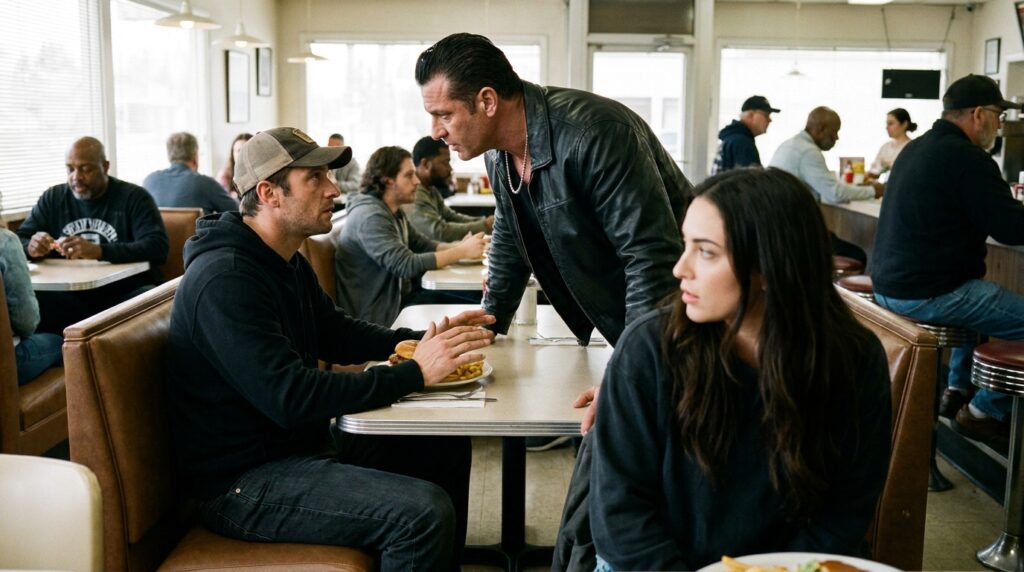
My right hand came out of my pocket, leaving the plastic capsule on the formica desk next to the epoxy-mended mug. My fingers were loose, my boots finding an even grip on the dry patch of concrete between the iron desk legs. The equal intellect opposite me didn’t move the weapon, but his shoulder hitched backward an inch—the identical micro-telegraph his enforcer had used down in the diner booth.
“The toll gate is three miles north,” I said, my voice dropping into the low, transactional flatline of the section. “And the flatbed truck doesn’t have the clearance numbers for the limestone track.”
“The flatbed is gone,” Vance said, his left hand reaching down to slide the top ledger into a coarse canvas sea bag. “And the only vehicle left with grease in the differential is the cook’s station wagon behind the coal bunker. You’ve got six minutes to decide if you’re a line item or a driver.”
The lock outside the steel hatch groaned—a long, agonizing shriek of rusted iron hinges being forced past their stop pins by a hydraulic spreader. The gray winter fog from the quarry began to pour beneath the orange seam, carrying the scent of wet shale and heavy machinery into the bunker.








