
CHAPTER 6: The Ultimate Baseline Resolution
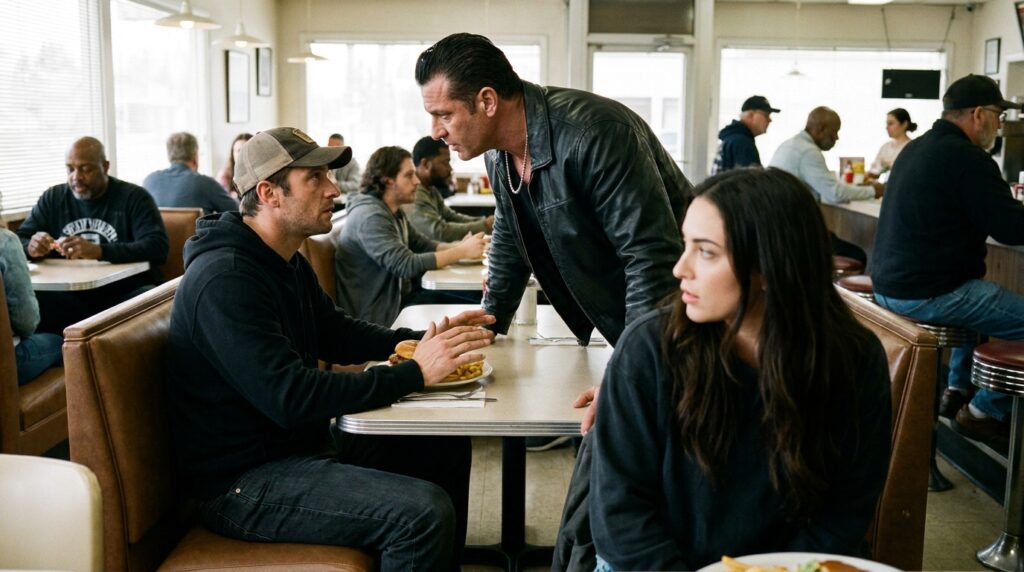
The frosted glass didn’t shatter; it caved inward under the weight of an iron prybar, sending long, crystalline spears of ice-crusted laminate across the booth seat.
Time didn’t rush. Under the high-decibel hum of the basement generator, the physics of the room slowed down to the single, heavy stroke of an engine cylinder. A shadow crossed the broken sill—one of the challenger’s cousins, a large, thick-necked man in a grease-stained canvas jacket, his knuckles white around a lengths of two-inch galvanized plumbing pipe. The scale on the metal was rusted, flaky, and smelled of oxidized iron.
My left hand didn’t go for a weapon. It reached across the formica, my fingers hooking into the handle of my old chipped mug. The cold porcelain felt heavy, an extension of my forearm bone. As the pipe swung inward, a wide, clumsy horizontal vector meant to clear the table line, I didn’t back away. I drove my mass forward, sliding off the sticky vinyl seat into the dead space beneath his arc.
The mug met the bridge of his nose with a dry, hollow crack. The ceramic shattered into three clean pieces, but the weight of my step carried the remainder of the porcelain base straight into his collarbone, driving him back through the window frame into the wet gravel of the timber lane. Transmission fluid from an old crane idling behind the ice machine pooled in the ruts outside, its sharp, purple chemical odor cutting through the smell of lard.
Miller didn’t fire. He stood by the brass cash register, his arm remaining rock-solid under the apron, his eyes tracking the second shadow passing the roadside door. “The extraction tunnel isn’t going to wait for your lungs, son,” the old man said, his dry throat barely clicking over the noise of the generator. “The toll gate drops in twelve minutes.”
My boots found the floorboards. I didn’t trace the path toward the back kitchen where the iron bolt had been thrown. I took three fast, short steps toward the front entryway, my shoulder striking the reinforced center post of the double doors. The wood was old, its grain split by fifty years of mountain winters, but the hinges had been greased with heavy military molybdenum.
A single lateral torque of my right hip against the latch rail sheared the secondary brass screws from the molding. The door flew outward, the desaturated gray light of the Pennsylvania hills hitting my eyes like a flash charge.
The world outside was a study in rust and lime. The parking lot was filled with the gray, broken ballast of abandoned railway beds. Two hundred yards up the slope, where the timber line died against the sheer face of the limestone quarry, the zinc vent pipes of the old transit bunker rose through the weeds like rusted periscopes.
The challenger was there, his leather jacket dark with the grease of the floor, standing beside a rusted flatbed truck with his three remaining kin. They weren’t moving down the hill; they were locking the chain on the main approach gate, their eyes fixed on the ridge where the blue strobe of a state cruiser was already cutting through the winter mist two miles out.
They had trapped themselves in the entrance lane, thinking the perimeter was designed to keep me inside the box. They didn’t see the structural flow of the valley.
I reached down into the pocket of my hoodie, my thumb sliding over the small plastic earplug capsule Miller had tossed. The yellow field paper inside was cold, dry, and contained the three grease-pencil coordinates that would override the concrete lock north of the toll gate. Marcus Vance was up there, five feet ten inches of a dead man’s legacy, waiting in the dark for a third-section signature that had been erased from the official archives two years ago.
“Hey,” a voice called from the broken window behind me.
I looked back over my shoulder. Miller had stepped through the ruptured frame, his canvas apron now hanging loose over his belt, his old service pistol held down against the seam of his dark jeans. His parchment skin looked transparent under the gray sky, but his grip was steady, the muzzle pointing toward the limestone gravel between my feet.
“You left your cap,” the old cook said.
I didn’t reach for the bill. The cold wind from the ridge was already lifting the hair from my forehead, carrying the smell of coal smoke and frozen mud down from the summits. The simple black cloth cap remained sitting on the table next to my broken egg plate—a marker left behind for the state troopers to file away in an empty drawer.
“Keep it,” I said, my voice flat against the whistle of the valley air. “I’m out of the registry.”
I turned my back to the diner and began to climb the slope, my boots catching the sharp edges of the fractured stone, my fingers tightening around the clearance capsule. The generator beneath the kitchen floorboards gave one last, heavy shudder and died, leaving the mountain silence to reclaim the road. Behind me, the blue light on the highway grew closer, but the path into the timber was already dark, gray, and completely unmapped.








