
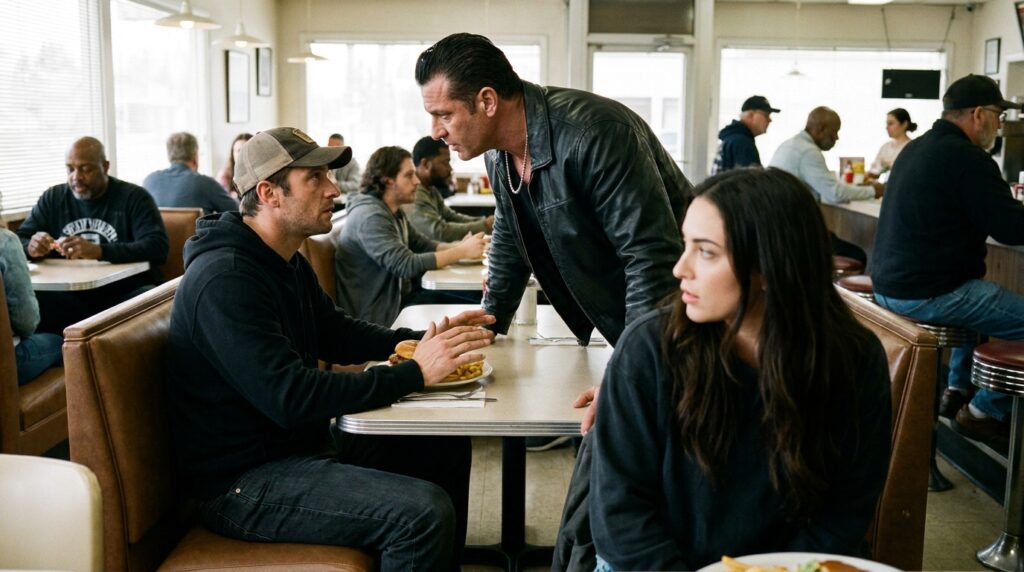
CHAPTER 3: The Room Changes Tone
The laminated card didn’t move, but it seemed to pull the remaining warmth straight out of the diner’s floorboards.
Marcus Vance had been buried in Section 60 at Arlington. I had touched the brass handles of the casket myself, watching the rain pit the dark Virginia clay while a secondary lieutenant stumbled through a prepared citation about sacrifice and structural integrity. Yet here, three feet from a grease-filmed table leg in western Pennsylvania, his digital signature caught the flickering blue glare of a faulty lottery sign in the window.
The challenger didn’t scramble for it. His breath came in heavy, liquid rattles, his boots making a dry, scratching noise against the base of the booth divider as he dragged himself six inches backward. The missing joint of his ring finger twitched, a raw pink stub of scar tissue clicking against the zinc lining of the floor rail. He was waiting for a executioner’s follow-up that wasn’t coming.
My right boot moved first. The leather of my sole rasped against the floor, stepping over his outstretched forearm with a deliberate lack of haste. I came down directly beside the card, my shadow swallowing the digital face of a dead man. I bent at the knees, my spine remaining straight, my weight centered over my heels so that if he lunged, his forehead would meet the point of my kneecap before his hands reached my laces.
My fingers took the plastic. The laminate was cold, stiff, and carried the faint, bitter smell of industrial cleaning fluid. When I flipped it over, the magnetic strip on the back was raw—scratched through with three parallel lines made by a safety pin or a diamond scribe, obliterating the verification sequence. A standard trick for clean field disposal, but whoever did this had left the signature block untouched.
“Where did you pull this?” I asked. My voice didn’t rise above the low hum of the pie cooler by the counter.
The challenger spat a dark string of saliva onto the linoleum. His leather jacket bunched around his neck as he pressed his back into the partition, trying to make himself smaller than the space allowed. “It’s none of your business, operator. You’re out. The registry says you’ve been dry for two years.”
Across the aisle, the young woman had lowered her coffee cup, but she hadn’t released the handle. The ceramic was cold now; the steam had died two minutes ago. Her eyes traveled from the blood on the man’s lip to the tiny piece of plastic between my fingers, trying to read a language she hadn’t been trained to see. Beyond her, the two truckers had slid three dollar bills onto the counter, their stools creaking with a slow, agonizing groan as they stood up, their bodies lowered to avoid drawing focus. They moved toward the exit like men walking through a minefield.
“The registry is six months behind on everything,” I muttered, my thumb finding the rough edge where the laminate had begun to peel near the seal. “Who gave you the billfold?”
He didn’t answer. His teeth clicked together, a sharp, nervous vibration that he tried to hide by biting his lower lip. His eyes flicked past my shoulder, toward the kitchen doors where the smell of burnt grease had turned sour and heavy.
A shadow broke the light from the small glass window in the swinging door. The metal handle rattled, a slow, deliberate sound of iron sliding against an oiled latch.
The diner owner—a thin man named Miller with skin like yellow parchment and an old grease apron tied tight around his hollow middle—stepped out onto the floor. He didn’t have a spatula or a rag in his hands. His right arm was tucked low, hidden beneath the stained canvas of the apron, his elbow pinned to his ribs in a configuration that suggested four inches of steel or five rounds of low-grain lead.
He didn’t look at the challenger on the floor. He looked at the card in my left hand, then at the chipped rim of the coffee mug still sitting on my table.
“The truckers left through the side entrance,” Miller said. His voice was thin, dry, like paper being dragged across sand. “They won’t call the county sheriff. They know what kind of county this is.”
“What kind is that, Miller?” I kept my eyes on the challenger, but my left heel shifted half an inch to face the apron.
“The kind where people stay in their seats until the food is cold,” Miller said. He stepped three inches closer, his boots making no sound at all on the linoleum. The grease on his apron was old, layered like the bark of a pine tree. “Give him his wallet back, son. He’s just the delivery boy.”
The challenger let out a long, shuddering sigh, his body relaxing against the wood as if the cook’s presence had adjusted the atmospheric pressure in the room. He reached out with his left hand—the one with the missing joint—and held his palm open, waiting for the plastic.
I didn’t give it to him. I slid the card inside the pocket of my black hoodie, my fingers curling around the stiff edges until the plastic bent slightly against my knuckles. The weight of the silver ring on my finger felt solid, cold, a permanent piece of ballast in an unstable room.
“He ruined my eggs,” I said, my voice flat, looking directly at the old cook. “And Marcus Vance doesn’t have a delivery service.”
Miller’s elbow moved half an inch under the canvas apron. The sound of a spring-loaded cylinder clicking into place was distinct, a small, metallic snap that everyone in that room understood.
“He does now,” Miller said. “And you’re the one who just signed for the package.”








