
CHAPTER 4: The Hidden Layer Reveals Itself
The sound of that cylinder shifting beneath the canvas was a precise, high-density metallic click. It wasn’t the sloppy snap of a cheap commercial revolver. It had the tight, dry tolerance of a military-issued weapon—the kind of tool meant to work when submerged in gray swamp water or buried under six inches of silt.
Old Miller stood three feet away, his yellowed apron hanging like a funeral shroud over his thin knees. He didn’t raise his hand, but the shape beneath the cloth remained perfectly level with my sternum. The smell of burnt lard coming from his skin was suddenly colder, sharp as zinc.
“Drop the billfold on the formica,” Miller said. His jaw barely moved. The light from the ceiling fixture caught the deep, vertical seams beside his mouth, turning his face into an ancient piece of carved pine. “The card stays where it is. In your pocket. But the boy gets his leather back.”
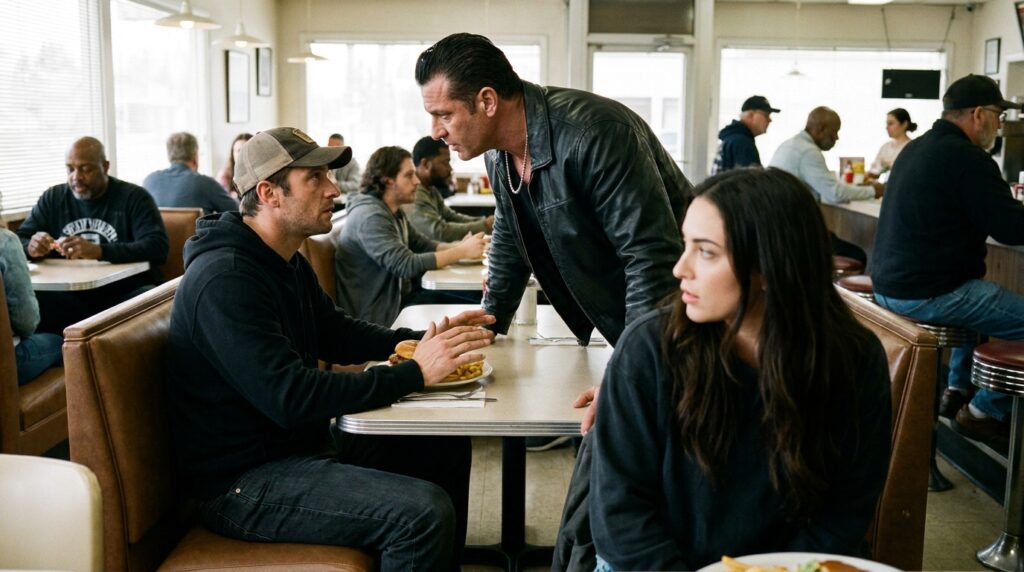
The challenger on the floor let out a ragged, wheezing breath. His good hand clawed at his chest, his fingers leaving red, sticky smears across the zinc rail as he dragged his heavy frame upright against the wood of the booth partition. The pink stub of his missing finger joint vibrated against his knee like an engine piston running out of oil. He didn’t look at me anymore; he kept his eyes on Miller’s apron, his posture shifting from aggressive dominance to the miserable compliance of an animal that knew the exact length of its chain.
My right hand remained deep in the pocket of my hoodie, my fingers locked around the plastic edge of Marcus Vance’s identification card. The thin, sharp corner pressed into the meat of my palm, a steady reminder of physical reality. My left hand stayed on the table, an inch from the chipped rim of my cold coffee mug.
“You’ve been holding this transit lane a long time, Miller,” I said. The words were flat, heavy, dragging against the low rattle of the pie cooler. “Since before the valleys went red in ’16.”
Miller didn’t blink. A fly landed on the greasy brim of his paper cap, stayed for three seconds, and flew away toward the dead neon sign. “I don’t keep records of the years, son. I keep records of the weight. And right now, you’re making the floorboards groan.”
He took one slow step forward. The leather of his work boots had been oiled so many times the surface looked like wet coal, but they didn’t squeak. He used his left hand—the free one—to reach down and grab the challenger by the shoulder of his black leather jacket. With a single, dry hitch of his back, the old man hoisted the two hundred and forty pounds of muscle off the linoleum as if he were pulling a sack of grain out of a truck bed. It wasn’t brute force; it was the practiced leverage of a man who spent his life handling carcasses.
The challenger stood unsteadily, his boots slipping once on his own blood before he found traction. His hand fumbled along the edge of the booth, his fingers catching a heavy brass key ring that had fallen from his pocket during the drop. I noticed the key ring wasn’t standard commercial steel—it was a heavy, milled piece of aircraft aluminum, stamped with a seven-digit numerical sequence that had been filled in with black epoxy. A field-grade equipment locker lock.
“Get in the back,” Miller told him without turning his head. “The truck’s idling behind the ice machine. Take the timber road until you hit the blacktop.”
The challenger didn’t speak. He didn’t even look back at his dropped chain. He simply grabbed his keys, his boots making a heavy, wet clicking sound as he retreated toward the swinging kitchen doors. The wood slammed shut behind him, the small wire-glass window vibrating within its iron frame until the silence returned, thicker than before.
I didn’t move from the booth. My spine remained pressed against the hard timber of the seatback, my weight distributed evenly across my thighs. The room felt empty now, but the air was still tight, compressed by the invisible cylinder beneath Miller’s apron.
“He’s a loud boy for this kind of work,” I said.
“He’s local,” Miller replied, his hand finally relaxing an inch beneath the canvas. The shape of the barrel tilted down toward the floorboards, though his elbow stayed pinned to his hip. “Locals are stupid, but they don’t draw the state troopers. An outsider like you stays in a diner forty minutes too long, and people start wondering why the coffee tastes like iron.”
He walked over to the counter, his apron dragging against the stools. He reached behind the cash register—an old mechanical National model with brass keys—and pulled out a fresh ceramic mug. He didn’t fill it from the glass pot on the burner. He reached down into the lower cabinet, where the cleaning buckets were kept, and brought up a dark, unlabeled thermos bottle.
The liquid he poured was black, thick, and smelled of nothing but chicory and scorched tin. He slid the mug across the laminate toward my hand. It stopped exactly an inch from my chipped cup.
“Drink your coffee,” Miller said, his voice dropping into a dry, rhythmic register that sounded like a command from an old manual. “Then we’re going to talk about why the flag on Marcus Vance’s box was three inches short on the left-hand fold.”
My fingers froze against the cold porcelain of my original cup. The room seemed to tilt slightly, the desaturated gray light from the window catching the grease-film on the table until the world looked like an old tin photograph.
“The fold was perfect,” I whispered. “I held the corner.”
“The fold was an inch short because the man inside wasn’t six feet two,” Miller said. He leaned his hips against the counter, his thin arms crossing over the canvas apron, the weapon hidden completely beneath the folds of his past. “He was five feet ten. And he’s currently sitting in a concrete bunker three miles north of the toll gate, waiting for a clearance number you don’t have.”
The paradigm shifted beneath my boots, a silent, sickening drop. The card in my pocket felt heavier now, an active tracking beacon hidden in the cloth. I had spent two years running from the memory of a burial, only to find that the grave was empty and the country I was standing in wasn’t a home at all—it was just the perimeter.
Miller’s eyes locked onto mine, completely devoid of empathy, filled with the cold, pragmatic survival of the gray road. “You think you’re the driver here, son? You’re just the roadblock.”
The kitchen door behind him didn’t swing this time. It rattled once, a sharp, violent vibration as a heavy iron bolt was thrown from the outside, locking us both inside the grease-scented box.








