
CHAPTER 7: The Limestone Quarry Threshold
The frost on the limestone ballast didn’t crunch; it sheared away like slate under the heavy tread of my boots.
The ascent was thirty degrees of loose, fractured stone, the remains of an old railway spur that had dead-ended into the mountain forty years ago. Every three paces, the scree slipped six inches backward, dragging against my ankles and forcing my thighs to carry the full, dead weight of the climb. My lungs tasted like iron—the sharp, cold sting of sub-zero altitude air mixed with the distant, sweet stink of unrefined diesel oil drifting up from the flatbed truck below.
Behind me, the main approach gate was a quarter-mile down the ridge. Through the skeletal mountain laurel bushes, the blue strobe of the state cruiser had reached the diner parking lot, its light reflecting off the chrome of Miller’s ice machine in rhythmic, silent pulses. They were looking for a body inside the box. They didn’t have their eyes on the timber line yet.
The challenger’s crew did.
A high, sharp yell cut through the wind from the eastern lip of the quarry. A hundred yards to my left, where the old wash-plant conveyor frame rusted into the clay, two figures in heavy orange hunting coats broke through the brush. One of them had a long, double-bit clearing axe held low by his thigh; the other carried a short, heavy iron breaker bar meant for unjamming stone crushers. They weren’t moving with the tactical precision of a team—they were scrambling, their boots sliding across the wet limestone as they tried to cut off the angle to the lower transit tunnel.
Internal calculations ticked behind my teeth. The distance to the vent pipes was eighty yards. My angle was cleaner, but the grade was steeper. My right hand remained stuffed inside the pouch of my hoodie, my fingers squeezing the olive-drab plastic container until the plastic seam creaked against my thumb. The yellow paper inside was my only currency.
I didn’t slow down to check their intervals. I dropped my center of gravity two inches, my torso leaning forward until my hands almost touched the frozen gravel of the bank, turning the climb into a low, four-point crawl. The skin on my knuckles caught the razor edges of the limestone flakes, leaving small, dark smears of rust-colored blood on the white stone.
The first cousin reached the lower housing of the conveyor belt thirty seconds before I did. He was winded, his breath coming in giant, white plumes that tore apart in the ridge wind. He didn’t use words; he simply raised the iron breaker bar with both hands, his shoulders bunching beneath his canvas coat as he stepped into the path, his boots planted on a flat slab of ancient grout.
The strike was vertical—clumsy, heavy, and reliant entirely on gravity.
I didn’t attempt a block. A block against forty pounds of solid iron will shatter a forearm regardless of discipline. I waited for the apex of his hitch, the split-second where his weight shifted from his hips to his wrists, then drove my left boot hard into the loose gravel at his feet. The scree gave way instantly. His base dissolved beneath his boots, his forward momentum carrying the iron bar inches past my right ear, where it buried itself four into the frozen clay with a dull, hollow thud.
My right elbow didn’t swing; it followed the straight line of my ribcage, driving upward into the soft meat beneath his chin.
The impact was short, dead, and carried the full force of my uphill lean. His teeth came together with a sound like dry twigs snapping. He went down sideways, his canvas coat catching on the rusted cotter pins of the conveyor frame, his legs sliding down the thirty-degree slope until he wedged against the lower roller assembly like a discarded tire.
The second man—the one with the clearing axe—stopped fifteen paces up the trail. He stood on a ridge of dark shale, the axe held across his chest, his red-rimmed eyes traveling from his cousin’s wedged boots back to my face. The wind caught his orange coat, making the fabric snap like a flag.
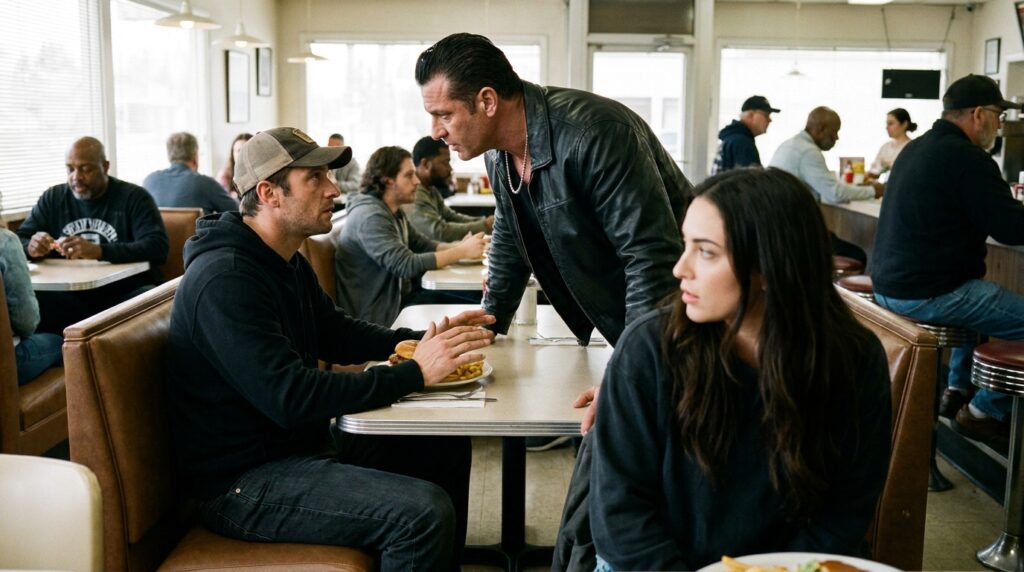
He didn’t advance. He saw my hands return to my pockets, my posture returning to that flat, unbothered stance he had misread in the diner booth.
“He’s inside,” the man with the axe said, his voice cracking under the cold. He didn’t point with the tool; he nodded toward the dark, rectangular mouth of the limestone adit twenty yards behind him. The opening was framed with rotting hemlock timbers, its lintel marked with a single, heavy cross drawn in black grease-pencil. “But you don’t have the log-code, outsider. Miller doesn’t give it to anyone who isn’t kin.”
I took the plastic capsule out of my hoodie, holding it between my index and middle finger so the grease-pencil markings on the interior paper were visible through the clear top. Three parallel lines.
The man with the axe lowered the blade two inches, his jaw tightening until the scar tissue on his throat turned gray. He didn’t say another word. He stepped off the shale path, his boots sinking into the deep mud of the drainage ditch as he ceded the threshold to the section.
The air inside the adit smelled different. It didn’t have the clean, frozen sting of the ridge; it was warm, thick, and carried the heavy, unmistakable alkaline weight of wet concrete, old copper wiring, and the bitter, chemical musk of ten men living on stored air.








