
CHAPTER 5: The Dynamic Deepens
The double-strike slam of the iron bolt outside the door didn’t vibrate through the air; it traveled through the structural steel of the floor, vibrating straight into the soles of my boots. A deadbolt thrown from the exterior didn’t mean a simple lockdown. It was an extraction seal. I had used the exact same sequence three times in Helmand to isolate contaminated extraction zones before the sweeps began.
Miller didn’t turn around to look at the door. He didn’t even adjust his posture against the counter. His thin arms remained crossed over his grease-stained canvas apron, his right hand still resting like a lead weight over the hidden barrel beneath the cloth. The desaturated gray light from the window pane caught the silver bristles on his jaw, making him look like part of the machinery he worked behind.
“The bolt is five-eighths hardened steel,” Miller said, his dry voice dragging against the low hum of the pie cooler. “It’s welded straight into the channel frame. A shoulder check will just crack your collarbone, son.”
My hand left my old ceramic cup, my fingers sliding across the cold formica until my palm flat-lined against the wood grain edge of the booth partition. My right hand remained deep inside my hoodie pocket, the laminated corner of Marcus Vance’s card biting into the meat of my thumb. The ring—my silver band—felt heavy, a cold ring of zinc around a finger that hadn’t pulled a trigger in twenty-four months.
“You’ve got a black network hub running under a truck-stop kitchen, Miller,” I said. The subtext wasn’t subtle anymore; it was an inventory. “The aircraft aluminum key ring the boy dropped. The Form 2 with the scraped mag strip. This isn’t a retirement community. It’s an unlisted staging lane.”
Miller reached down, his left hand grasping the dark thermos he had pulled from the lower cabinet. He didn’t lift it to pour; he simply held the base against the scarred laminate, his thumb tracing a horizontal notch ground into the steel casing—a field marking used to identify equipment containing encryption variables.
“The country doesn’t stop being a grid just because you hand in your kit,” Miller murmured, his eyes locking onto mine with the flat, unblinking clarity of an old logistics sergeant. “Vance didn’t fake the tent fire to save his skin. He faked it because the names on the third-section registry were being sold by the regional office before the ink was even dry. If he stays dead in Virginia, forty men stay alive in the timber.”
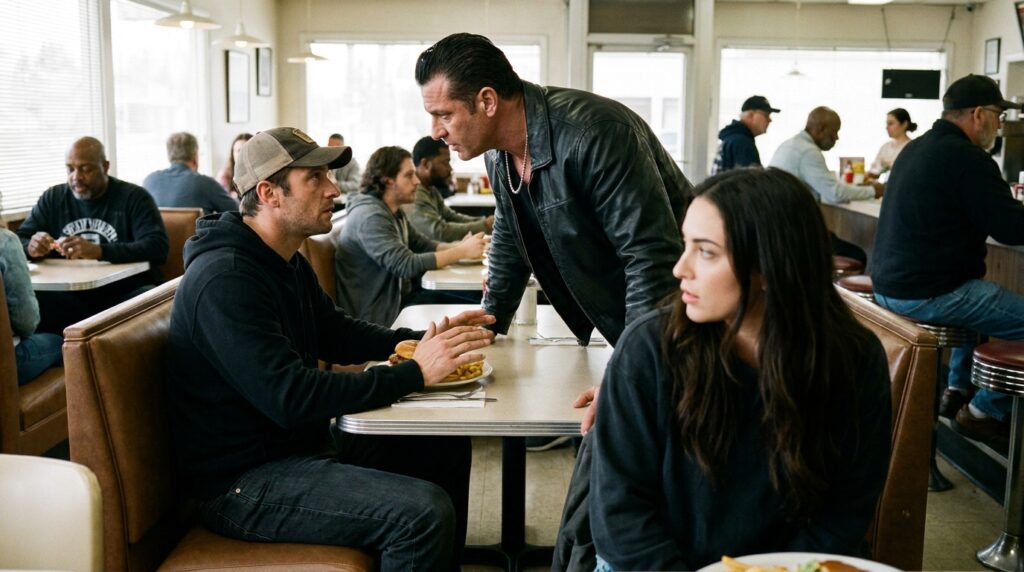
The room seemed to shrink, the sticky menus, the smell of chicory, and the ancient grease on the grill plates turning into a perimeter wall. Every interaction since I crossed the county line hadn’t been an accident of civilian friction; it had been a systematic drift toward a filter. The bully hadn’t chosen me out of arrogance; he had been the sweep, testing the threshold to see if the stranger in the black hoodie still carried the reflexive torque of the section.
“He’s three miles north,” I said, calculating the distance through the broken asphalt maps ground into my memory. “The old limestone quarry behind the toll gate. The extraction tunnel with the zinc vent pipes.”
Miller’s elbow twitched beneath the apron. The fabric bunched, a raw geometric fold revealing the clean, blued steel slide of an issue sidearm. “You always were too quick with the vectors. That’s why your file has three parallel strikes across the clearance block.”
He didn’t raise the weapon, but the tension between his hip and my sternum tightened until the air between us felt like solid iron. Beyond the glass window of the swinging door, a low, rhythmic thud began—the heavy, ungreased compression stroke of an old diesel generator kicking over in the crawlspace beneath the kitchen. The lights in the diner flickered once, the yellow neon lottery sign in the window dying completely, leaving only the dull, overcast winter light to illuminate the dust motes rising from the floor.
“The boy with the missing finger didn’t go to the truck,” I said, my body staying low in the booth, my thighs ready to take the weight of a sudden lateral break toward the kitchen lane. “He went to the breaker box.”
“He went to set the seal,” Miller corrected. He took his hand out from beneath the apron, leaving the weapon cold against his hip, and tossed a small, heavy object across the table. It slid through the grease-film, striking my cold egg plate with a dull, ceramic chime.
It was a standard military-issue earplug container—the small, olive-drab plastic capsule used during high-decibel ordnance disposal. Inside the clear plastic top, instead of foam, sat a tightly folded strip of yellow field paper, marked with three hand-drawn lines of grease pencil.
“That’s the clearance number for the gate,” Miller said, his voice dropping into a dry whisper as the generator’s vibration began to rattle the spoons inside their metal canisters. “But it only works if you’re the one delivering the boy’s leather jacket. And right now, the boy is waiting outside that door with an iron pipe and three cousins who think you’re a state witness.”
The victory of dropping the challenger two chapters ago wasn’t a win; it had been the trigger for an escalation I hadn’t prepared to fight. Every piece of data I had gathered was a false flag designed to lock me into a transit line I had spent two years trying to forget. I was the active driver, but the road had been built before I even bought my cap.
I reached out with my left hand, my fingers wrapping around the small plastic capsule, my thumb feeling the rough, unground seam of the injection-molded plastic.
“I didn’t come here for a registry, Miller,” I said, my voice flat against the growing roar of the generator beneath the floorboards. “I just wanted to finish my coffee.”
“There isn’t any coffee left, son,” Miller said, looking toward the side window as the first heavy shadow crossed the frosted glass from the timber lane. “There’s just the perimeter.”








