
CHAPTER 2: The Iron Law of Momentum
The challenger’s fingers never made it to my collar.
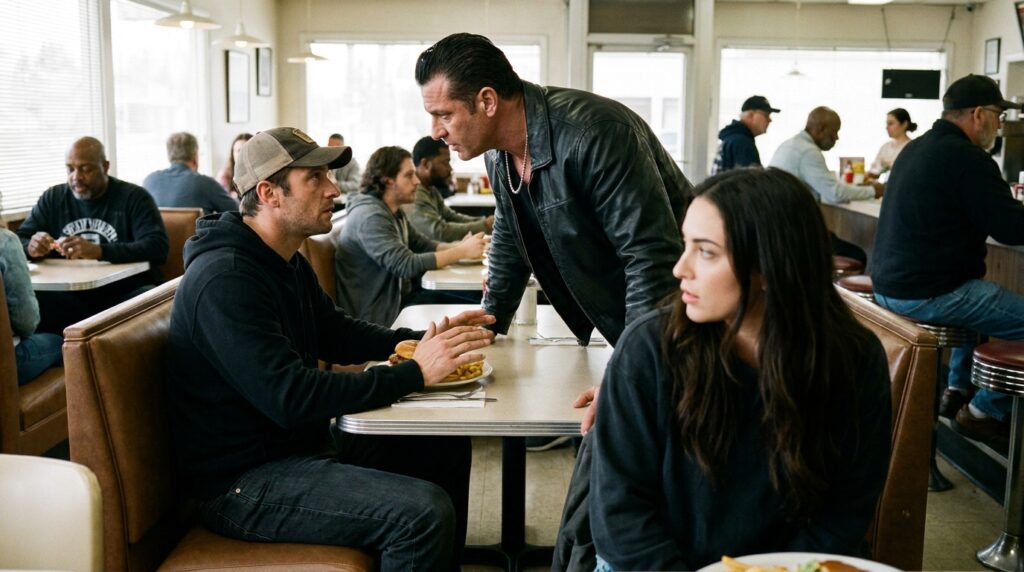
His forward lean was his undoing, a textbook error born of thirty years of clearing rooms through sheer mass rather than geometry. As his right hand lunged into the space above my plate, my left hand—the one resting flat against the sticky laminate—pivoted. I didn’t strike. A strike creates noise, a visible fracture that witnesses can categorize. Instead, I simply caught the meat of his thumb with my palm, shifting my torso exactly three inches to the left, inside the dead space of his reach.
Physics took the room’s oxygen. His momentum, built on two hundred and forty pounds of muscle and arrogance, met the immovable vector of a low center of gravity. My right hand left the chipped ceramic mug, slid beneath his extended armpit, and hooked the stiff leather of his jacket sleeve, pulling down and inward toward the booth’s edge.
It wasn’t a fight; it was a deployment of mass.
The scrape of his boots against the linoleum was loud, a screech of rubber on grease-slicked synthetic tile. Then came the sudden, heavy thud that rattled the diner’s framework. The challenger hit the floor face-first, his chin catching the metal molding of the lower booth frame before his torso slammed flat against the grime-crusted ground. The silver chain around his neck snapped, its links scattering across the floor like teeth.
The clinking of silverware in the back kitchen cut off cleanly, replaced by the low, rhythmic rattle of the exhaust fan.
I rose from the seat before his breath could return to him. The transition was smooth, my boots finding traction on the dry patches of the floorboards, my hands returning to my sides, fingers loose, palms open. I didn’t drop into a stance. A stance is an admission of intent; a stance tells the room you are willing to negotiate with violence. I stood simply, a shadow in a faded black hoodie, holding the lane between his prone ribcage and the table where my cold eggs still sat.
On the floor, the challenger gasped—a short, wet sound as the air was forced from his lungs through a mouth that had tasted the iron edge of the molding. He rolled onto his side, his face dark with a mix of blood and gray floor dust. His left hand clawed at the air, trying to find purchase against the leg of the table. I noticed then that the tip of his ring finger was missing, a clean, scarred truncation right above the first joint. It wasn’t an industrial accident; that was a surgical removal, the kind they do in field hospitals when the bone splits under a door frame.
“I told you,” I said, my voice remaining flat, devoid of the high-register vibration that comes with adrenaline. “I’ve had enough. Don’t make me put you down again.”
The young woman three booths down didn’t move. Her coffee cup remained suspended two inches above her saucer, her knuckles white, her jaw slightly unhinged as she stared at the bulk of the town’s enforcer lying beneath the boots of a man who looked like he belonged behind a warehouse loading dock. Beyond her, a pair of truckers in oil-stained hats slowly withdrew their hands from the counter, their eyes scanning the distance between the door and my shoulders. They weren’t looking for a fight; they were checking the exit vectors.
The challenger didn’t get up. He stayed on one hip, his breath coming in ragged, whistling gasps as his fingers found the broken chain on the floor. His eyes, small and red-rimmed under his slicked dark hair, looked up at me with something that wasn’t rage anymore. It was the sharp, cold clarity of a man who had suddenly run into a wall he didn’t know was built there.
“You’re… you’re from the third section,” he wheezed, his voice thick with saliva and gray dust. His right hand went to his ribs, checking the structural integrity of his cage. “You’ve got the ring.”
I didn’t look down at the silver band on my left hand, though the weight of it felt suddenly immense, an anchor pulling my hand down toward the floorboards. Instead, I kept my gaze fixed on the center of his forehead, the point where the skull is thickest and easiest to control.
“You have five seconds to get your feet under you,” I said, the words measured by the low, vibrating click of the neon sign behind me. “Then I’m going to consider your presence an active threat to my personal space.”
He didn’t use the table to climb this time. He rolled away, his leather jacket dragging against the grease-film of the floor, creating a dull, scraping sound that seemed to echo in the absolute silence of the diner. He reached into his pocket, his fingers fumbling with a cracked leather wallet that had slipped halfway out during the fall. As he pulled his hand away to press against his bleeding lip, a small laminated card slid from the billfold, landing face-up on the dirty linoleum right between my boots.
The light from the window was poor, filtered through layers of grime and cheap venetian blinds, but the blue seal at the top of the card was unmistakable. It was a standard Department of Defense Form 2, an active-duty identification card.
And beneath the plastic laminate, the faded digital photograph stared back at me with the severe, unblinking eyes of Colonel Marcus Vance—the man I had watched disappear into a burning command tent in the valleys outside Jalalabad ten years ago. The man whose flag I had helped fold.
The challenger saw where my eyes were fixed. He didn’t reach for the card. His hand froze, his missing finger joint twitching against his knee as he stayed pinned between the floor and my shadow.
“Stay down,” I murmured, my voice losing its transactional edge, replaced by something cold and rusted. “And walk away.”








