
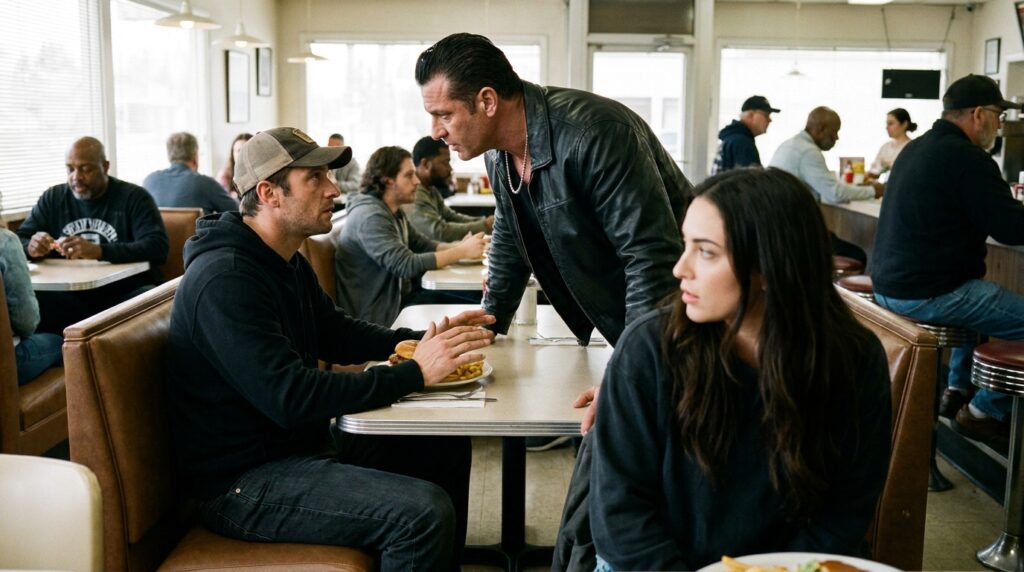
CHAPTER 10: The Toll Gate Extraction
The steel hatch tore open with a sound like a small mortar detonation, the structural casing splitting along the old weld seams.
Fog didn’t crawl into the bunker; it erupted, a gray wall of cloud smelling of wet sulfur and unburnt premium gasoline. My boots hit the floorboards before Vance’s sea bag could clear the iron desk. I didn’t stop to verify the positioning of the collection crew. An entry team utilizing a hydraulic spreader doesn’t split their perimeter; they stack their files thick and fast along the primary center lane.
My mass went lateral. My shoulder took the lower wooden panel of a structural utility door hidden behind the iron filing lockers, the soft, rotting pine timber collapsing into a narrow coal chute that sloped thirty degrees down toward the subterranean drainage ditch.
The drop was raw friction—wet slate, stone coal dust, and the jagged edges of rusted iron reinforcement bars tearing at the sleeves of my black hoodie. I didn’t look back for Vance. The rhythmic, mechanical pop-pop-pop of an unsuppressed automatic weapon echoed through the concrete space behind me, the sound flattened and swallowed instantly by the heavy mud of the floor. He was an equal intellect; he had calculated his own exit vectors before he ever filled the first page of the ledger.
I broke out into the mountain air behind the coal bunker. The light was almost dead now, the desaturated winter sky turning the color of wet zinc. The cook’s station wagon—an old, salt-rusted Ford with wood-grain panels peeling away from the wheel wells—sat idling in a nest of frozen weeds. The exhaust was white, heavy, and smelled of bad valve seals and ancient fuel.
The door handle was cold, the latch mechanism stiff with frozen grease. I threw my mass behind the steering column, my left hand finding the gear lever while my right boot slammed the throttle down to the rusted floorboards. The differential didn’t catch immediately; the gears groaned, a dry, grinding shriek of unlubricated iron spinning through the slush before the bald rear tires bit the packed shale of the limestone track.
The track was three miles of broken mountain vertebrae. The wagon bounced violently, the suspension bottoming out against the stone axles with every ridge, the steering wheel kicking against my palms like a live wire. Through the cracked rearview mirror, the quarry was shrinking into a gray mist, but two separate sets of high-beam halogen lights had already cleared the wash-plant line, tracking my path down the mountain side with the steady, unblinking speed of a professional recovery squad.
They weren’t trying to box me in anymore. They were pushing the pace, forcing the station wagon to destroy its own oil pan against the rocks before we hit the concrete barrier at the highway junction.
The toll gate appeared through the pine branches two minutes later. It wasn’t a standard highway booth; it was an abandoned state forestry check station, blocked by an old counter-weighted iron pipe gate that had been locked down with a heavy logging chain. Beside the concrete island, where the old toll house rotted beneath the hemlocks, two men in identical gray storm coats stood waiting. They didn’t have rifles out; they had their hands stuffed deep into their pockets, their silhouettes completely motionless against the headlights of an idling black utility vehicle.
The physical reality of the section came down to an inch of steel.
My left hand went to the pocket of my hoodie, pulling out the olive-drab plastic container Miller had tossed across the diner table. I didn’t drop the wheel. I used my teeth to rip the clear cap off, letting the tightly folded strip of yellow field paper fall onto the oil-stained vinyl passenger seat. The grease-pencil lines were clear, but I didn’t look at them. I knew the sequence. Every regional block used the same base configuration—three numbers that correlated to the physical balance weights hanging from the gate’s rear lever.
I didn’t stop the wagon. I accelerated, the speedo needle vibrating wildly around fifty as the station wagon hit the flat concrete of the toll lane. The two men in the gray coats didn’t run; they stepped back exactly six inches, their hands remaining in their pockets as the rusted front bumper of the Ford missed their knees by the width of a finger.
I threw my weight to the right, sliding across the bench seat while my left hand jammed the transmission into park. The gears sheared with a sound like a buzzsaw hitting an iron spike, the entire vehicle fish-tailing across the concrete before slamming sideways into the rotted base of the toll house.
The impact threw my head against the passenger glass, the world fracturing into a brilliant, crystalline grid of pain, but my boots were already out the door before the glass could hit the floorboards.
The chain on the counterweight was five-eighths iron, scaled with orange rust that bit into the palms of my hands as I reached the gear assembly behind the tool shed. The lock housing was a solid block of zinc, stamped with the old Department of Transportation seal. Beneath the grime, three mechanical dial plates were ground into the metal—the old manual override for forestry blockades.
I spun the plates with my thumb, the skin on my print tearing against the cold iron notches. Four. One. Seven.
The heavy brass internal tumblers dropped with a single, clear clank that echoed over the roar of the oncoming halogen lights down the track. The massive iron pipe gate swung upward, its counterweights dropping into the pit with the slow, crushing dignity of an old guillotine.
The station wagon was dead, smoke pouring from the ruptured radiator grid in thick, oily plumes, but the highway lane was open. Beyond the gate, the empty asphalt of Route 6 ran straight and desaturated into the gray winter horizon, entirely devoid of traffic, completely unmapped.
I didn’t look back at the men in the gray coats. I didn’t look at the ledgers Vance had buried in the canvas sack. I stepped over the shattered links of the logging chain, pulled my black hoodie tight against the rising wind from the summits, and walked out past the perimeter into the open country.








