
CHAPTER 8: THE ECHO OF THE GRACE RESTORED
“He kept it,” Arthur said, his voice dropping into a soft, textured rasp that seemed to absorb the wet drip of the subterranean brickwork, “because a piece of brass doesn’t remember a regulation. It only remembers the lives.”
The boy’s hand remained suspended near the rusted keyway of the olive-drab iron cabinet. His fingers had stopped trembling, his shoulders slumping under the immense, crushing weight of an emotional reality he had never been trained to calculate. The old man reached into his jacket pocket one final time. His fingers bypassed the manila folder, bypassing the paper registries, and pulled out the small, notched brass key. He didn’t drop it into the boy’s hand. Instead, he leaned forward, his slender frame holding its position with the quiet grace of a structural anchor, and slid the square-toothed metal straight into the keyway himself.
The mechanism didn’t turn with a clean, industrial click. It resisted, clogged by decades of oxidized scale and dust, requiring Arthur to apply the firm, steady leverage of his thumb against the head of the key until the internal pins gave way with a heavy, metallic crunch. The heavy iron door swung outward by three inches, its hinges screaming against the static dampness of the room.
Inside the small, dark recess, there were no bundles of corporate passing documents. There were no typed administrative logs detailing millions of dollars in back-dated federal pensions. There was only a single, heavy canvas ditty bag, its fiber faded to a dull, washed-out sage green, secured at the throat by a length of frayed parachute cord. Resting on top of the canvas was a single, fired thirty-millimeter brass casing, its cylindrical body tarnished to a deep, dark amber.
The boy stepped closer, his sneakers scraping against the linoleum film of the floor. He didn’t reach for the bag; his eyes were fixed on the brass shell. Etched into the metal with the rough, uneven point of a combat knife was a single name in Vietnamese characters, followed by a handwritten date: November 14, 1969.
“That’s not a pension file,” the youth whispered, the word coming out flat, his entire focus dilating into the sensory slow-motion of the reveal.
“No,” Arthur murmured, his hand settling over the tattered crown of his black veteran cap, adjusting the brim against the pale glare of the dangling bulb. “That’s the medical manifest for a girl named Linh. Your grandfather carried her four miles through a burning bamboo draw after the rest of the sector had been cleared by the tactical logs. He didn’t ask for a record because if the command knew she was on that evacuation chopper, they would have court-martialed the entire flight crew for breaking the border quarantine.”
The boy reached out, his calloused fingertips finally brushing the cold, oxidized ridge of the brass casing. The internal shock was visible in the way his jaw went completely still, the thin line of sweat along his temple catching the yellow light. The grand narrative of his anger—the beautiful, desperate belief that his family had been broken by an unthinking administrative oversight—shattered completely, leaving behind the raw, golden kintsugi of a profound sacrifice. His grandfather hadn’t been forgotten by the world; he had chosen to be invisible so that someone else could live.
“The state house,” the boy said, his voice cracking against the stone masonry. “He never told my dad. He never told anyone.”
“Because the silence was the only thing keeping the girl safe,” Arthur said softly. He reached into the ditty bag, pulling out a small, yellowed piece of cardstock—not a platoon ledger, but a civilian citation from a provincial field hospital, signed by a doctor whose name had long since faded into the grain of the paper. It was a document tracking a quiet, painful mercy-action that had cost his grandfather his physical health, but it carried an unassailable moral weight that no federal court could ever evaluate or match. “He didn’t leave you a fortune, son. He left you an unpardoned grace.”
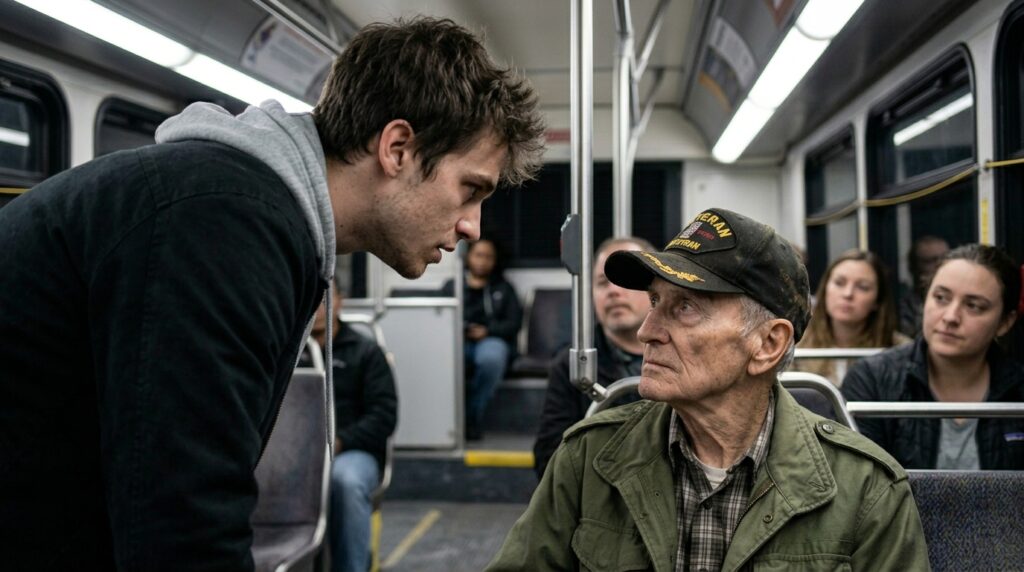
The rumble of a train passing overhead grew louder, vibrating through the structural steel pillars, but inside the small vault corridor, the air remained completely static, held in a long, respectful dilation of time. The boy’s hand wrapped around the brass shell, lifting it from the iron shelf. He didn’t look for more papers. He held the metal against his chest, his posture losing its defensive, confrontational edge, his frame aligning with the same quiet dignity that Arthur had carried into the car two hours ago.
Slowly, Arthur turned back toward the concrete stairwell, the tip of his ash cane marking the wet stone with a deliberate, unhurried stroke. He had delivered the core truth; the ledger was clear, and the horizon was finally open.
As he reached the base of the platform stairs, the mid-30s transit employee who had followed them down stepped out from the shadow of the pillar. He didn’t speak. He stood perfectly straight under the flickering station lights, his unbuttoned jacket revealing the silver badge, his right arm rising into a slow, formal, and unprompted military salute that held until Arthur’s frayed cap cleared the threshold into the evening air above.








