
CHAPTER 4: THE THRESHOLD OF EYELEVEL TENSION
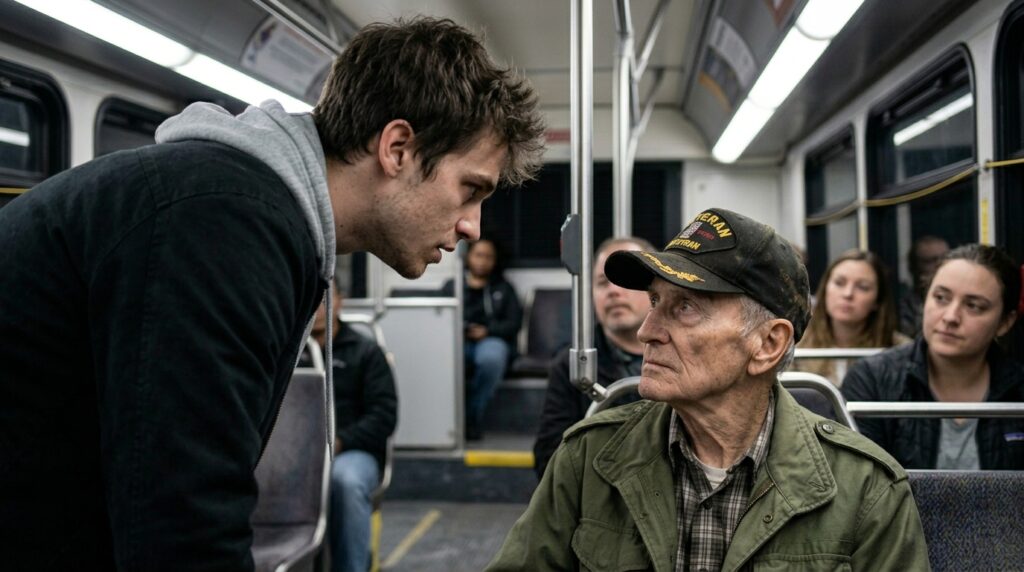
The mechanical brakes of the carriage ground to an uneven, high-pitched halt, sending a shudder straight through the iron core of Arthur’s cane. He stood up slowly, allowing his joints to absorb the momentum of the train’s final registration against the concrete platform. The manila folder was tucked securely under his left armpit, his jacket pinning the paper thinness against his ribs like a protective shield. With his right hand, he kept his fingers pressed over the cold outline of the notched key in his lower pocket.
The sliding doors parted with a pressurized gasp, admitting the stale, exhaust-laden atmosphere of the terminal. Arthur stepped over the iron gap between the train and the platform, his heavy leather-soled boots making a dull, flat thud as they found solid ground. The midground riders spilled out around him, a silent, hurried tide of shoulders and lowered heads, eager to shake off the lingering residue of the confrontation that had just played out on the blue plastic benches. None of them looked back at him. The protective wall they had formed during the intrusion had completely atomized into individual urgency.
Arthur didn’t follow the main artery toward the exit turnstiles. Instead, he pulled back against the tiled structural pillars, letting his back find the cold, glazed masonry. He drew the folded square of paper from the dropped vinyl pouch, his calloused thumb unfolding the stiff, coarse fibers. In the dim light of the station, the text became readable. It wasn’t a standard document; it was a single carbon-copy voucher bearing the official ink stamp of the United States Army Support Command, dated November 1969. Stamped diagonally across the upper margin were the letters PROP-REC-8, followed by a handwritten ledger location that corresponded precisely with the old storage basement beneath the transit authority’s central hub three blocks north.
The boy’s earlier taunt seemed to vibrate through the paper: The ribbons didn’t buy him a damn thing.
Arthur understood the specific architecture of that anger. The decoy layout was completely visible now. The boy had been hunting for his grandfather’s missing service record, tracking Arthur through the VA administration logs because he believed Arthur was the last surviving officer who could verify a claim for corporate or state reparations. The key in Arthur’s pocket was the physical link—the anchor meant to unlock an unvouched locker of unit files left behind during the bureaucratic confusion of the late sixties. It was a clean, logical motivation born from generations of neglect.
But Arthur’s internal calculation went deeper, tracking a far more fragile truth. The boy believed he was uncovering a simple story of bureaucratic theft, a narrative where a heartless system had denied an old soldier his pension. He didn’t know about the deeper layers of the registry Arthur guarded. He didn’t know that the platoon hadn’t been forgotten by an administrative error; they had been deliberately deleted to protect the names of three wounded men who had been quietly moved out of a field hospital under false identifiers to escape a targeted retaliatory sweep.
“Looking for a ghost in the ledger,” Arthur murmured, his thumb smoothing the crease of the voucher before sliding it back into his pocket.
He looked down the length of the platform. The shadows between the steel support columns were long, cast by low-wattage safety bulbs that hadn’t been cleared of dust in a decade. Fifty yards away, near the base of the concrete stairs leading up to the street level, a dark shape shifted. A young man in a black nylon jacket over a gray hoodie was standing under an unlit transit map, his hands buried deep in his pockets, his posture tense and unyielding. He wasn’t running. He was waiting, his eyes tracking the thinning crowd, searching for the distinctive silhouette of a worn veteran cap and a polished oak cane.
The antagonist had realized what he’d dropped during the physical interception. He hadn’t left the station because the key in Arthur’s pocket was the only instrument that could open the door to his family’s lost history. The environment had narrowed down to an intentional lane between the two men, a physical corridor of tile and shadow where status and leverage were about to be re-tested.
Arthur tightened his grip on the handle of his ash cane, feeling the solid wood anchor him against the low hum of the station. He didn’t turn back toward the safety of the train. He adjusted his cap, pulling the frayed brim down just enough to shield his eyes from the harsh glare of the upcoming stairs, and began to walk forward, his cane rhythmically marking the distance on the concrete floor.








