
CHAPTER 3: THE REMAINS OF THE STRANGE LANE
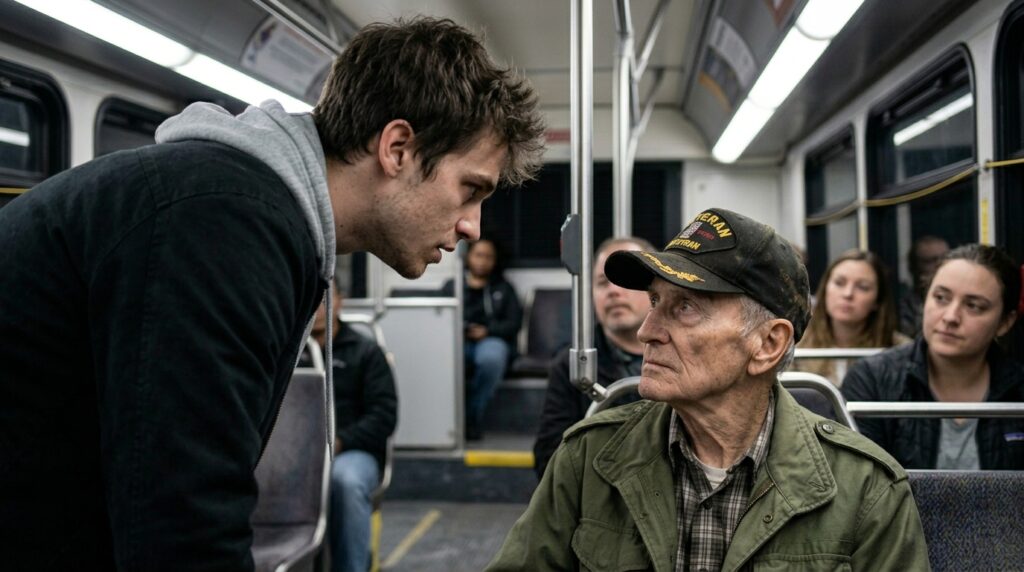
The heavy rubber edges of the pneumatic doors sealed with a pressurized hiss, locking out the damp chill of the 8th Street station. As the train gathered its slow, groaning momentum toward the next transit block, the space across from Arthur seemed to widen. The blue plastic bench, still retaining a faint residue of corporate warmth from the young man’s presence, sat vacant. At the center of that plastic mold lay the black leather card holder. It was small, scuffed along the seams where the cheap imitation thread had begun to unravel, mimicking the fraying edge of the world Arthur had traveled through all afternoon.
Arthur didn’t reach for it immediately. He let his eyes trace the contours of the cracked vinyl. In his line of work, decades ago, you never touched an unchecked object in a cleared zone until the dirt settled. He looked around the perimeter of the carriage. The midground riders had already begun their retreat into the safety of their small, isolated lives; headphones were being tugged back over ears, and eyes were dropping down toward glowing screens. The brief crystallization of public witness energy had broken. They had stood as a wall when the intrusion was active, but now that the threat had slipped into the gray tunnels, they wanted their silence back. Only the mid-30s transit employee several seats down kept a lingering, protective gaze fixed on Arthur’s position before shifting to look out into the dark windowpane.
Slowly, using the crook of his wooden walking cane, Arthur hooked the small strap of the card holder and slid it across the linoleum floor until it rested against his own boot. The friction made a faint scratching sound against the rumble of the undercarriage. He leaned forward, his spine offering a familiar, dull ache that registered through the olive fabric of his jacket, and picked it up.
The weight of it was negligible. Inside the transparent plastic window where a driver’s license usually rested, there was no identification card. Instead, Arthur’s thumb brushed against a hard, metallic ridge. He slid his fingers into the tight pocket, pulling out a small, uniquely notched brass key. It wasn’t a standard house key; the teeth were square, cut with the industrial precision of a government-issued padlock or a military locker anchor. Tucked right behind it was a folded square of paper, yellowed at the crease line and matching the exact, distinctive tint of the platoon registry sheets resting inside his own VA hospital folder.
He didn’t unfold the paper yet. He held it between his fingers, tracking the texture. The boy’s final words echoed beneath the steady rhythm of the wheels below: He died in a state house with nothing but his name.
Arthur’s internal landscape shifted, the quiet tactical calculation of his training taking over the emotional weight of the encounter. The boy hadn’t chosen this specific transit car by pure coincidence. The target wasn’t random underestimation; it was a tracking lane. The surname Miller typed on the loose slip within Arthur’s own document file began to feel less like a ghost from an old ledger and more like a live coordinate. The sergeant he had left behind in the tall grass had a son who died broken, and now a grandson was riding the cross-city loops with an institutional key and a tattered piece of history in his jacket.
“You dropped this,” Arthur muttered to the empty air across from him, his voice absorbed by the heavy acoustic isolation of the moving car.
He looked down at the veteran cap in his lap. The tarnished Silver Star citation pin caught the yellow cast of the overhead bulb. The boy thought the ribbon hadn’t bought his grandfather a damn thing. He thought the system had simply chewed through a name and left a family to rot in a state facility. It was a familiar harshness, a shared burden that Arthur understood better than anyone else in this carriage. But the boy didn’t know about the physical secret locked inside the VA folder—he didn’t know that Arthur carried the very registry that proved his grandfather’s platoon had been officially scrubbed from the active operational logs during the final withdrawal across the border.
The train slowed again, entering a long, sweeping curve where the lights flickered twice, plunging the interior into a brief, shadow-filled twilight. In that darkness, Arthur felt the notched key slip into his palm, cold and real. The decoy secret was already taking shape in his mind—the boy was hunting for the platoon registry to prove a case of systemic neglect, to demand a retroactive settlement for a grandfather who died in poverty. It was a logical, desperate pursuit. But it wasn’t the ultimate final reality. The boy didn’t know what that key actually opened, or what Arthur had truly done in the field hospital to keep that specific registry from being burned.
Arthur slid the black card holder deep into the inner pocket of his olive jacket, right beside the manila folder. He gripped the polished wood of his cane, his knuckles turning a dry, pale white. The next stop was his own, but the path was no longer leading toward his quiet apartment.
“Eighth Street was just the entry point,” he murmured, his thumb checking the placement of the cap on his head, ensuring the frayed edge was straight before the doors opened.








