
CHAPTER 6: THE VOICE OF THE RECORD
“You look like you’ve walked enough miles for one night, chief,” the transit employee said, his voice dropping from its formal, security-coded edge into a softer, gravelly resonance that sounded like old tobacco and long shifts. He didn’t step out of Arthur’s personal space immediately. Instead, he reached up with a slow, deliberate movement, his fingers brushing against his unbuttoned collar where a faint blue ink smudge—an inspection marker from the central hub depot—shadowed the gray fabric. His silver badge settled against his chest with a soft metallic click as he shifted his weight.
Arthur didn’t lower his guard. He kept his right hand anchored to the cracked handle of his ash cane, feeling the vibration of another north-bound local train throbbing through the concrete under his boots. “The miles don’t change much down here, son. They just get louder.”
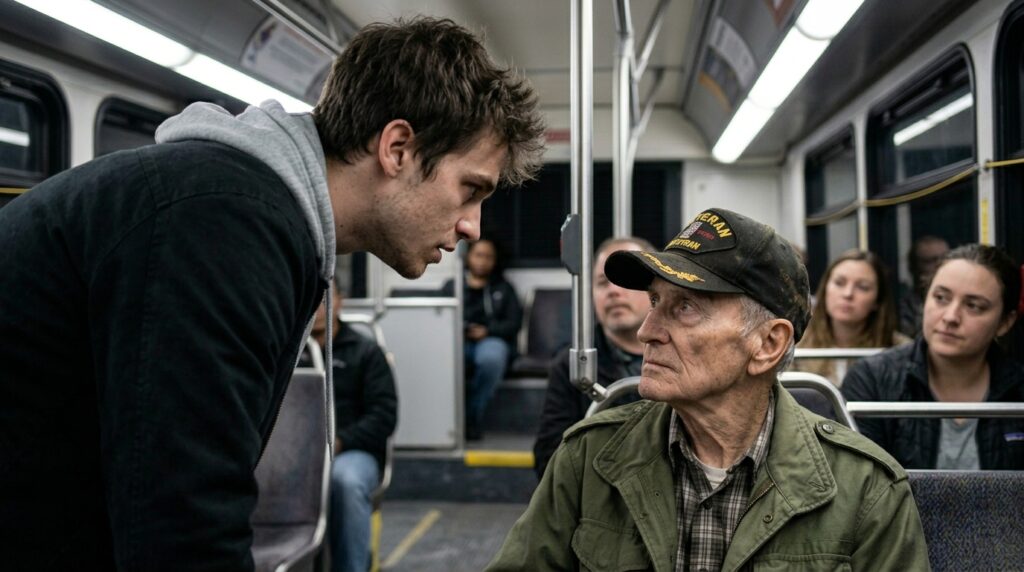
The employee looked down at the yellowed manila folder pinned tightly against Arthur’s ribs, then his gaze moved upward, pausing on the frayed crown of the black cotton cap and the tarnished star silhouette pinned to its center. A slow, quiet recognition settled into the lines around the worker’s eyes—not the superficial pity of a bystander, but the specific, heavy understanding of a man who knew exactly how much paperwork it took to bury a name.
“Third Battalion,” the worker murmured, his eyes locking back onto the insignia. “My old man was with the First Group out of Da Nang. He had a footlocker full of those carbon vouchers before the state facility cleared out his room. I know the stamp on that paper you’re holding. PROP-REC-8. That’s the old regional property reclamation locker under the north hub platform.”
Arthur felt his chest tighten by a fraction of an inch, the physical cardstock of his VA folder flexing against his thumb. The environment had narrowed again, the cold tile corridor turning into a repository of shared burdens. “Your father knew Thomas Miller?”
“Everyone who survived the draws knew Miller,” the worker said, leaning back against the structural pillar, his leather belt creaking against the masonry. “But the boy doesn’t know what he’s digging up. He thinks if he pulls those old crates out of the hub basement, he’s going to find a clean line of text that says the government owes his family fifty years of back-pay. He’s going to use that notched key to open a box of ashes.”
The devastating setback of the decoy secret crystallized fully in the dim light of the platform. The boy’s entire pursuit was built on a false flag—a beautiful, desperate belief that the system had simply made an error, that a legal correction could mend the fraying edges of his grandfather’s broken life. But the transit worker’s words confirmed the deeper, locked truth that Arthur had carried alone for over half a century. The files weren’t mislaid. They had been hidden by the men who lived through that valley to bury the evidence of an unauthorized mercy-action that saved civilians but technically violated the strict rules of engagement of the late sixties. If the boy brought those records into the light of a modern courtroom, it wouldn’t bring healing; it would dismantle the one thing Sergeant Miller had died protecting: the absolute anonymity of the survivors.
“The boy has the voucher now,” Arthur said, his voice dropping into a dry, flat rasp. “He’s heading toward the north hub. He’s going to force the lock.”
“He won’t get past the gate supervisor on a Friday night without an administrative pass,” the employee said, but his eyes drifted toward the exit stairs where the boy’s black jacket had vanished. “Unless he knows the service tunnels. The Miller family always knew the tunnels. His dad used to work the track maintenance lines before the facility took him.”
Arthur didn’t wait for the worker to finish the calculation. He adjusted his veteran cap, his fingers sweeping over the coarse fabric of the brim to ensure it sat straight, and turned toward the north-bound platform edge. The failure to stop the boy at the stairs had created a direct, unyielding consequence loop. If Arthur remained passive, the boy would break the lock, destroy the secrecy of the platoon registry, and unwittingly expose an entire generation of old men to a retroactive tribunal inquiry that would strip away their remaining dignity. The agency had to be his own; he had to be the one to intercept the boy before the brass key found its target.
“The north loop train is coming in on track two,” the employee noted quietly, not moving to block Arthur’s path. Instead, he stood straight, his arm rising in a small, unprompted gesture—not a formal military salute yet, but a respectful, disciplined nod of acknowledgment as the headlights of the approaching train cut through the platform darkness, washing the grimy tiles in a blinding, electric white.
Arthur stepped toward the yellow safety line, his cane marking the floor with a heavy, persistent strike that drowned out the squeal of the incoming brakes.








