
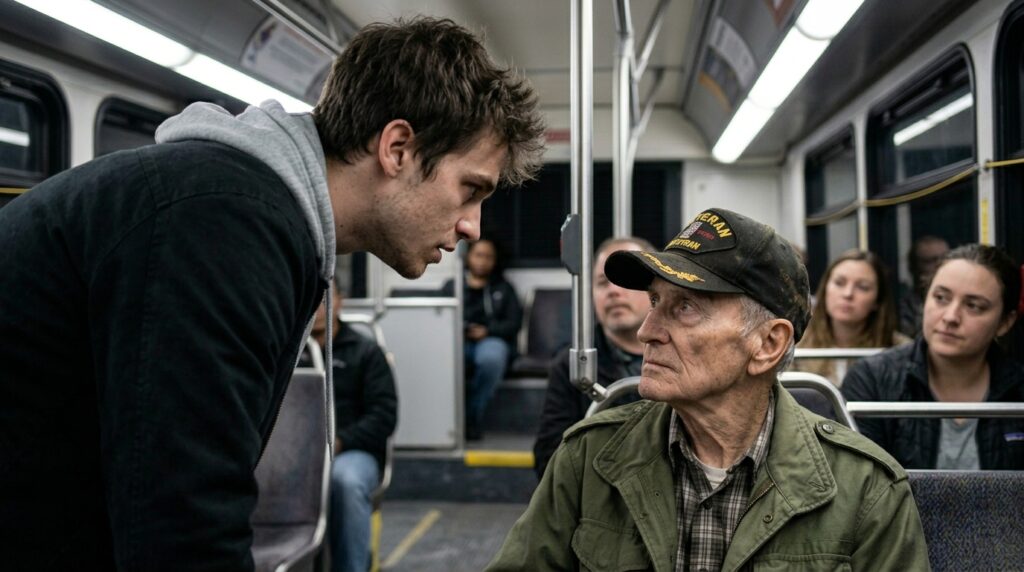
CHAPTER 2: THE AMBIENT SILENCE OF THE CAR
The word hung in the humid air of the transit car, dense and unyielding, like the sulfurous smoke that used to pool in the low draws of the central highlands after the mortars fell. The young man’s arm remained locked in Arthur’s grip, the fabric of his cheap black jacket bunching beneath Arthur’s liver-spotted fingers. For three full oscillations of the train, neither of them moved. The smugness on the youth’s face didn’t vanish so much as it curdled, his eyes darting from Arthur’s steady, blue gaze down to the ancient, liver-spotted hand that held his wrist with the precise, structural leverage of a brass clamp.
Arthur felt the subtle tremor in the boy’s sleeve. It wasn’t the shaking of fear yet; it was the vibration of a sudden, deep confusion. The boy had expected a soft target—an old man whose joints were brittle and whose spirit had been ironed flat by decades of waiting in the fluorescent purgatory of federal clinics. Instead, he had hit something dense. The bone beneath Arthur’s thin skin was still heavy, seasoned by the weight of things the boy had only ever seen digitized on a screen.
Slowly, Arthur released his grip. He didn’t pull his hand back in a defensive jerk; he simply opened his fingers and let his arm drop back onto the yellowed surface of the manila VA folder resting on his lap. As his hand settled, his thumb brushed the rough edge of the tucked-away slip of paper. The typed surname on that scrap—Miller—seemed to hum against his skin through the thin cardstock. It was a common name, an ordinary American name, but the registry number beside it matched the designation of a platoon sergeant who had gone into the high tall grass near the Cambodian border and never walked out.
The youth pulled his arm back, his mouth twisting into a hard, defensive line to cover the embarrassment blooming across his cheeks. He looked around the carriage, his eyes searching the faces of the midground riders for a shared smirk, a nod of agreement, some sign that the collective environment was still on his side. But the room had changed its texture. The passive detachment that usually governed the evening rush had dissolved into a tight, observant stillness.
“Yeah, whatever,” the boy muttered, his voice dropping an octave as he tried to regain his footing. He didn’t step back out of the interaction lane, but his shoulders slouched slightly, his forward lean losing its predatory edge. “A hat’s a hat, old man. You don’t gotta make it weird.”
“It isn’t weird,” a voice cut in from three seats down.
Arthur didn’t turn his head, keeping his eyes fixed on the boy’s chest, watching the rapid, shallow rise and fall of the dark nylon jacket. The voice belonged to a woman in her mid-forties, her fingers tightly coiled around the brushed steel of a vertical stanchion. She had lowered her white earbuds, letting them dangle against her coat like twin pendulums. “He told you to leave it alone. So leave it alone.”
A low murmur of agreement passed through the rear depth of the carriage—a collective shifting of boots on scuffed linoleum, the rustle of grocery bags, the soft click of a tongue against teeth. The public witness layer, which had been a collection of isolated strangers moments before, was beginning to crystallize into a single, defensive wall. The unwritten social contract of the transit line had been breached, and the weight of the car was beginning to lean toward the corner where Arthur sat with his oak cane.
The boy’s friends—two other youths in oversized athletic gear who had stayed near the center doors—didn’t move forward to support him. They remained back, their eyes fixed on their own shoes, subtly untangling their bodies from his proximity. They were reading the environment with the quick, sharp instinct of the young; they knew when the floor was dropping out from under a friend, and they knew how to let him fall alone.
Arthur let the silence do the heavy lifting. He reached down, his fingers moving with deliberate slowness, and adjusted the placement of his wooden cane, letting the brass collar rest more firmly against his knee. The wood was old, smoothed by twenty years of skin oils until it felt like silk, but the core of it was solid American ash.
“You got the next stop, son,” Arthur said softly. It wasn’t a threat. It was a diagnostic observation, delivered with the same flat cadence he used when telling a junior corpsman which tourniquet to tighten first.
The boy looked at the flickering digital map above the emergency exit. The indicator for 8th Street was pulsing in red intervals, the train’s brakes beginning to hum as the undercarriage took the friction of the descent. The youth’s jaw worked silently, his fingers curling into loose fists inside his pockets, but the kinetic energy had drained completely out of his frame. He was no longer the author of the scene; he was merely an occupant waiting for a door to open.
Beneath Arthur’s hand, the manila folder shifted slightly as the train slurred to the left. The loose registry slip inside peeked out by a fraction of an inch, revealing the date October 1969 typed in a faint, manual ribbon ink. Arthur’s thumb covered it again, his internal monologue silent, calculating the distance between the boy’s messy dark hair and the facial structure of the man he had left behind in the mud fifty-seven years ago. The resemblance was there, buried under the soft fat of a comfortable life, but the eyes were the same—furious, untethered, and looking for something to break.
The brakes gave a final, metallic shriek, and the carriage came to a halt. The pneumatic doors slid open with a heavy huff of stale tunnel air, revealing the dirty white tiles of the 8th Street platform. The boy didn’t move immediately, waiting for a second of delayed pride, but his friends had already stepped out onto the concrete, leaving him alone in the threshold.
“My granddad had one of those,” the boy said suddenly, his voice tight, his hand pointing quickly at the tattered black cap on Arthur’s head before he turned toward the exit. “He died in a state house with nothing but his name. The ribbons didn’t buy him a damn thing.”
Before Arthur could answer, the boy stepped through the threshold, his black jacket disappearing into the gray current of the platform crowd. But as the doors began to slide shut, Arthur noticed a small, black leather card holder lying on the blue plastic seat directly opposite him—dropped from the boy’s pocket during the brief physical interception.








