
CHAPTER 1: THE WEIGHT OF THE RIBBON
The metallic rattle of the subway car pulsed upward through the rubber-scuffed floorboards, vibrating into the worn brass collar of Arthur’s wooden cane. He didn’t look up. At eighty-one, you learned to read the world through its structural frictions—the screech of steel flange against a curved track, the dry chemical scent of aged air conditioning, the subtle shifts in human weight filling the blue plastic benches around you. On his lap rested the yellowed, corner-bent manila folder from the downtown VA hospital, its metal prongs slightly oxidized. It was thick with printouts detailing things that were slowly giving out inside him, a quiet bureaucratic ledger of a body paying its final interest on a decades-old debt.
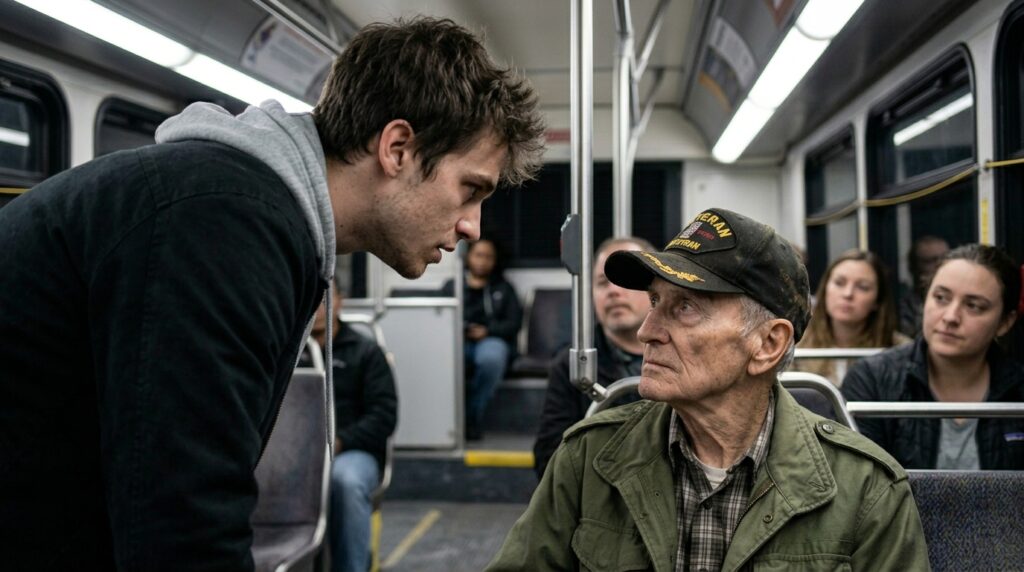
Overhead, the fluorescent tubes flickered, casting a pale, desaturated wash over the passengers packed into the evening rush. Arthur kept his fingers looped loosely around the cap resting near his chest. The black cotton was faded to a soft, charcoal gray along the crown, its edges tattered into fine, wispy threads that caught the light like spiderwebs. Pinned to the center was a small, tarnished piece of metal—a Silver Star citation pin, its enamel long since chipped away by time, leaving only the raw, dull silhouette of an anchor and a star. To anyone else, it was a relic of an obsolete geography. To Arthur, it was simply the weight he carried.
The train slammed through the switchyard near 4th Street, throwing the standees into a brief, synchronized lurch. When the car stabilized, the air changed. A cold draft spilled from the vestibule doors, accompanied by the sharp, rhythmic slap of a heavy nylon zipper.
“Mind if I take a closer look at that hat?”
The voice was young, reeking of cheap synthetic cologne and the hollow bravado of someone who needed an audience to feel anchored.
Arthur didn’t blink. He kept his gaze fixed on the scuffed linoleum between his boots, but his peripheral vision locked onto the gray hoodie and the dark, messy hair leaning into his space. The young man had stepped deep into the interaction lane, his thighs crowding Arthur’s knees, forcing the passengers on either side to shrink back into the plastic molding.
“Relax, it’s just a hat,” the youth sneered, his hand rising from his pocket, fingers hovering inches from the frayed brim. “What’s the big deal?”
The hand moved—a casual, predatory swipe meant to snatch the cloth and see if the old man would weep or beg.
But Arthur’s right arm didn’t rise in panic. It moved with the ancient, unthinking economy of a muscle memory that had survived the Ia Drang Valley. A micro-shift of his shoulder, a clean rotation of the wrist, and his forearm intercepted the young man’s sleeve with a dull, flesh-on-fabric thud. It wasn’t a strike; it was a wall. The sheer placement of Arthur’s skeletal frame stopped the momentum cold, the brass collar of his cane clicking once against the floor as his steady blue eyes locked directly onto the young man’s face.
The car went dead silent. The young passenger froze, his arm suspended in the air, his fingers twitching against the invisible barrier of an old man’s absolute composure.
Arthur cleared his throat, his voice low, gravelly, and entirely devoid of anger. “That hat was earned, son.”
As the words left his mouth, Arthur’s thumb accidentally brushed the underside of his VA folder, his skin catching on a piece of paper tucked behind his medical charts—a faded, photocopied enlistment record bearing a name that didn’t belong to him, but to the young man’s family.








