
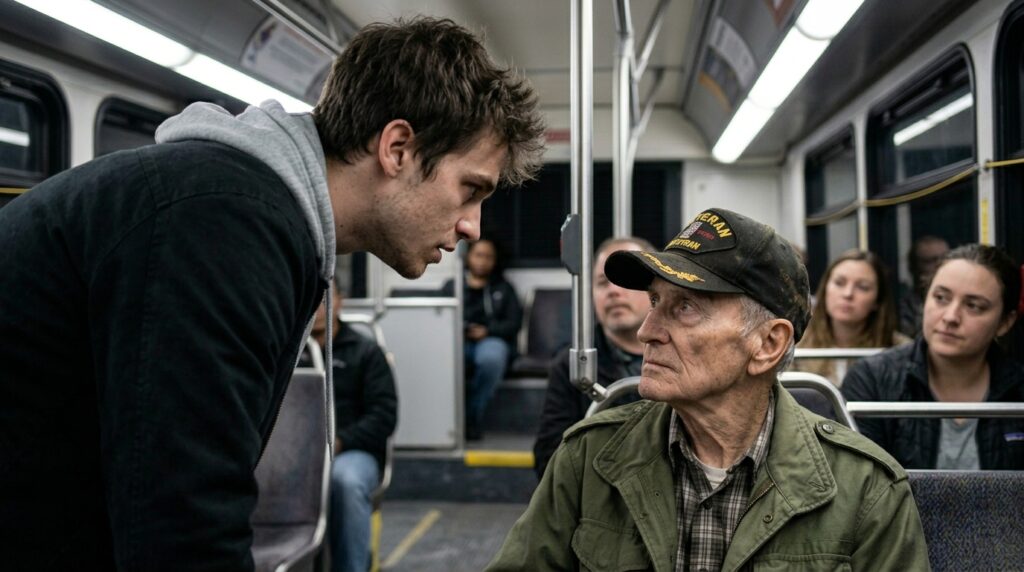
CHAPTER 5: THE AMBIENT SILENCE OF THE REVERBERATION
The steady tip-tap of Arthur’s ash cane echoed against the glazed masonry of the station walls, each strike a distinct, rhythmic marker counting down the cold space remaining between him and the base of the stairs. The air down here felt static, thick with grease and old brake shoe dust, vibrating every few seconds as a local train rumbled through an adjacent tube. Fifty yards away, the youth remained stationary. His hands stayed buried in the black nylon pockets of his jacket, but his shoulders had squared beneath the hood, his gaze locking onto the approaching silhouette of Arthur’s frayed cap.
Arthur tracked the boy’s chest. The shallow, rapid rise and fall had returned. The young man was trying to project an aura of unyielding placement, but his weight kept shifting back and forth between his sneakers—a classic structural tell of an inexperienced defender whose nerves were beginning to fray. As Arthur drew within ten paces, the low-wattage station bulb overhead caught the boy’s face, revealing a tense line of sweat trickling down past his dark sideburns.
“You have something that belongs to me,” the boy said, his voice bouncing off the grimy white tiling with a hard, hollow edge. He didn’t yell, but the words carried a transactional sharpness designed to regain the leverage he had dropped back on the train car.
Arthur stopped, resting both hands on the smooth, polished handle of his walking cane. His fingers felt the small, jagged hairline crack running down the back of the ash wood—a physical stress fracture from an old winter fall he’d never bothered to repair, choosing instead to let the split remain as part of the tool’s history. “I have a lot of things that belong to people who aren’t around to collect them, son. You’ll need to be specific.”
“The card holder,” the boy snapped, taking half a step forward into the interaction lane, his sneakers squeaking against the scuffed linoleum floor. “And whatever was left inside the transparent sleeve. Don’t play the old-man memory card with me. I saw you look at it before the doors shut.”
Arthur let his gaze drop to the boy’s collarbone, deliberately refusing to match his hostile eye-contact to suppress the escalation before it turned kinetic. He reached into the deep pocket of his olive jacket, his fingertips tracing the stiff, coarse fiber of the Army Support Command voucher before bypassing it to pull out the cracked vinyl pouch. He held it out between them, suspended in the pale light of the platform.
The boy reached for it with a quick, predatory jerk—but Arthur didn’t let go. His grip remained tight on the lower seam, his fingers anchoring the material with an absolute composure that forced the young man to stop, his hand frozen mid-air, clutching only the top edge.
“Your grandfather was Sergeant Thomas Miller,” Arthur said softly, his gravelly voice cutting through the sudden hiss of an automated drainage pump down the track. “Third Battalion. Sixty-nine.”
The boy’s hand flinched against the vinyl. The smugness vanished completely from his mouth, replaced by a sudden, protective shadow of old grief. “How do you know that name? The clinic folder on your lap—you’ve been tracking us. The VA office said his records were destroyed in the fire at St. Louis, but you have them. You have the original platoon registry sheet.”
“I have the ledger that states who went in,” Arthur corrected, his voice flat, retaining its command authority. “And I have the voucher for what was left behind. You think if you find the original logs, you can force the state to pay out the back-dated benefits they denied him when he was in that facility. That’s why you stole the locker key from the district archive.”
The boy didn’t deny it. His jaw worked silently, his fingers tightening on the leather holder until the cheap thread began to pop under the strain. “He spent thirty years staring at a blank wall, waking up screaming in the middle of the night because nobody would admit he was even there. They scrubbed the unit. They treated him like a liar until the day he stopped breathing. If I get those files out of the hub basement, the lawyers have to look at the paperwork. They have to admit his name mattered.”
Arthur felt the heavy weight of the shared burden pressing into the space between them. The boy’s logic was flawless, a perfectly justified pursuit born from decades of watching a family member dissolve into the gray bureaucracy of public state housing. It was a beautiful, desperate attempt to fix a broken legacy.
But as Arthur looked at the young man’s furious, untethered eyes, the devastating setback of the decoy secret began to manifest. The boy was hunting a false flag. He believed the registry would bring validation and legal vindication, but Arthur knew what was actually written in those files locked beneath the transit hub. The platoon hadn’t been deleted by a cold administrative error or state neglect; they had been officially erased because Sergeant Miller himself had requested the scrub to mask an unauthorized mercy-evacuation of three wounded Vietnamese children from an active free-fire zone. If those documents were made public in a court of law, it wouldn’t trigger a pension payout—it would retroactively expose his grandfather’s estate to an old, unresolved military tribunal inquiry that would strip what little honor remained to his name.
“You can’t open that locker, son,” Arthur said, his hand releasing the card holder suddenly, letting the boy stumble back with the prize. “The truth isn’t what you think it is.”
Before the boy could answer, a heavy, measured step sounded behind Arthur. The mid-30s transit employee who had been watching them from the train car stepped out from the shadow of the structural pillar, his blue uniform jacket unbuttoned, revealing a silver badge gleaming against his shirt. His hand was resting casually on his utility belt as his eyes shifted between the old man and the youth.
“Is there a problem here, sir?” the employee asked, his eyes locking onto the boy with a hard, unyielding authority that completely broke the young man’s physical posture.
The boy took two rapid steps backward toward the concrete stairs, clutching the vinyl pouch against his chest like a shield. He looked at the transit worker, then back at Arthur’s frayed cap, his face a mixture of deep frustration and unspent rage. “This isn’t over,” he whispered, his voice shaking as he turned and disappeared up the concrete steps into the noisy current of the street-level traffic above.
Arthur watched the empty stairwell for a long moment, the notch of the brass key still pressing into his palm through his lower jacket pocket. He had kept the core reality locked, but the failure to make the boy understand had left a bitter, metallic taste in his mouth.








