
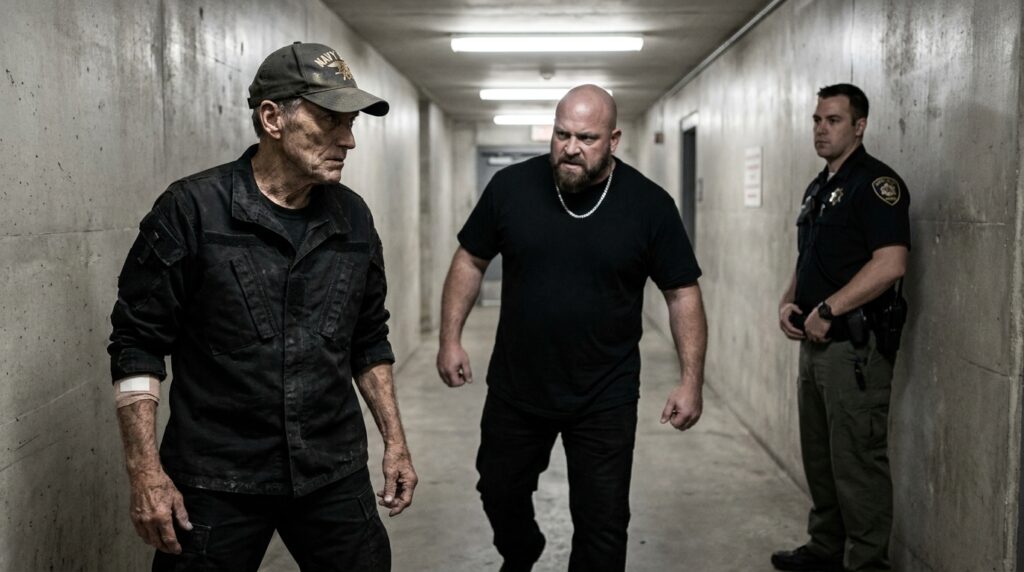
CHAPTER 9: THE CORROSIVE ISOLATION
The shockwave of the elevator’s crash traveled up the concrete shaft as a dull, subterranean thud that rippled through the gray-green water, sending a series of dirty, oil-slicked rings sloshing against John Vance’s shins. The iron floor grates groaned beneath the sudden atmospheric displacement. Vance didn’t look back toward the shaft. His boots were already locked into a wide, defensive stance at the base of the massive hydraulic pressure hatch, his palms flattening against the cold, scaling rust of the perimeter seal.
“The elevator’s gone,” Harris whispered, his voice thin, jumping an octave as he backed up against a rows of rusted conduit pipes. He gripped the backup security baton with both hands, his fingers turning a pale, bloodless white. “Chief, we’re sealed in. We’re six floors down and the water is rising faster.”
“The water isn’t the problem, son,” Vance said, his gravelly voice dropping into a flat, level register that brooked no panic. “The volume is coming from the primary ballast trunk. Someone opened the secondary sea-chests to drown the registry. If we don’t clear this wheel before the head pressure equalizes, the iron will warp inside the track.”
He didn’t check his Rolex Submariner. The rhythmic, mechanical drip of brine from the ceiling was clock enough. Vance reached into the dark gap between the door frame and the heavy lock wheel, his fingers tracing the contours of the iron pry-bar that had been driven through the spokes. The metal was pitted, rough with layers of corrosive salt scale that tore into the skin of his knuckles as he verified the leverage angle.
“Torres, hand me the sling strap off your carbine,” Vance ordered.
The Admiral didn’t ask for a tactical rationale. She snapped the heavy nylon webbing clear of her weapon’s receiver and shoved it into Vance’s palm. Vance looped the nylon twice around the base of the pry-bar, creating a improvised high-tension wrap, then braced his good right heel against the concrete frame. His left knee screamed, the joint dry, swollen, and clicking with a deep, grinding friction that radiated directly into his hip block, but he locked the bone through sheer automated discipline.
“On my mark,” Vance growled. “Pull the top spoke.”
Torres threw her weight onto the iron wheel, her boots slipping on the wet masonry before her soles found purchase against a rusted drainage rim. Vance threw his shoulder into the nylon strap, pulling upward with the explosive, mechanical leverage of a man who had spent forty years hauling iron cargo lines out of deep water.
Skrrr-tack.
The pry-bar didn’t slide out; it sheared cleanly at the stress point, the rusted iron fragment snapping with a sound like a pistol shot before clattering into the gray current. The lock wheel spun backward three inches, its internal gears grinding together with a wet, heavy rattle that sent a shower of black iron filings into the foam.
Through the laminated glass of the viewport, Master Chief Rourke didn’t move. He sat perfectly still on the wet wooden bench, his silver beard matted against his collarbone, his eyes still fixed on the pale, naked patch of skin on his left wrist. He was still counting. His lips moved in that silent, unvarying rhythm—a phantom watch keeping time in a room where the air was running out.
“Rourke,” Vance barked, his knuckles rapping hard against the reinforced glass. The sound was flat, deadened by the density of the iron plate. “Rourke, look at the alignment. We’re unsealing the track.”
The old man inside didn’t lift his head. His fingers simply tightened their grip on his bare wrist, his thumb digging into the tendons until the skin turned a bloodless gray. He wasn’t ignoring them; his internal architecture had been broken down by eighteen months of systematic, sensory isolation until the outside world no longer possessed the specific data parameters required to register as real.
“He’s institutionalized, John,” Torres said, her voice tight as she wiped a streak of rusty condensation from her visor lens. “The logistics cell didn’t just lock him away. They ran a continuous psychological rotation on him to dissolve his operational memory. He thinks the door is a decoy.”
“He knows exactly what the door is,” Vance muttered, his face hardening into a grim mask beneath the brim of his Navy SEAL cap. He grabbed the rim of the lock wheel, his corded forearms bulging as he forced the heavy mechanism through its final three rotations. “He’s counting the pressure cycles. He knows the ballast valve is open.”
The hydraulic seals gave way with a long, deafening screech of tearing rubber. A thick sheet of brackish water erupted through the lower seam of the hatch, hitting Vance’s boots with enough force to drag his left leg six inches back into the current. The door swung inward, its massive iron hinges groaning under the weight of the water column.
Vance stepped across the threshold, his boots sinking into the thick, black silt that had settled inside Rourke’s cell. The air here tasted of old zinc and ammonia, completely dead, carrying the cold, biting chill of an underground vault that hadn’t seen an active ventilation cycle since the previous winter.
“Master Chief,” Vance said, standing directly over the old warrior. He didn’t offer a hand. He didn’t drop his stance. He stood rigid, his shoulders square, his gravelly voice projecting the unyielding, absolute authority of a deployment commander. “The unit manifest has been unsealed. Your timeline is clear. Stand up.”
Rourke’s thumb stopped its circular movement against his wrist. For the first time in two years, his head lifted, his faded blue eyes cutting through the silver tangle of his hair to lock onto the small, scratched face of the Rolex watch on Vance’s arm. The ticking wasn’t audible beneath the sloshing of the ballast tide, but the geometric reflection of the white searchlights against the steel casing was a language his brain still understood.
“The watch is late, John,” Rourke whispered. His voice was a dry, hollow rasp, like two pieces of rough canvas rubbing together in an empty room. “They changed the tides at Norfolk. They’re harvesting the deep ledger.”
Before Vance could seize the old man’s utility shirt, a sharp, metallic clack echoed from the conduit pipes overhead. The emergency white searchlights blinks out, replaced instantly by a blinding, flashing crimson flash as the facility’s primary security net initialized its final containment directive.
From the dark drainage tunnel behind the cell block, the heavy, mechanical roar of an industrial turbine pump began to spin up, but it wasn’t clearing the floorboards—it was pulling the cold harbor water directly into their survival radius.








