
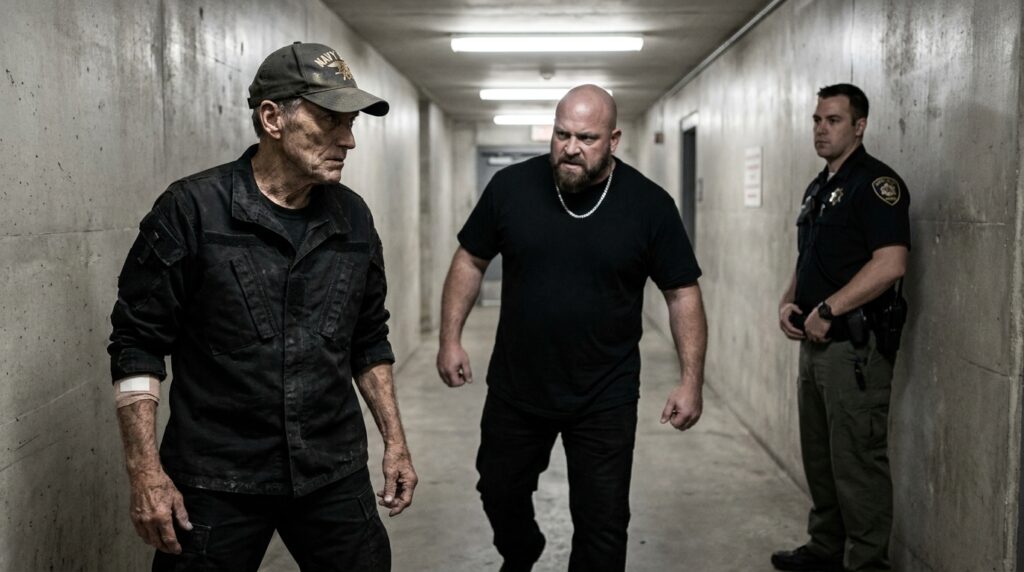
CHAPTER 6: THE ADMINISTRATIVE STANDOFF
The blue glow of the second operator’s infrared illuminator swept across the wire mesh cage, locking onto the broad, glowing shape of Miller’s shoulders. The carbine’s muzzle followed the beam, the weapon rising with automated precision. Miller was too heavy, too injured from his initial floor impact to drop or roll clear.
John Vance didn’t have the leverage to throw another four-pound cargo eye. He used the body of the first operator.
With a sharp, downward wrench of his forearms, Vance twisted the nylon shoulder webbing of the blinded man he was holding, driving his foot hard into the back of the man’s knee joint. The operator collapsed backward like an unanchored pillar, his full deadweight crashing directly into the path of the second man’s advancing stride. The collision was a chaotic crunch of ceramic plate against ceramic plate, a dull, metallic clank that disrupted the second man’s shooting platform just as his finger compressed the trigger.
Three rounds erupted into the darkness, but the recoil arc was thrown wide. The bullets tore into the steel framing of the property bins, spitting yellow sparks and jagged copper fragments into the aisle.
Vance didn’t pause for the dust to settle. He used the momentum of the falling bodies to drive himself out of the vault threshold, his right boot clearing the fallen door, his bad left knee grinding with a wet, sickening pop as he forced his frame into the wider, open space of the medical bay. He needed the administrative terminal. He needed to lock the elevator shaft from the inside before the third operator, still guarding the rear exit vestibule, could establish a crossfire position.
“Harris,” Vance barked, his gravelly voice cutting through the deafening ringing left by the muzzle blasts. “The terminal. Punch the master override.”
Harris was already moving. Fear had stopped paralyzing him and shifted into raw adrenaline. The boy scrambled across the wet, tile floor, his hands slick with saline fluid and splintered wood, his fingers hitting the plastic keys of the diagnostic unit. The screen flickered violently as he slammed his palm onto the manual lock-out relay.
Behind them, the high-frequency clack-clack-clack of a tactical radio headset signaled the third operator’s movement. A cold, detached voice whistled through the static of the open channel: “Asset is breaking containment. Move to Phase Two protocol.”
The administrative elevator door at the far end of the intake desk didn’t close; instead, it began to slide open further, its internal emergency overrides clicking as a manual key was turned from the upper level. The heavy, measured thud of leather boot soles echoed from the shaft, but these weren’t tactical boots. The rhythm was slower, heavier—the deliberate pace of an individual who controlled the architecture of the building.
A single figure stepped into the blinding glare of the intake room’s unshielded fluorescent bulbs.
He didn’t wear a helmet or gray nylon armor. He wore a crisp, tailored federal marshal’s uniform, the gold star on his leather breast-badge reflecting the harsh light with a sharp, geometric edge. His hair was iron-gray, cropped close to his skull, his face flat and expressionless, like a ledger page. In his right hand, he carried a heavy-barreled Colt revolver, held loosely at his side, the muzzle pointed at the floor boards.
“Stand down, Master Chief,” the man said. His voice was completely calm, devoid of the operational urgency of the retrieval team. “You’ve verified the transponder. You’ve looked at the manifest. Let’s not make the clean-up any more expensive than it needs to be.”
Vance stopped five feet from the plexiglass partition. His chest rose and fell in slow, deliberate expansions, his right hand resting flat against his thigh, his fingers still wrapped around the folded brass pocket knife. He looked through the shattered pane where the desk sergeant’s body had been pulled clear of the desk.
“You’re out of Norfolk, Marshal,” Vance said, the words coming flat from his chest. “The routing numbers on your processing sheets belong to a deactivated maritime security cell. You aren’t executing a federal detainer. You’re running a black-site pipeline.”
The marshal didn’t deny it. He didn’t offer a villainous speech or attempt to justify the dead bodies on the floor. He simply raised the heavy revolver by two inches, his thumb drawing the hammer back with a distinct, triple-click that sounded like ice cracking under a boot.
“The country doesn’t have a budget for retired specialized foreign-theater assets who know where the old coal was buried, John,” the marshal said softly. “The system requires a clean margin. Rourke understood that before we brought him down to Layer Four. You’re just a line-item that refused to balance.”
Behind Vance, the two operators inside the property vault were already recovering, the scraping sound of their tactical gear against the splintered wood of the door signaling their imminent realignment. Harris was backed against the terminal, his eyes darting between Vance’s rigid shoulders and the marshal’s steady weapon barrel.
“You think you locked Layer Four?” Vance muttered, his voice dropping into a register so low it was almost lost beneath the hum of the light bulbs.
“I know I did,” the marshal replied. “The network is fully isolated.”
“Then you should have checked the serial number on the transponder you left in the bin,” Vance said. He didn’t look down at his naked left wrist, but his index finger moved in a tiny, circular pattern against his seam. “The tracking array wasn’t a broadcast beacon. It was a secondary validation loop. Every time your operators hit the security override keys with that alpha stamp, they unsealed the naval intelligence logistics trunk at the department level.”
The marshal’s left eyebrow twitched by a fraction of a millimeter—the first break in his professional composure. His eyes drifted to the glowing screen behind Harris, where the project manifest columns had suddenly frozen, replaced by a blinking red notification text that read: CRITICAL SYSTEM DISRUPTION – EXTERIOR INTERVENT.
From the corridor behind the administrative elevator, the distant, muffled thud of heavy, synchronized rotors began to vibrate through the concrete masonry of the ceiling, shaking the dust from the fluorescent light fixtures.








