
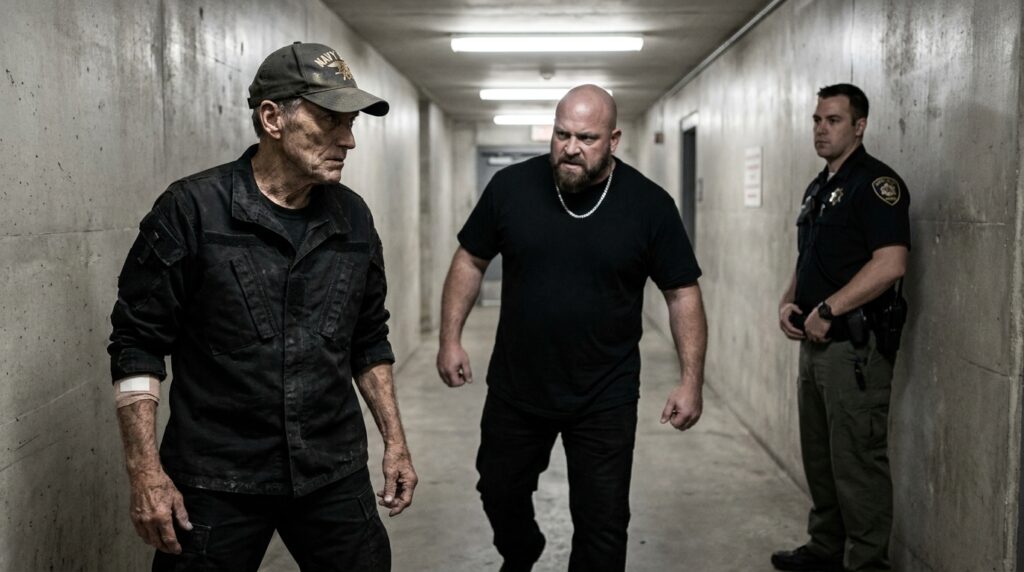
CHAPTER 3: THE STRATEGIC MISDIRECTION
The green indicator light above the administrative elevator died, replaced by a harsh, rhythmic amber pulse that bathed the room in mechanical shadows. The machinery groaned, steel cables scraping inside the concrete shaft as the platform settled behind the heavy security door. John Vance didn’t turn his back on the desk sergeant. He stood perfectly still, his weight evenly distributed over his good right leg, his fingers resting casually on the edge of the glass tray where his pocket knife lay.
“Harris,” the sergeant barked again, his face losing its flat gray color, turning a blotchy, panicked red. His hand remained pressed flat against the purple-stamped routing manifest, completely covering the brass security key. “Get that man out of the intake lane. Now.”
Harris didn’t move fast enough. The boy was staring at the elevator door, his mouth slightly open, his fingers white where they gripped the leather of his holster. Vance could hear the specific cadence of the footsteps inside the elevator before the pneumatic seal broke—three sets of boots, heavy, synchronized, the distinct sound of nylon tactical gear rubbing against ceramic chest plates. Not local marshals. The stride was too wide, the footing too aggressive. These were operators trained for aggressive entries, their movements carrying the specific, sharp precision of an active retrieval team.
“They’re early,” the sergeant muttered, his gaze shifting from the screen to Vance’s lined face.
“They’re exactly on time for what they think is an easy pickup,” Vance said, his voice dropping into a low, gravelly rasp that barely cleared the plexiglass speaker grill. He didn’t look at the elevator. He kept his eyes locked on the sergeant’s right hand. “But you’ve got a routing slip from Norfolk that doesn’t match the federal registry, and you’ve got a key under your palm that says someone’s running an unauthorized bypass on your security net. If those doors open and I’m standing here in standard processing, your name goes on the bottom of that manifest. You know how these logistics cells clean up their paper trails.”
The sergeant’s fingers twitched against the paper. The logic hit him exactly where Vance intended—not as a threat, but as a calculation of institutional survival. In the black-budget pipelines, the clerk who stamped the wrong box was always the first asset to be liquidated from the ledger.
“The medical bay,” the sergeant whispered, his index finger sliding the brass key back across the metal drop tray toward Vance’s hand. “Behind the intake desk. There’s a secure diagnostic suite with an independent magnetic lock. They don’t have the override codes for the medical block on the standard transport manifest.”
“Give me the file,” Vance said, his hand closing over the brass stub and his pocket knife in a single, fluid motion.
The sergeant hesitated for the fraction of a second it took for the elevator’s primary pneumatic seal to hiss open. Then, with a quick, desperate jerk of his wrist, he shoved the purple-stamped intake folder through the narrow slot at the bottom of the plexiglass. “Get out of the lane.”
Vance didn’t run. A tactical retreat required the same steady cadence as an advance; any sudden increase in velocity would trigger Harris’s defensive instincts or draw the attention of the arriving team through the glass window. He gripped the edge of the folder against his thigh, using his large frame to shield it from Harris’s line of sight, and stepped backward into the shadow of the rear corridor wall. His left knee screamed with every step, the joint dry and swollen from the strain of the corridor takedown, but he kept his posture rigid, his shoulders square beneath the tactical shirt.
“Harris,” Vance said, his voice carrying the calm, absolute authority of a commanding officer in an active theater. “Secure the rear door. Don’t look back at the desk.”
The boy turned instantly, his automated military background overriding his civilian training at the sound of the command tone. He stepped into the frame of the medical bay access door, his body blocking the view from the primary intake vestibule just as the heavy elevator door slid back into its steel recess.
Through the smoked glass of the partition, Vance watched three figures step onto the floor. They wore desaturated gray tactical uniforms without agency patches or nametags, their faces obscured by low-profile ballistic helmets and dark protective visors. The leader carried a short-barreled carbine held at a perfect low-ready position, his movements fluid, calculated, and entirely devoid of the standard hesitation common to municipal law enforcement.
The leader stepped directly to the desk sergeant’s window, the hard muzzle of his weapon tapping once against the plexiglass with a sharp, crystalline click.
“Detainee Vance,” the leader said, his voice muffled by the speaker system but carrying a cold, flat finality. “Where is the intake file?”
Vance didn’t wait to hear the answer. He slid through the door into the medical bay, his eyes already scanning the layout of the narrow, white-tiled room. The air here was colder, smelling of rubbing alcohol and stale ozone from an old sterilization unit. A steel examination table sat in the center of the floor, its leather padding cracked and worn down to the yellow foam beneath.
He didn’t look for medicine or supplies. He moved directly to the small electronic terminal mounted beside the secondary diagnostic door. The keyhole beneath the digital keypad was square, its interior cut with four precise, vertical grooves that matched the brass key in his hand.
Vance inserted the key. The terminal didn’t beep; instead, a low, mechanical hum vibrated behind the drywall as the magnetic deadbolts retracted, but the screen didn’t display a medical status. It flickered twice, then initialized an entirely separate data layer, displaying a series of encrypted manifest columns labeled PROJECT HORIZON – RETIRED ASSET ROUTING.
At the top of the screen, beneath a blinking terminal prompt, a single name was listed under the current transit log: MASTER CHIEF H. ROURKE – STATUS: PROCESSING.
Vance’s hand went completely rigid on the key. Rourke had been missing for two years, officially designated as a casualty during a non-attributable maritime operation in the Mediterranean. He wasn’t dead. He was three floors below this desk, trapped in the same institutional pipeline that had just tried to close around Vance.
Behind him, the heavy wooden door to the intake room splintered as a tactical boot struck the frame.








