
CHAPTER 8: LAYER FOUR
The subterranean elevator didn’t drop; it shuddered downward through the concrete shaft with a rhythmic, mechanical groan that vibrated straight through the soles of John Vance’s boots. The auxiliary power grid was straining, the light inside the steel cage flickering between a dim, unshielded white and the dull, desaturated crimson of an emergency battery loop. The air here was different than the upper processing blocks—it was dense, freezing, and carried the thick, bitter stink of oxidized iron and stagnant, subterranean brine.
Clunk.
The cage stopped with a violent, metallic jolt that sent a white-hot needle of pain shooting straight from Vance’s left heel into his lower vertebrae. He didn’t drop his stance. He reached down, his fingers clamping onto the cold, rusted surface of the manual door lever, his palm catching the gritty texture of flaking rust. Beside him, Admiral Torres held a short-barreled tactical light under the receiver of her weapon, the clean white beam slicing through the wet mist rising from the floorboard slats.
“The hydraulic lines are down,” Torres said, her voice dropping into a tight, quiet rasp that was nearly swallowed by the rhythmic drip-drip of water leaking from the shaft walls. “The facility director isn’t trying to hold the gate anymore, John. He’s dumping the main storage tanks into the lower conduit to wash out the ledger.”
“He’s thirty years too late to learn how to clean a deck,” Vance muttered.
He threw his weight against the iron lever. The rust inside the housing ground together with a dry, screaming screech before the steel mesh doors popped back into their recesses.
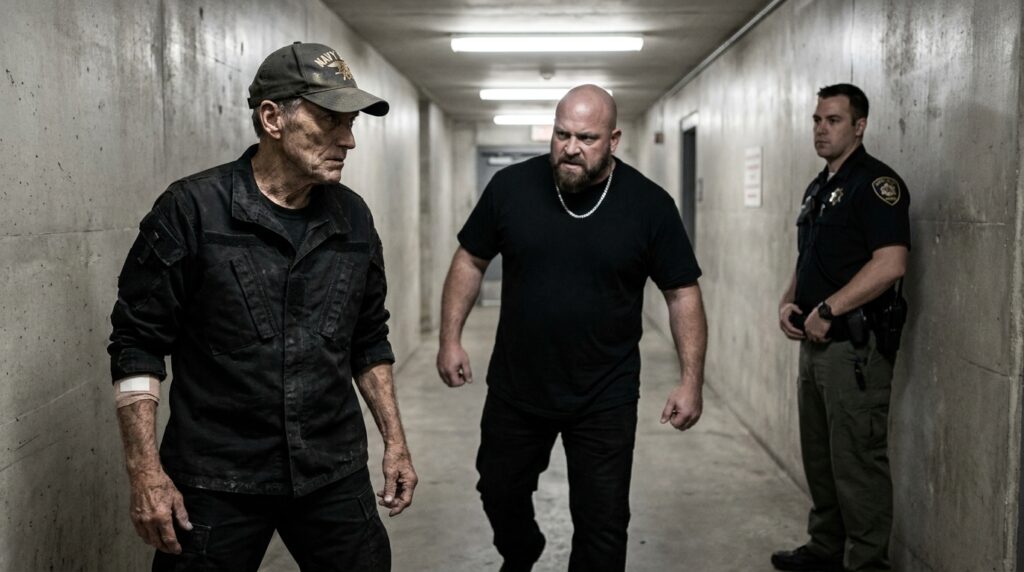
The world beyond the gate didn’t look like a federal building. It was an old, wartime coastal artillery bunker, repurposed and reinforced with three-inch slabs of desaturated steel-blue plate that were now weeping moisture. The corridor ahead was narrow, the ceiling curved like the interior of a submarine hull, and the floor was entirely submerged under four inches of murky, gray-green water that swirled with grease rings.
Vance stepped out, his boot breaking the water with a heavy, flat splash. The cold hit his ankles instantly, a sharp, numbing chill that actually helped dull the throbbing ache in his swollen knee. He looked down the lane. A row of low, iron-riveted cell doors stretched into the darkness, each one fitted with a small, rectangular observation slit that had been welded shut from the outside.
“They aren’t cells,” Vance said, his thumb tracking the hard, square edges of his newly returned Rolex Submariner watch. The glass was cold against his skin. “They’re dry-dock storage vaults. They built this pipe out of an old maritime depot.”
“Rourke’s tracking signal is coming from the terminal room at the end of this spine,” Torres said, her light beam sweeping across a rusted brass junction box on the wall. A hand-painted number 4 had been scrubbed off the metal, replaced by a stenciled logistic code: SYS-LOG-DIST-00.
Beneath the box, half-submerged in the swirling gray water, lay a small, forgotten object. Vance reached down, his thick, corded fingers breaking the surface to retrieve it. It was an old navy-issue brass compass, its glass face cracked, its brass casing deeply pitted with green verdigris. When he wiped the silt from the backplate, his thumb hit an engraved emblem—a trident crossed with a surveyor’s transit, the unlisted seal of their original deep-cover detachment.
Rourke had been here. He’d left a breadcrumb the only way an old operator knew how—by discarding a piece of survival gear that didn’t exist on any standard military manifest.
“Chief,” Harris whispered from the rear of the team, his boots sloshing unsteadily through the current. He was carrying a backup security baton and a spare radio block, his face pale under the white tactical lights. “The water’s rising. It’s up an inch since we left the cage.”
“Maintain the interval, son,” Vance growled without looking back. “Watch the seams where the wall meets the floorboards. If you see bubbles, it means the primary drainage lines are backing up from the harbor side.”
The team advanced in a tight, three-man tactical wedge, their weapons covering the dark upper angles of the curved ceiling. The sound of their progress was an unbroken chain of wet friction—the heavy slosh of boots, the rhythmic click of gear harnesses, and the steady, automated breathing of men trained to move through high-pressure voids.
At the sixty-foot mark, the corridor widened into a square, low-ceilinged vault dominated by a massive, hydraulic pressure hatch. The steel surface was covered in bubbling, rusted scale, and a large digital readout above the wheel was dead, its housing cracked open to reveal a nest of charred, melted copper wires.
Someone had manual-locked the wheel from the far side, driving a heavy iron pry-bar through the spoke rings to freeze the mechanism.
Through the thick, laminated glass of the hatch’s viewport, a single unshielded emergency bulb flickered. Beneath it, sitting cross-legged on a wet wooden bench, was a man in a tattered gray utility uniform. His hair was a long, tangled knot of silver, his face covered in a thick, unkempt beard that hid the deep scar running from his left ear to his collarbone.
It was Master Chief Rourke. He wasn’t looking at the door. He was staring at his own bare, pale wrist, his fingers moving in a slow, phantom circle over the skin where his watch used to be, his lips moving as he repeated a silent, unvarying count against the dark.
Behind Vance, a heavy, wet thunk echoed from the elevator shaft. The cables had finally given way, and the steel cage fell through the dark, sealing their only vertical exit path with a deafening, distant crash of grinding metal.








